
Home LED strip and cabinet lighting accessories explained
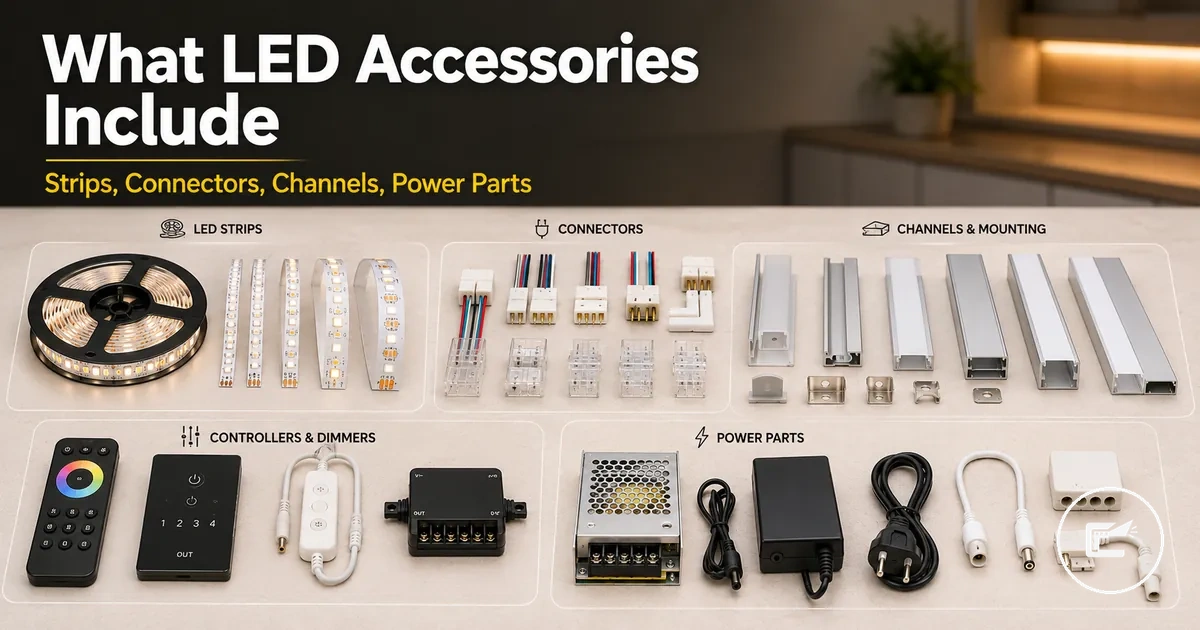
Home LED strip and cabinet lighting accessories are the supporting parts that help a cabinet lighting system hold, route, power, control, and shape its light. The LED strip or cabinet light body may provide the light source, while the accessory set organizes the parts around it.
Home LED strip and cabinet lighting accessories explained means the main accessory families are identified before the page separates them into part groups. The accessory set can include power parts, controllers, connectors, mounting parts, diffuser channels, and cabinet-specific support parts that respond to the setup type. These parts help the cabinet lighting system work as a connected component set rather than a loose group of items. Accessories should not be confused with the full lighting unit, because complete kits may combine the light source with support parts.
Before evaluating fit, the reader needs to identify which parts are present and which parts are only needed for a specific cabinet layout, control preference, or kit contents. Compatibility can vary by strip type, power requirement, connector style, mounting surface, and whether the setup uses separate accessories or a bundled lighting kit.
What home LED strip and cabinet lighting accessories are
Home LED strip and cabinet lighting accessories are supporting parts used to power, connect, control, mount, protect, or improve a cabinet lighting setup. These accessory parts work alongside the light source and help different elements of the lighting system function together. Their purpose is to provide the support function needed for the lighting setup.
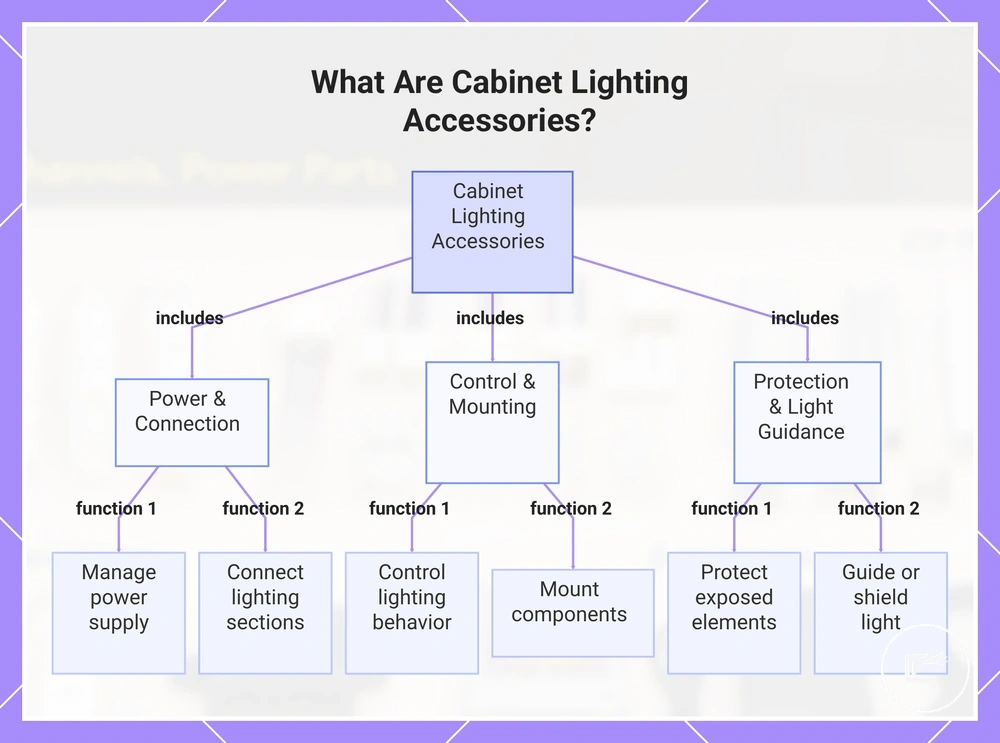
home LED strip and cabinet lighting accessories refers to the accessory parts that help a cabinet lighting system operate as a connected system rather than a light source alone. Depending on the cabinet lighting setup, these accessories may help manage power, connect lighting sections, control lighting behavior, mount components, or protect exposed elements. Diffusers and channels can also improve how light is guided or shielded within the lighting environment. Together, these supporting parts serve specific functions within the broader lighting system.
A simple example is a connector that links lighting sections together while the light source continues to produce illumination. The connector performs a support function, while the lighting unit remains responsible for creating light.
This chart shows the main functional categories of accessories that support a cabinet lighting system, including power management, connection, control, mounting, protection, and light guidance.
What counts as an accessory versus the lighting unit itself
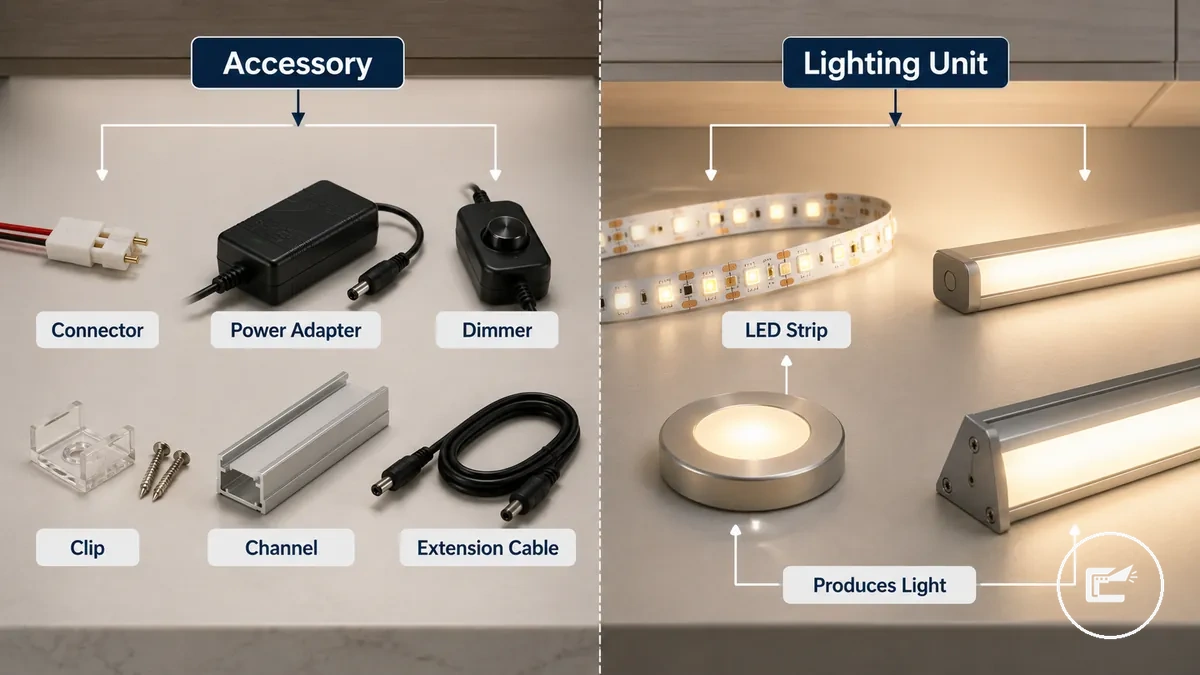
An accessory supports a cabinet lighting setup, while a lighting unit is the part that produces light. This distinction helps classify components by function rather than by how they are packaged or grouped. The key difference is whether the item produces light or supports the lighting setup.
Accessory parts include a connector, power adapter, dimmer, clip, channel, or extension cable. These parts help connect, mount, control, protect, or supply power within the system. When a complete kit contains combined parts, classification may vary because support parts and lighting units can be packaged together.
What counts as an accessory versus the lighting unit itself becomes clearer in the contrast below, which highlights the functional boundary between the two categories.
Accessory part: Supports the setup by helping connect, mount, control, protect, or power lighting components.
Light-producing unit: Produces illumination as the primary light source, such as a strip, bar, puck light, or fixture.
What counts as an accessory versus the lighting unit itself is also illustrated in the image below, which labels the boundary between support parts and light-producing units.
Lighting units include LED strips, light bars, puck lights, and other fixtures that generate illumination. A lighting unit remains a light-producing unit even when sold alongside accessory parts or built into a complete kit. For a broader comparison of lighting categories, see lighting type differences.
Main components in an LED strip and cabinet lighting setup
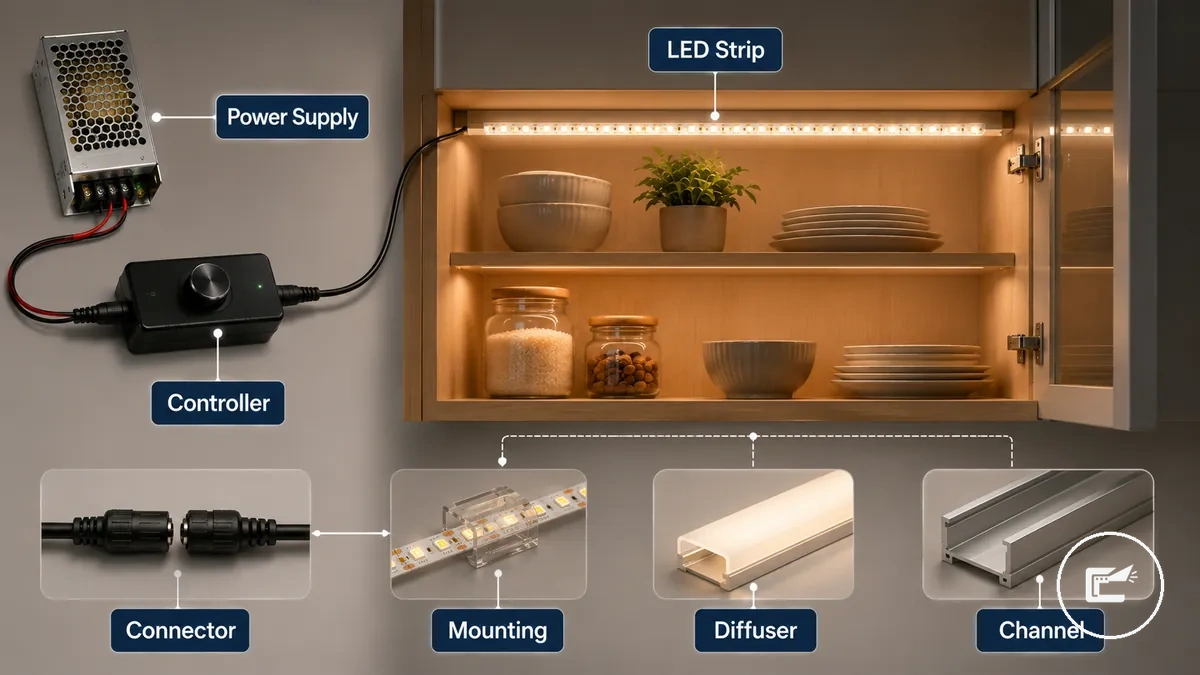
Main components in an LED strip and cabinet lighting setup are the major groups of lighting components that work together to provide illumination, control, support, and light management. A cabinet lighting setup may include different parts depending on its design, but the core roles can usually be organized into a small number of component groups. These groups help organize the setup into major parts.
The table below summarizes the primary groups by function, common conditions, and their role within the setup. The rows organize major roles rather than every variation.
Main components in an LED strip and cabinet lighting setup are illustrated below, and the image labels the main roles used across common configurations.
| Component group | Main function | Common conditions | Why it matters |
|---|---|---|---|
| Light source | Provides illumination through an LED strip or similar light body | May vary by layout, light output needs, or fixture type | Determines the visible light output |
| Power | Supplies power through a power supply | Must match the requirements of the lighting components | Allows the setup to operate correctly |
| Control | Adjusts lighting behavior through a controller | Present when control functions are needed | Supports lighting management |
| Connection | Links parts through a connector or cable | Depends on layout and component compatibility | Helps connect sections within the setup |
| Mounting | Secures lighting components in position | Varies by surface and installation method | Supports placement and stability |
| Diffusion | Uses a diffuser or channel to manage light distribution | May be included when light appearance requires refinement | Can influence light quality and visual finish |
LED strips, tape lights, bars, and cabinet light bodies
LED strips, tape lights, light bars, and cabinet light bodies are light-producing units that act as the light source within a cabinet lighting setup. These formats create illumination, while support parts help power, connect, control, mount, or protect them. In this context, they are light sources rather than accessories in the narrow sense.
A LED strip or tape light may require different support parts than a light bar or cabinet light body because the format influences mounting, power connection, and physical support needs. For example, a tape light may use adhesive backing and mounting support, while a light bar or fixture body may rely on a different power connection or mounting approach. The light-source format can therefore affect which support parts are used.
Power supplies, drivers, adapters, and plug-in power parts
Power supplies, drivers, adapters, and plug-in power parts are accessories that provide usable electrical input for a lighting setup. These power parts help deliver the voltage and power needed by the light source and related components. Power parts should match the requirements of the setup rather than appearance alone.
Power-part suitability depends on the characteristics of the lighting system and connected components. Voltage, wattage capacity, connector fit, and load margin can influence whether a power supply, driver, adapter, or plug-in power part is appropriate for a specific setup. Compatibility depends on the requirements of the light source and the conditions of the installation.
- Voltage: The output voltage should align with the requirements of the connected lighting components.
- Wattage: Wattage capacity may need adequate load margin for the intended lighting load.
- Connector fit: Connector fit depends on the connection type used by the lighting system.
- Plug-in power: Plug-in power parts can vary by output type and connector arrangement.
- Driver or adapter: A LED driver or power adapter should be selected according to the requirements of the specific light source and setup condition.
Controllers, dimmers, switches, remotes, and sensors
Controllers, dimmers, switches, remotes, and sensors are control accessories that adjust switching, dimming, sensing, or user control within a lighting setup. These control parts work with the light source to change how the lighting system responds to user input or operating conditions. Their primary role is to provide the control function for the setup.
Control accessories can vary by controller type, dimming support, sensor trigger, user interface, and strip compatibility. For example, a sensor may respond to motion as a trigger, while a dimmer may adjust light output when the connected lighting system supports dimming. A controller may need to match the strip type or color type used by the lighting setup because control behavior depends on those characteristics, and not every setup requires every control part.
- Controller: Manages control behavior and may depend on strip type compatibility and color type.
- Dimmer: Adjusts light output when dimming support is available.
- Switch: Provides direct switch control for turning lighting on or off.
- Remote: Enables user control through a remote interface when a compatible receiver is present.
- Sensor: Responds to a trigger condition, such as motion sensing, to change control behavior.
Connectors, jumpers, extension cables, and splitters
Connectors, jumpers, extension cables, and splitters are connection accessories that join, extend, branch, or route LED strip and cabinet lighting circuits. These parts help create a connection path between lighting components and support different cabinet layouts. Their role is to join, extend, branch, or route the connection path.
Connection accessories should match factors such as strip width, pin count, polarity, and the intended voltage path. A corner connector may help route a connection path around a change in direction, while an extension cable or splitter may support a specific cabinet layout. If strip width, pin count, or polarity do not align with the connected parts, connection reliability may be affected by loose contact, reversed polarity, or non-working sections.
Connectors, jumpers, extension cables, and splitters are labeled in the image below, including matching points such as pin count, polarity marks, extension cable routing, and corner connector placement.
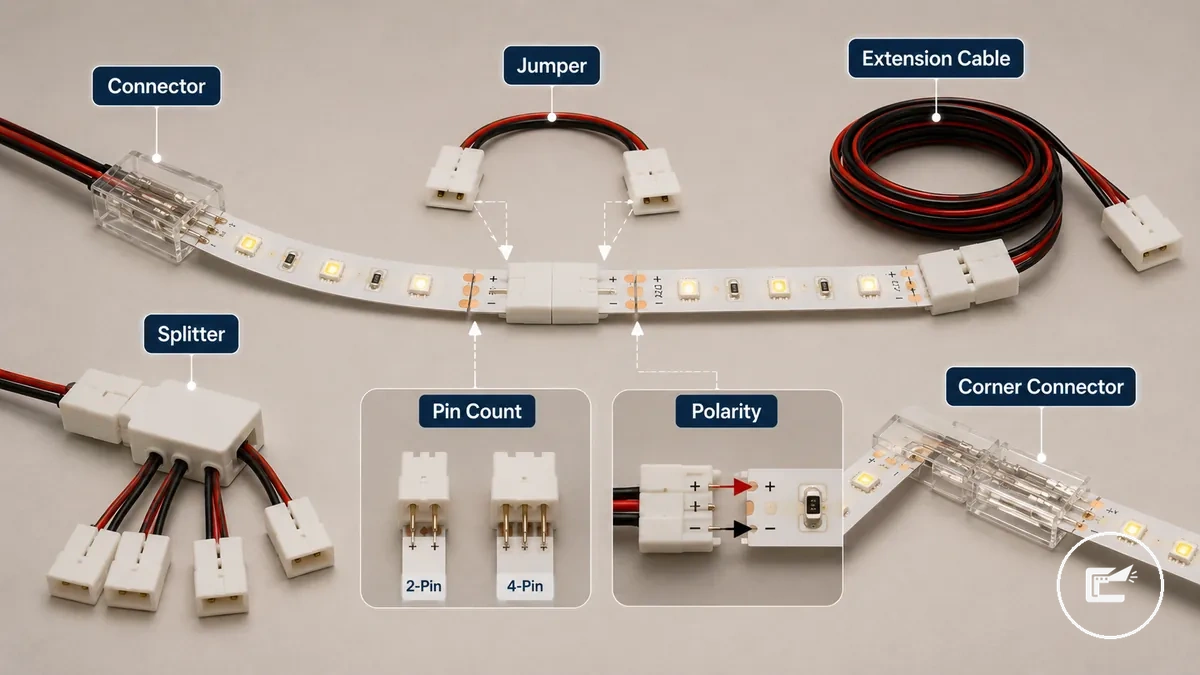
| Connection part | Attribute to check | Condition | Effect if mismatched |
|---|---|---|---|
| Connector | Strip width and pin count | Should align with the connected strip | May result in poor fit or loose contact |
| Jumper | Polarity and connection path | Should follow the intended connection path | May affect circuit continuity |
| Extension cable | Extension length and connection path | Should suit the cabinet layout | May affect routing suitability |
| Splitter | Voltage path and branch layout | Should match the intended branch connection | May affect connected sections |
| Corner connector | Corner connection and pin alignment | Should align with the direction change | May create unreliable contact |
Mounting clips, adhesive backing, channels, diffusers, and covers
Mounting clips, adhesive backing, channels, diffusers, and covers are mounting and light-control accessories that hold lighting components in place and influence visible light output. These parts support physical stability while helping manage protection, diffusion, and light appearance. Their role is to provide both support and light-control functions within the lighting setup.
A diffuser channel can help soften the appearance of individual light points and may reduce visible dotting or glare, depending on strip type, channel design, and viewing conditions. Mounting and light-control accessories can also affect how lighting components are supported, protected, and presented within the installation area. The visible outcome may vary with surface condition, channel design, heat-related factors, and the characteristics of the connected strip.
- Mounting clips: Help hold lighting components in position and support stability on a mounting surface.
- Adhesive backing: Provides surface attachment, and performance may depend on surface condition and environmental factors.
- Channel: Supports placement and may assist with heat management depending on channel design.
- Diffuser: Spreads visible light and may help reduce glare or dotting under certain conditions.
- Cover: Provides physical protection while contributing to the finished appearance of the lighting setup.
How accessories support power, control, mounting, and light output
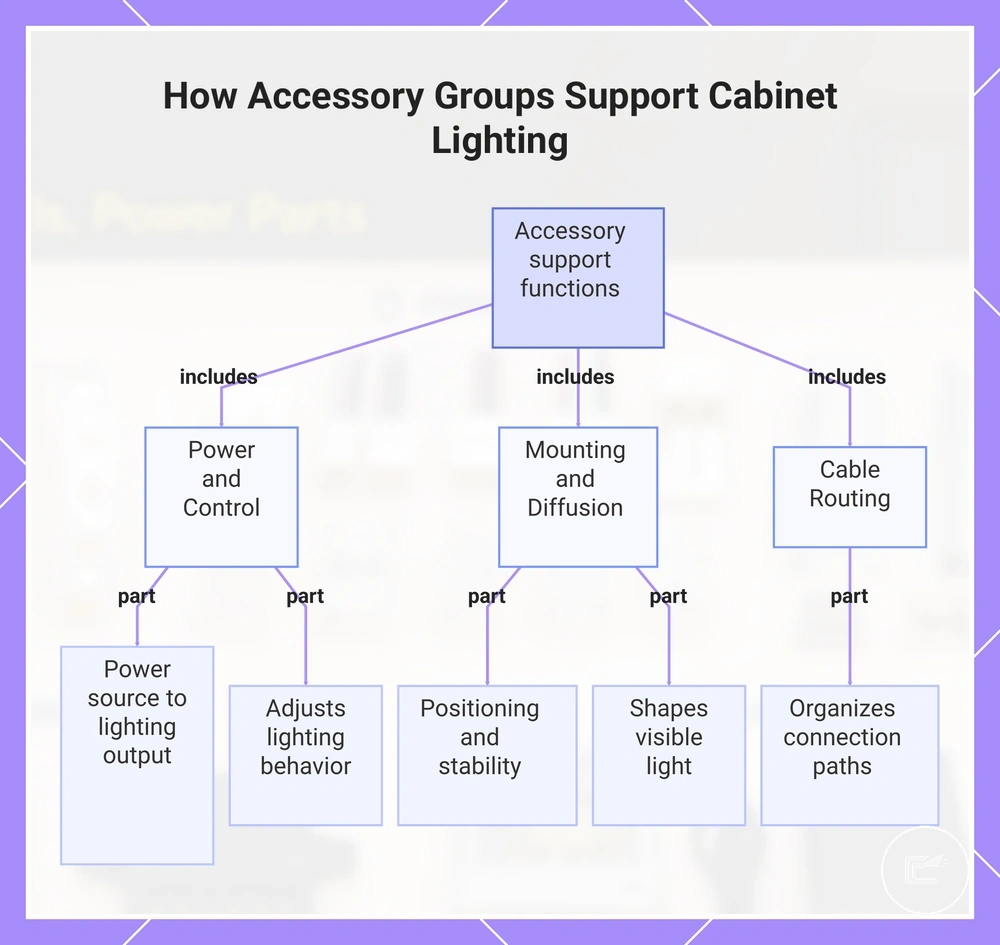
Accessory groups are supporting components that work together to manage power delivery, control flow, mounting, diffusion, and cable routing within a cabinet lighting setup. Each accessory group performs a different support function, but the overall result depends on how these functions connect and interact. Together, accessory groups create a component relationship that supports the lighting system.
Power delivery supports the flow of power to lighting components, while control flow adjusts how the system responds to user preferences or operating conditions. Mounting supports physical positioning, and diffusion helps shape visible light output. Cable routing connects these system roles across the cabinet layout and helps organize the relationship between components. The accessory mix may vary by setup type, cabinet layout, and control preference.
- Power delivery: Supports the relationship between the power source and lighting output.
- Control flow: Connects controllers and related accessories that adjust lighting behavior.
- Mounting: Supports positioning and stability for lighting components.
- Diffusion: Shapes visible light through channels, diffusers, or covers.
- Cable routing: Organizes connection paths between accessory groups and supports the overall system relationship.
This role flow describes relationship logic rather than a fixed sequence. For example, a compact cabinet layout may place greater emphasis on cable routing and mounting, while a setup with additional control preferences may use a different accessory mix.
This chart shows the main accessory groups and their support functions, including power delivery, control flow, mounting, diffusion, and cable routing.
What usually comes in an LED strip accessory kit
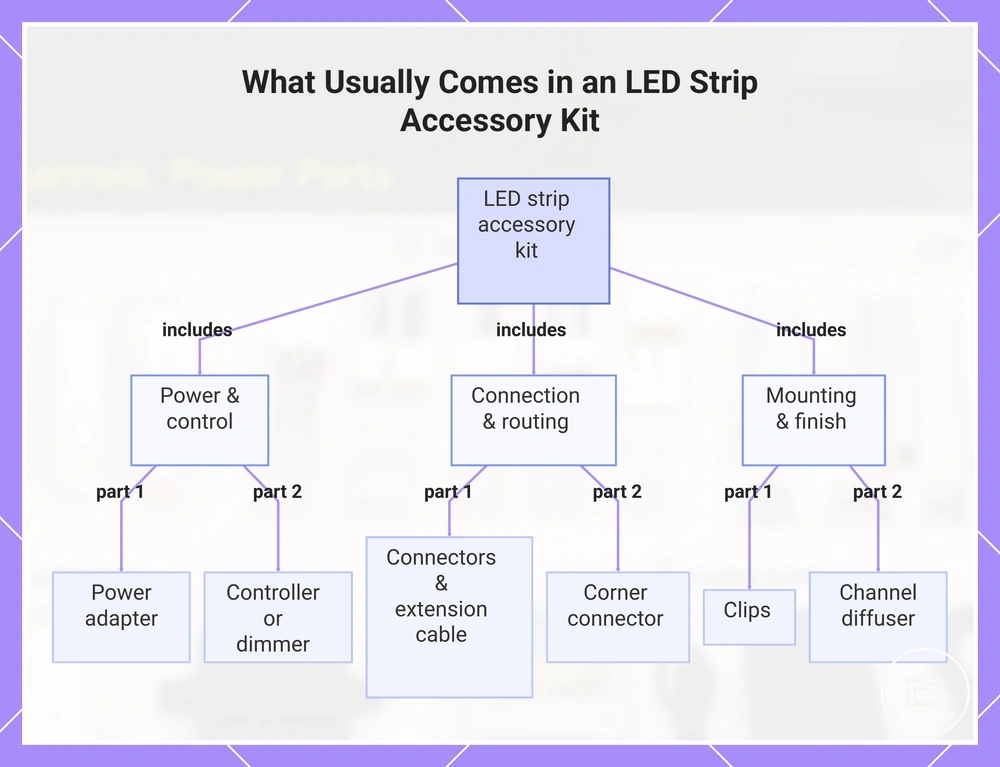
A LED strip accessory kit is a bundle of support parts that help power, connect, control, mount, or route a lighting setup. LED strip accessory kits usually group these support parts into a single accessory bundle for convenience and organization. Kit contents vary by kit type and lighting setup.
An accessory-only kit may include support parts without including the LED strip itself. A complete lighting kit may include the strip along with selected accessories, depending on the kit design. The checklist below helps verify what usually comes in an LED strip accessory kit.
- Connectors
- Power adapter
- Controller or dimmer
- Clips
- Extension cable
- Corner connector
- Channel
- Diffuser
Specific kit contents may differ by accessory bundle, and compatibility depends on the lighting setup and the components included.
This chart shows typical support parts grouped by function; actual kit contents may vary by kit type and lighting setup.
Compatibility basics for power supplies, connectors, and controllers
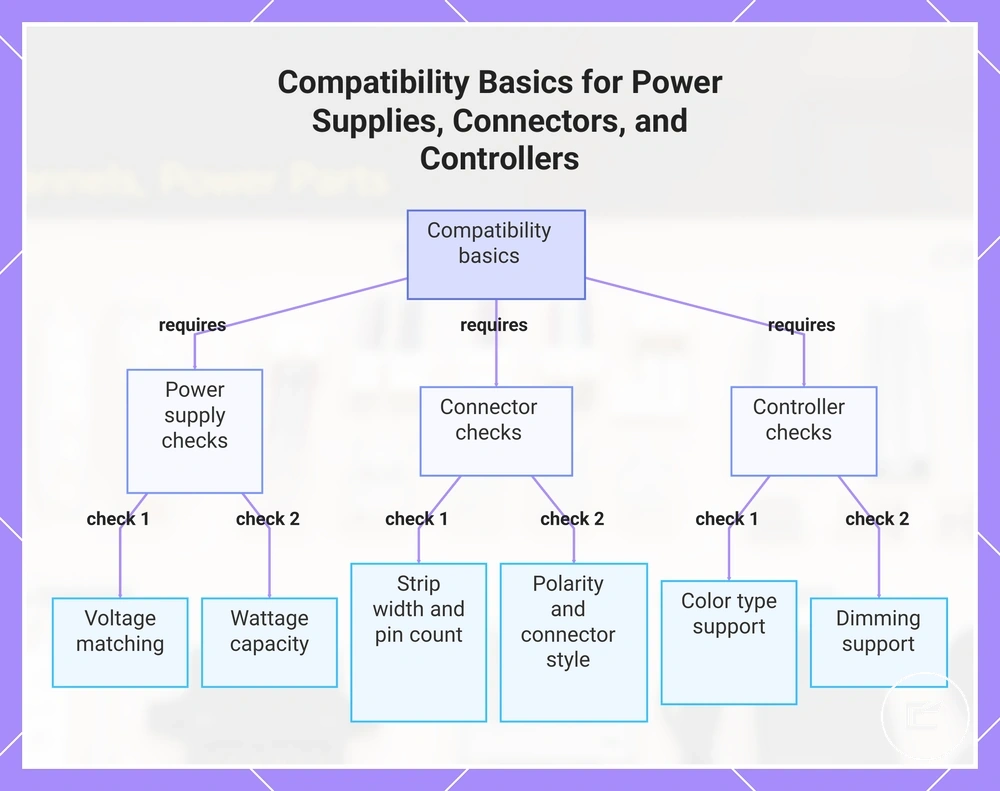
Compatibility depends on matching the specifications of power supplies, connectors, and controllers to the lighting setup. Compatibility checks help determine whether components are suitable to work together under the same conditions. The minimum compatibility checks require matching key specifications and setup conditions.
A power supply should match the required voltage and provide suitable wattage capacity for the intended load. Connector compatibility depends on strip width, pin count, polarity, and connector style because a mismatch in these attributes may limit component fit. For deeper criteria related to connectors power supplies and channels, additional compatibility checks may be needed before choosing or connecting parts.
Controller suitability can depend on color type, dimming support, and the characteristics of the connected lighting components. When controller support does not align with the color type or operating condition, expected functions may not be available. Compatibility should therefore be confirmed against the specifications of the individual components involved.
Compatibility basics for power supplies, connectors, and controllers can be checked through the following fit conditions:
- Voltage matching
- Wattage capacity and load suitability
- Strip width compatibility
- Pin count alignment
- Polarity matching
- Connector style suitability
- Controller support
- Color type compatibility
This chart outlines the key compatibility checks required for power supplies, connectors, and controllers to work together in a lighting setup.
Cabinet-specific parts that change the accessory set
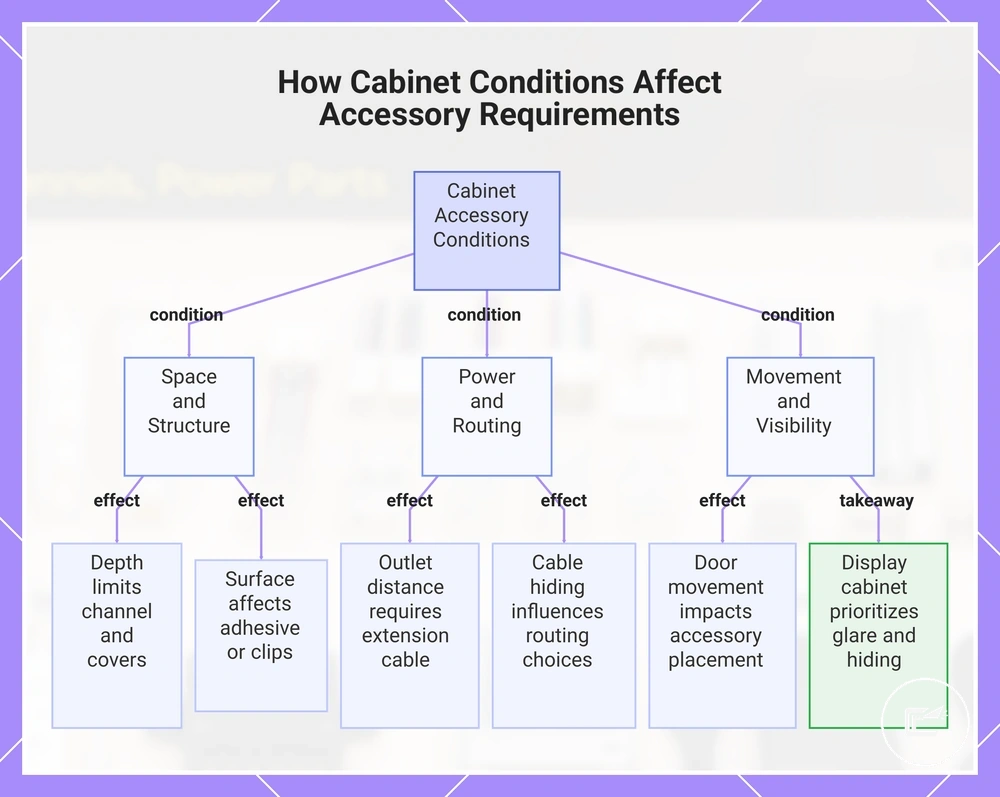
A shallow shelf, a display cabinet, or a cabinet with limited routing space can change which accessories are suitable for a lighting setup. Cabinet conditions affect accessory needs because space, visibility, and routing requirements may differ from one setup to another. Accessory requirements can therefore vary based on cabinet depth, underside surface, outlet distance, cable hiding needs, door movement, and glare control.
Cabinet depth may affect the suitability of channels, covers, or routing accessories when space is limited. An underside surface can influence whether adhesive-backed parts, clips, or a channel are appropriate for the installation surface. Outlet distance may increase the need for an extension cable, while cable hiding requirements can affect routing choices. Door movement and glare control may also influence accessory selection, depending on cabinet conditions and visibility requirements.
Cabinet-specific parts change the accessory set through conditions such as:
- Cabinet depth
- Underside surface
- Shelf or display cabinet visibility
- Outlet distance
- Cable hiding needs
- Door movement
- Glare control requirements
For example, a display cabinet may place greater emphasis on glare control and cable hiding, while a shelf setup may place greater emphasis on visibility and routing needs. These conditions can affect accessory requirements without defining a complete placement or installation plan.
This chart groups cabinet-specific conditions into three categories—space, power, and movement—and shows how each affects lighting accessory selection.
Accessory groups to recognize before choosing a lighting setup
Recognizing accessory groups before choosing a lighting setup helps organize evaluation around function rather than individual parts. Accessory groups identify which areas of a setup provide light, power, control, connection, mounting, or support. This recognition framework prepares comparison and selection without focusing on specific products.
Accessory groups can be scanned according to setup needs. If a setup requires electrical input, the power group may be checked first. If adjustment features are needed, the control group may be more relevant, while cleaner mounting or easier connection may shift attention to mounting, diffusion, or connection groups. Accessory groups to recognize before choosing a lighting setup are organized below for recognition rather than product choice.
- Light source
- Power
- Control
- Connection
- Mounting
- Diffusion
- Cable management
- Cabinet-condition parts
These accessory groups help recognize how a setup is structured and which functional areas may need closer review. For the next stage of evaluation, see how to choose the right setup. Selection logic depends on setup requirements and the role of each accessory group within the lighting system.