Home LED Strip and Cabinet Lighting Accessories Selection Guide
Home LED strip lighting accessories define the parts that help a cabinet lighting setup fit a specific cabinet use, lighting purpose, and component plan. Selection should start with the role of the light, not with a kit or offer. A suitable setup depends on how the cabinet lighting will support task work, accent effect, or placement comfort. Fit depends on cabinet use and component matching.
A kitchen counter, shelf, display cabinet, or under-cabinet lighting area can change the importance of brightness, color temperature, strip length, dimming, diffusion, and mounting space. The LED strip must also align with the power supply, controller, connectors, and any channel or accessory used around it. A kit may simplify the decision when its included parts match the planned setup, while separate accessories may be useful when compatibility labels or layout needs vary. These conditions should be evaluated as criteria before comparing offers.
This guide supports buying decisions without treating products as the main subject. Use the selection logic first, then compare lighting bundle contents, dimmable kit options, and accessory fit with caution. Product examples appear only after the selection logic is clear.
Cabinet Lighting Goals Before Choosing Accessories
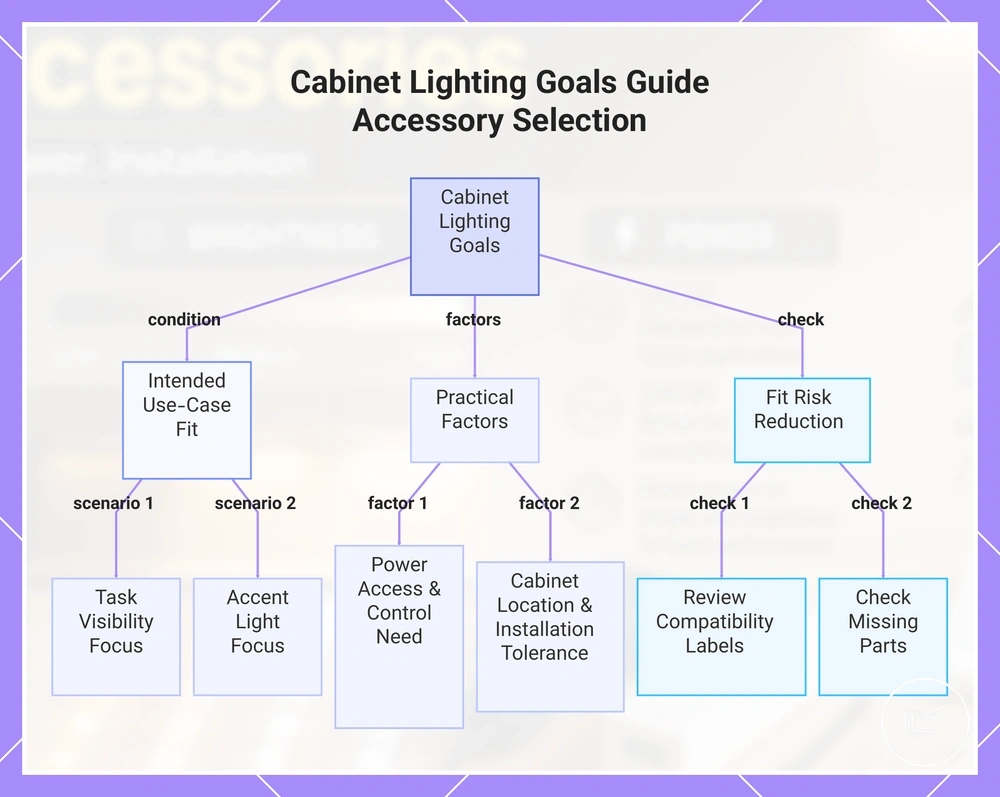
Cabinet lighting goals are the selection criteria that define what a lighting setup needs to achieve before accessories are evaluated. User needs such as task visibility, accent light, control need, and cabinet location help qualify which accessory types may be suitable. The main condition that changes the choice is the intended use-case fit.
A cabinet area used for focused work may prioritize task visibility, while a display space may place more emphasis on accent light and visual effect. Within home LED strip and cabinet lighting accessories, power access, cabinet location, and control need can influence which components are practical to consider. Installation tolerance can also affect whether a light strip kit or separate accessory parts are easier to evaluate. These attribute values influence the selection outcome.
When included parts do not fully match the lighting goal, reviewing compatibility labels and checking for missing parts can reduce fit risk. Understanding parts and accessory roles can help clarify why one cabinet light kit may suit a situation better than another. Accessory selection depends on use-case fit rather than a universal kit for every cabinet lighting scenario.
This chart shows how cabinet lighting goals define selection criteria and influence accessory choice through use-case fit, practical factors, and fit verification.
Choose by Cabinet Area, Room Use, and Lighting Purpose
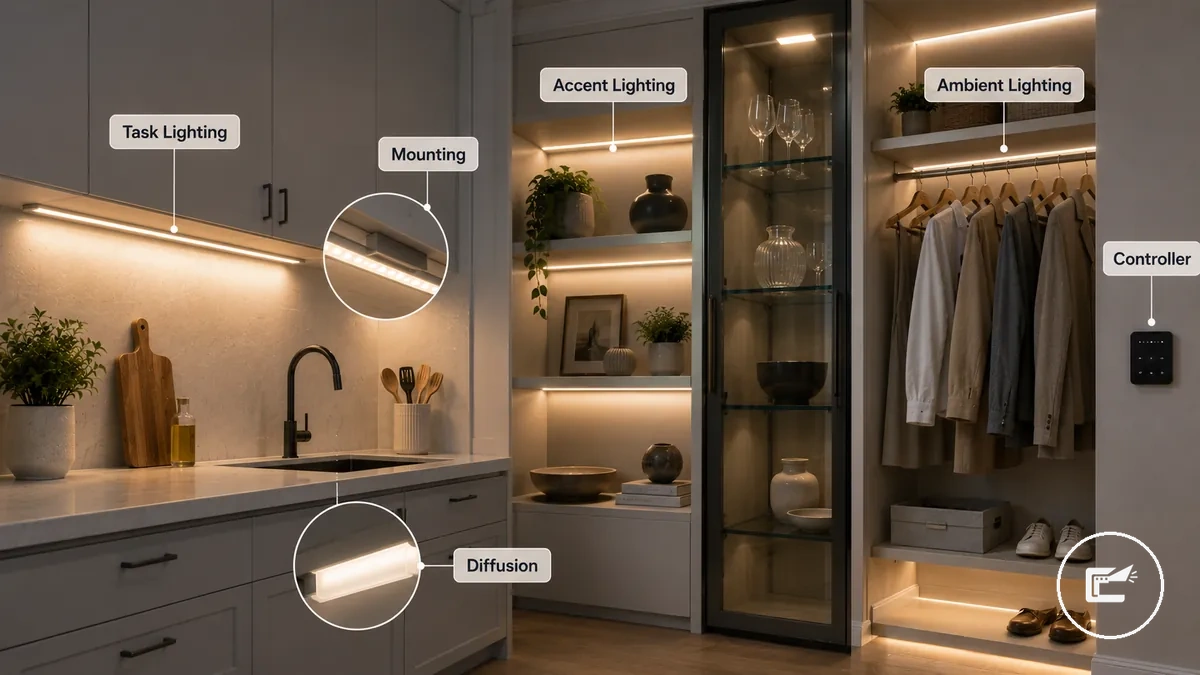
Choose by Cabinet Area, Room Use, and Lighting Purpose by matching the lighting goal to the location where the accessories will be used. Cabinet area, room use, and lighting purpose can change mounting needs, control options, and accessory selection. The most important condition is how the intended lighting function affects the setup.
Choose by Cabinet Area, Room Use, and Lighting Purpose becomes easier when placement conditions are compared before evaluating accessory options. The image below clarifies common cabinet lighting situations and shows how visible surfaces, control locations, diffusion needs, and hidden mounting areas may influence selection.
| Area/use | Lighting goal | Accessory implication | Selection note |
|---|---|---|---|
| Kitchen cabinets | Task lighting | Mounting and control access may matter more | Check whether the cabinet area supports the intended use |
| Counters with under-cabinet lighting | Task lighting | Diffusion may help reduce visible light points | Selection depends on work-surface visibility needs |
| Shelves | Accent lighting | Hidden mounting can become a priority | Consider how the light path affects display items |
| Display cabinets | Accent lighting | Control options may help adjust the visual effect | Accessory choice depends on the display objective |
| Closets | Ambient lighting | Power access and mounting space may influence setup | Evaluate fit according to cabinet location and use |
When a cabinet area appears to match more than one lighting purpose, start with the primary use rather than the accessory type. For broader indoor placement options, room use can help clarify whether task lighting, accent lighting, or ambient lighting should guide the decision. Accessory selection should follow the intended use-case rather than a fixed placement rule.
Task Lighting for Counters and Work Areas
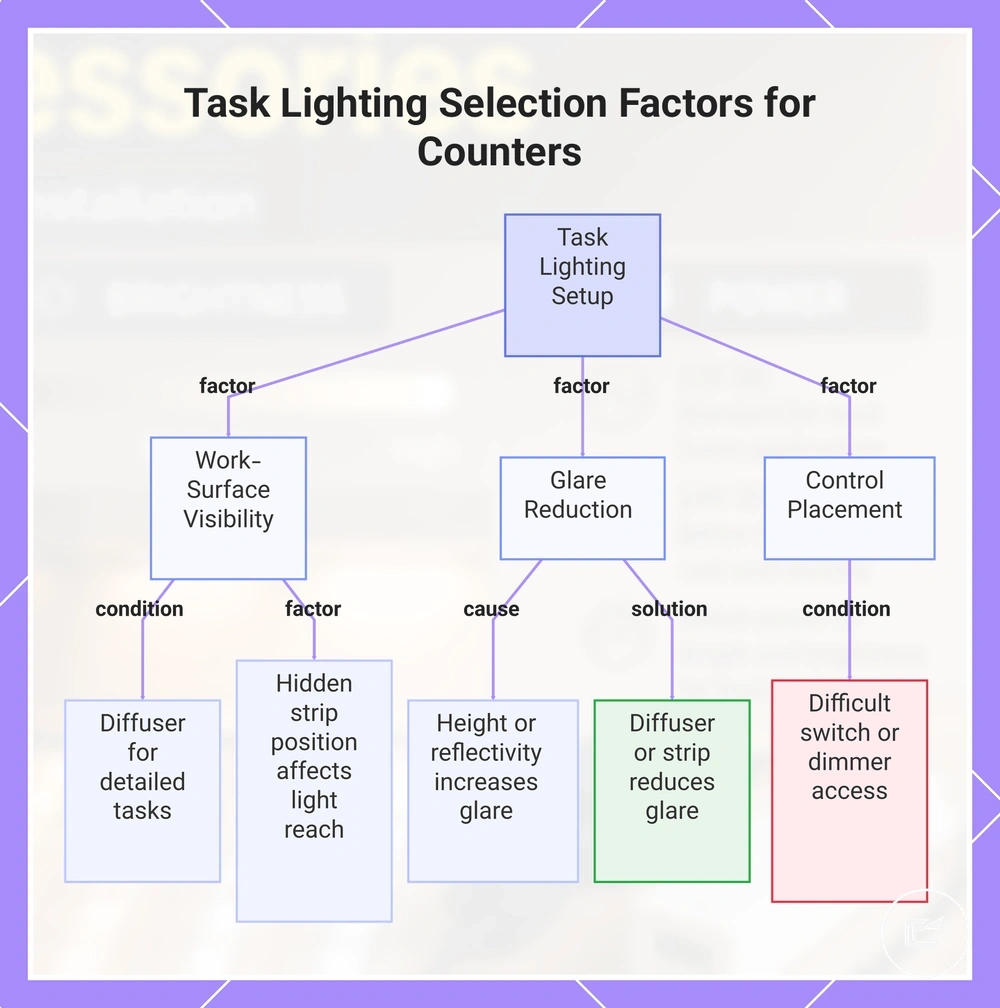
When task lighting is used over a work surface, accessory selection depends on how clearly the counter area needs to be illuminated and how easily controls can be reached. A hidden strip may help keep the light source out of direct view, while glare control can become more important when cabinet height or surface reflectivity increases visible brightness. The local decision factor is whether work-surface visibility or glare reduction has a greater influence on the task lighting setup.
- If the work surface is used for detailed tasks, a diffuser may help create a more even light pattern and a soft glow.
- If shelf depth or cabinet position places the light source in direct sight, glare can influence whether a diffuser or different strip position is considered.
- If switch location or dimmer access is difficult during regular use, control placement may affect accessory choice as much as lighting output.
- If under-cabinet lighting is intended mainly for counter visibility, the position of the hidden strip can influence how effectively light reaches the work surface.
This chart shows the main factors influencing task lighting accessory selection for counters and work areas, including visibility, glare control, and control placement.
Accent, Shelf, and Display Lighting Needs
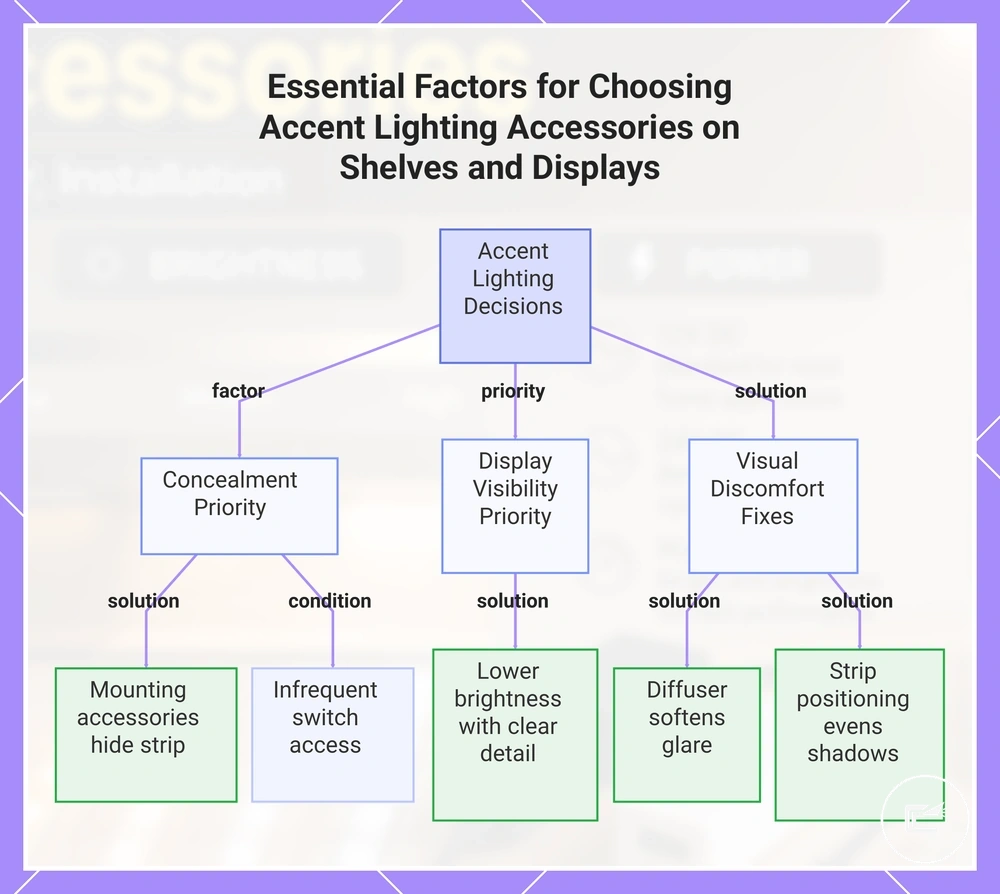
When accent lighting is used for shelves or display areas, accessory choices depend more on display visibility and visual comfort than on illuminating a work surface. Unlike task lighting, accent lighting often focuses on creating a soft glow, reducing glare, and keeping the light source less visible. The local decision factor is whether shelf depth and viewing angle make concealment or display emphasis more important.
- If shelf depth creates shadows around displayed objects, strip position may influence how evenly items are highlighted and how visible the display remains.
- If a hidden strip is preferred, mounting accessories may help keep the light source out of direct sight while maintaining a soft glow.
- If glare becomes noticeable from common viewing angles, a diffuser may help soften the light effect and influence the accessory decision.
- If display visibility is the priority, lower brightness may be suitable when object detail remains clear under the intended viewing conditions.
- If switch location is not accessed frequently, visual concealment may influence selection more than immediate control access.
This chart outlines the key priorities and common solutions for selecting accent lighting accessories for shelves and displays.
When LED Strips Fit Better Than Other Cabinet Lighting Formats
LED strips fit better than other cabinet lighting formats when flexible runs, cuttable length, and low-profile placement are important selection criteria. They can help cover longer cabinet sections with continuous light while remaining easier to conceal in narrow mounting areas. The local decision factor is whether the cabinet layout benefits more from flexibility and length coverage than from a fixed lighting format.
The comparison below organizes the main format differences. For a broader view of how these options relate, compare lighting formats using the same visibility, run-length, and mounting-space criteria.
| Format | Typical fit and limitation |
|---|---|
| LED strips | Suitable when flexible runs, cuttable length, hidden placement, and continuous light are priorities. |
| Light bars | May suit locations where a more fixed linear format fits the available mounting space. |
| Puck lights | May suit situations where individual light points are preferred over continuous coverage. |
| Tape lights | Can support low-profile placement, but fit depends on the lighting purpose and accessory configuration. |
Light Output, Color Quality, and Visual Comfort Criteria
Light output, color quality, and visual comfort criteria help determine how cabinet lighting will appear and function after installation. Brightness, lumens, watts per meter, color temperature, CRI, dimming capability, and diffusion work together to influence visibility, appearance, and comfort. The most suitable combination depends on the cabinet area, lighting purpose, and control needs.
Light Output, Color Quality, and Visual Comfort Criteria become easier to evaluate when the visible effects are compared side by side. The image below clarifies how color appearance, diffusion, dimming, and glare can change the visual result on cabinet surfaces.
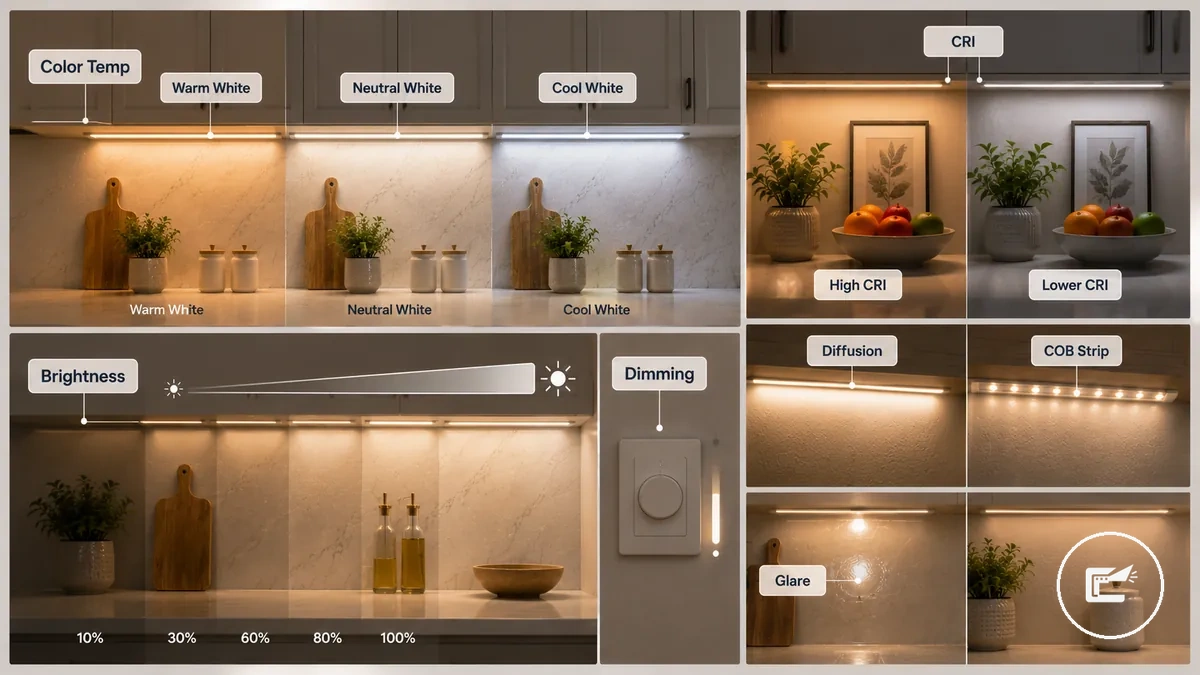
When task-focused areas require clearer visibility, higher brightness levels, suitable lumens, and appropriate watts per meter may become more important than in softer display or accent settings. Color temperature can influence whether the lighting appears warmer, more neutral, or cooler, while CRI may affect how accurately cabinet contents and surface colors appear. Diffusion can help soften visible diodes and reduce glare, while a COB strip may create a more continuous light appearance than formats where individual light points remain visible. These attribute values influence accessory and kit selection outcomes.
When visible dots, glare, or uneven appearance become concerns, diffusion, dimming, and strip type can help refine the visual result. The table below organizes the main evaluation criteria, while deeper attribute comparisons are available through light quality selection. Exact values depend on cabinet layout, lighting purpose, viewing distance, and user preference rather than a fixed rule.
| Attribute | Value/condition | Visual effect | Selection note |
|---|---|---|---|
| Brightness | Depends on lighting purpose | Changes surface visibility | Evaluate according to cabinet use |
| Lumens and watts per meter | Higher or lower output levels | Affects perceived light intensity | Match output to the intended task or display need |
| Color temperature | Warmer, neutral, or cooler appearance | Changes visual atmosphere | Choose according to the desired lighting effect |
| CRI | Varies by lighting specification | Influences color appearance | Consider when color presentation matters |
| Dimming | Available when supported | Adjusts perceived brightness | May improve flexibility across different situations |
| Diffusion and COB strip design | Diffused or visible diodes | Can reduce glare and visible light points | Consider visual comfort and viewing angle |
Brightness and Lumen Output for Cabinet Tasks
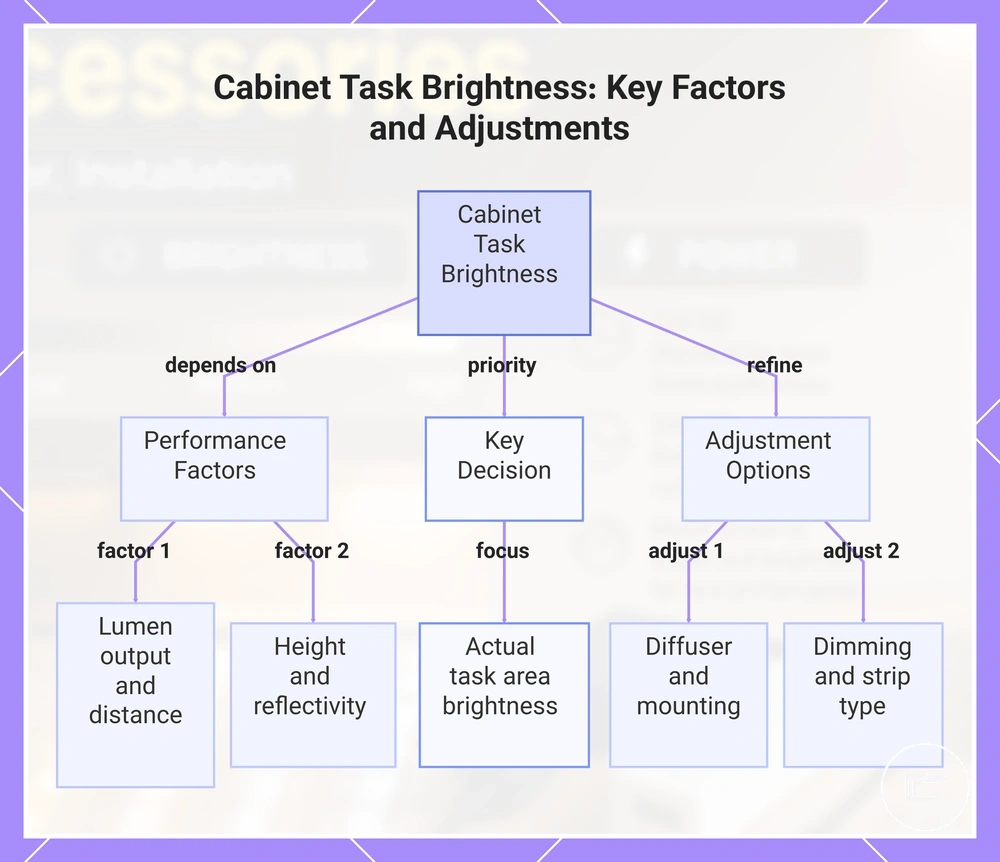
When cabinet tasks require clear work-area visibility, brightness depends on lumen output, cabinet height, countertop reflectivity, and the distance between the LED strip and the working surface. Higher lumens or watts per meter may appear different when light travels farther or when darker surfaces absorb more light. The key decision factor is how brightness performs in the actual task area rather than how high the output specification appears on its own.
When a lighting setup seems bright but still creates visibility concerns, diffuser loss, mounting position, and dimming range may help explain the result. Diffusion can soften glare and visible diodes, while a COB strip may create a more continuous appearance than exposed light points. Color temperature and CRI can influence how surfaces and objects appear, but a wider dimming range may provide more usable control when task requirements change throughout the day.
This chart shows the main factors affecting cabinet task brightness, the key decision to prioritize actual task area performance over spec, and available adjustment options.
Color Temperature and CRI for Kitchen Cabinets
When kitchen cabinet lighting supports food preparation or display, color temperature and CRI influence how surfaces, finishes, and food items appear under the light. Warm white, neutral white, cool white, and tunable white options can create different visual results depending on cabinet finish, kitchen ambience, and visibility needs. The key decision factor is whether the lighting priority is appearance, visibility, or a balance of both.
The table below compares common color temperature choices and their potential effect on kitchen cabinet lighting decisions.
| Option | Visual effect | Condition | Decision note |
|---|---|---|---|
| Warm white | Softer visual appearance | Often considered when ambience is a priority | May complement certain cabinet finishes and decorative settings |
| Neutral white | Balanced color appearance | Can suit mixed visibility and ambience needs | Often evaluated when kitchen activities vary throughout the day |
| Cool white | Crisper visual appearance | May support visibility-oriented tasks | Suitability depends on cabinet finish and personal preference |
| Tunable white | Adjustable color appearance | Useful when lighting needs change by activity or time of day | May provide greater flexibility than a fixed color setting |
| CRI | Can influence color presentation | Relevant when food appearance and finish detail matter | Should be evaluated alongside color temperature |
When cabinet finishes appear different than expected or food colors seem less accurate, reviewing both color temperature and CRI can help identify the cause. Brightness, lumens, watts per meter, dimming, diffusion, COB strip design, visible diodes, and glare may still influence the overall lighting result, but color appearance decisions depend primarily on how color temperature and CRI interact with the kitchen environment.
Dimming, Diffusion, and Light Continuity
Dimming, diffusion, and light continuity depend on how brightness is adjusted, how glare is controlled, and how visible diodes appear across the cabinet area. When under-cabinet lighting is viewed directly or reflected from glossy surfaces, diffusion and light continuity may become as important as lumens, watts per meter, color temperature, or CRI. The key decision factor is whether visual comfort, control range, or a smoother light appearance has the highest priority.
The comparison below highlights how these attributes can influence accessory selection.
| Attribute | Condition | Accessory implication | Decision effect |
|---|---|---|---|
| Dimming | Brightness needs vary by task or time of day | Dimmer compatibility may need to match the controller type | Can provide greater control over light output |
| Diffusion | Glare or visible dots are noticeable | Diffuser channels may be considered | May improve visual comfort and soften light appearance |
| COB strip design | Continuous-looking light is preferred | Strip style becomes part of the accessory decision | May reduce the visibility of individual light points |
| Diode spacing | Visible diodes affect the appearance | Diffuser use or strip selection may change | Can influence perceived light continuity |
When a cabinet light kit includes a compatible controller but visible diodes remain distracting, adding a diffuser channel may change the accessory bundle more than increasing brightness alone. Dimming can adjust output levels, while diffusion and COB strip options may help address glare and continuity concerns that brightness adjustments do not fully change.
Strip Length, Cut Points, and Cabinet Run Planning
Strip length planning starts with measuring the cabinet run before choosing a light strip kit or separate accessory parts. A measured run helps estimate usable length, identify potential fit risks, and reduce the chance of selecting a kit with insufficient coverage or missing parts. The main condition that changes the choice is how the cabinet layout affects the required strip length and accessory quantity.
When a cabinet run includes corner turns, gaps between sections, or separate cabinet areas, the measured run may differ from the usable length of a continuous strip. Cut points determine where strip length can be adjusted, while an extension cable may be needed when sections cannot be connected directly across a gap. Maximum run considerations and possible voltage drop can influence whether a longer run or multiple sections are more suitable. These attribute values can affect both buying quantity and fit.
Strip Length, Cut Points, and Cabinet Run Planning becomes easier when the main measurement factors are reviewed before comparing kits or separate accessories.
| Measurement factor | Condition | Fit risk | Buying decision |
|---|---|---|---|
| Measured run | Cabinet length includes multiple sections | Coverage may be underestimated | Confirm total length before comparing options |
| Usable length | Cut points limit shortening locations | Excess or insufficient length may remain | Check how strip sections align with the layout |
| Corner turns | Direction changes within the cabinet run | Additional accessories may be required | Review connector and layout requirements |
| Extension cable | Lighting sections are separated by gaps | Direct strip placement may not fit | Verify whether extra connection parts are needed |
| Maximum run | Long continuous layouts are planned | Performance may vary because of voltage drop and product specifications | Check product guidance before choosing a longer run |
| Spare length | Layout measurements are close to kit limits | Minor measurement differences may affect fit | Evaluate whether additional length is justified |
When a layout appears simple but includes hidden gaps or corner turns, accessory needs can change even if the measured run remains similar. Cutting and connecting details should stay high-level unless they directly affect buying quantity or fit risk. The most suitable strip length plan depends on the cabinet layout, required accessories, and product-specific specifications.
Measured Length Versus Usable Strip Length
Measured length is the raw cabinet run, while usable strip length is the portion that can actually fit after cut points, corner turns, connector space, and power-entry location are considered. A measured run may not equal the purchasable or usable length when hidden cable allowances or gaps between cabinet sections change how the LED tape is routed. The local decision factor is whether the layout needs extra strip length, an extension cable, or a different light strip kit size to fit properly.
- If corner gaps interrupt the measured run, connector space may reduce usable length and affect buying quantity.
- If the power-entry location sits away from the first lighted section, hidden cable allowance may change the accessory plan.
- If cut points do not align with the cabinet run, the strip may leave excess or uncovered space depending on the layout.
- If a light strip kit is close to the measured run, spare length may be useful when fit depends on corner turns, gaps, and connector placement.
When a cabinet measures as one continuous line but includes a side turn and a separated section, usable length may need to account for both the visible strip and the non-lit connection path. Maximum run and voltage drop should stay at specification-check level for longer layouts, not assumed from measurement alone.
Maximum Run Length and Cuttable Sections
Maximum run length and cuttable sections constrain strip selection because strip specifications determine how a cabinet layout can be divided and configured. A strip length that matches the measured run may still require different planning when cut points, controller capacity, voltage, or voltage drop considerations affect the layout. The local decision factor is whether the cabinet run remains within the product specifications or benefits from multiple sections.
- If the maximum run rating is lower than the planned strip length, multi-run planning may be needed and can influence kit selection.
- If cut points do not align with cabinet dimensions, usable length may change and affect how the strip is divided.
- If voltage drop becomes a consideration across a longer run, strip specifications may influence whether separate sections are evaluated.
- If controller capacity is limited, a longer cabinet run may require a different layout approach rather than simply adding more strip length.
- If corner turns require connectors or an extension cable, accessory selection may change even when the measured run appears suitable.
When a long cabinet run extends across multiple sections, the solution may depend on dividing the layout according to strip specifications instead of extending a single continuous run. Layout decisions can depend on the relationship between maximum run limits, cuttable sections, controller capacity, and cabinet configuration.
Power Supply, Voltage, Controller, and Connector Compatibility
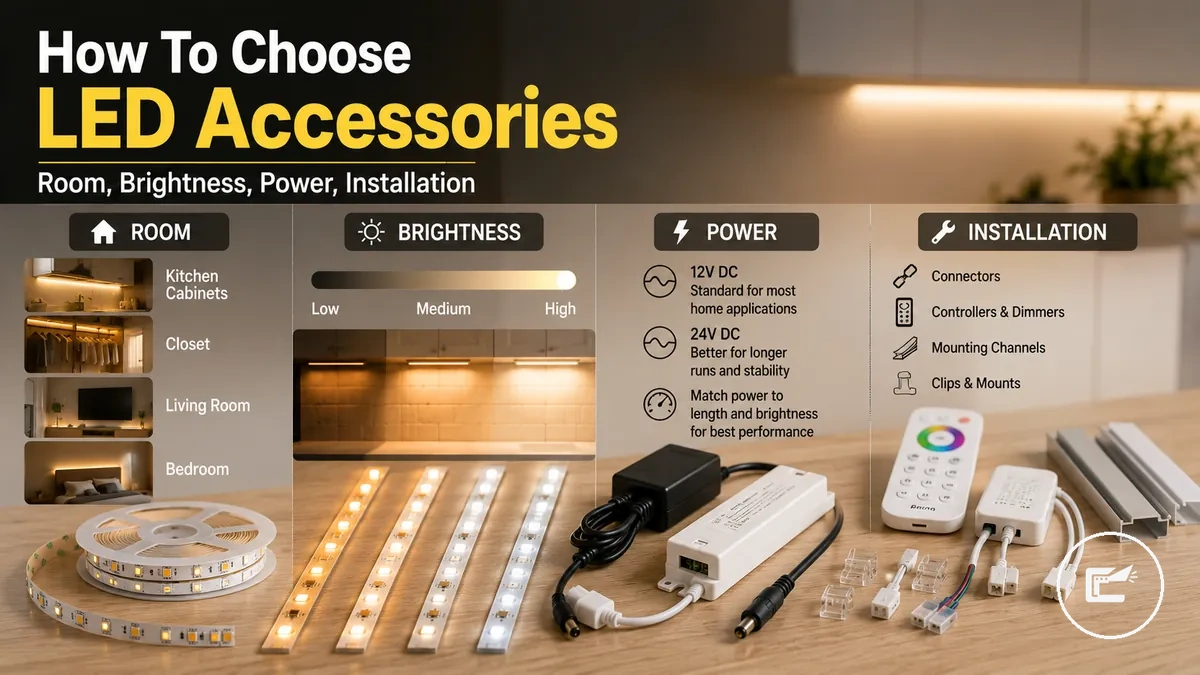
Power Supply, Voltage, Controller, and Connector Compatibility depends on matching the specifications of all connected parts before comparing kits or offers. A light strip kit may include compatible components, but voltage, power supply capacity, connector type, controller support, and accessory fit should be checked together. The main condition that changes the choice is whether component labels and ratings align with the intended lighting purpose and control needs.
Power Supply, Voltage, Controller, and Connector Compatibility becomes easier to evaluate when each component is viewed as part of the same system. The image below clarifies how the power path, adapter, controller, connector, channel, and mounting parts relate to the LED strip and influence compatibility decisions.
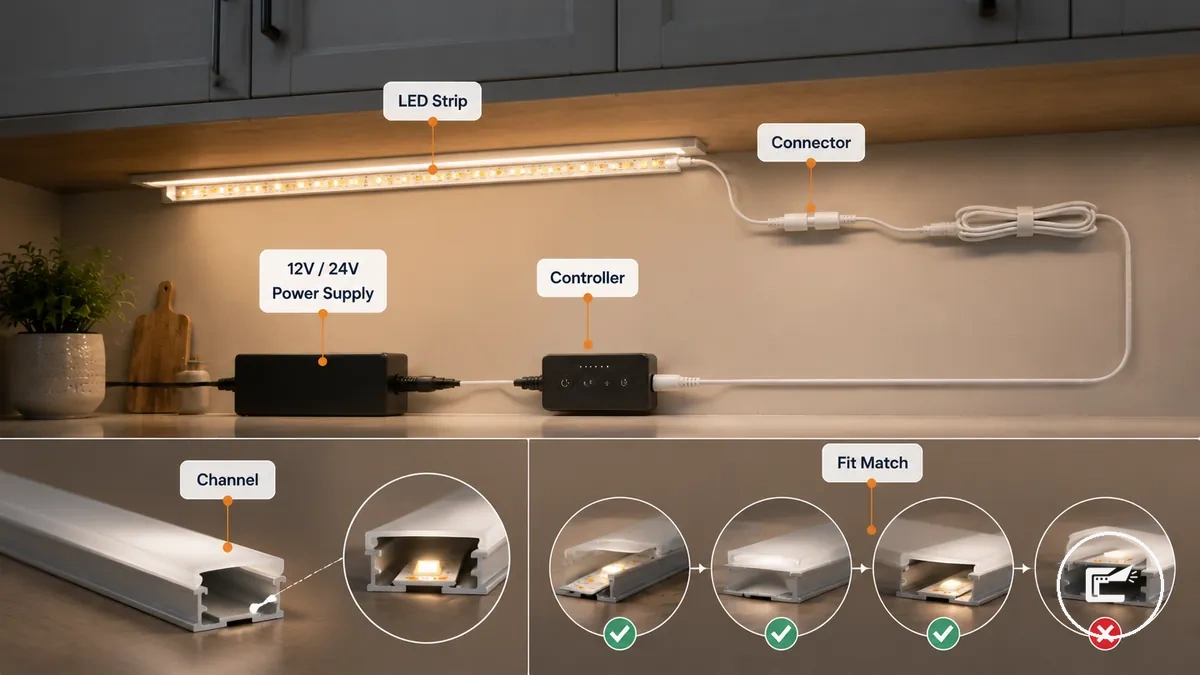
| Part | Attribute/criterion | Value/condition | Effect/risk/decision |
|---|---|---|---|
| LED strip | Voltage | 12V or 24V | Voltage labels should match connected components |
| Power supply | Wattage and output rating | Compatible with strip requirements | An underpowered adapter may affect performance |
| Controller or dimmer | Control compatibility | Matches strip type and control function | Incompatible controllers may limit available functions |
| Connector | Connection type | Matches strip format and accessory parts | Fit risk may increase when connector labels differ |
| Extension cable | Connection purpose | Used when sections are separated | May influence layout and accessory selection |
| Channel and mounting clips | Physical fit | Compatible with strip dimensions | Can affect installation options and overall fit |
When a kit includes a controller, adapter, and connectors, compatibility should be checked across all included parts rather than assumed from a single specification. For deeper compatibility planning, compare voltage labels, wattage ratings, controller support, and connector formats as a combined criteria set. If voltage labels do not match, an adapter lacks sufficient wattage, or a controller is incompatible with the strip, performance or safety characteristics may vary depending on the configuration.
12V and 24V Strip Matching
12V and 24V Strip Matching depends on keeping the voltage label consistent across the LED tape, power supply, controller, dimmer, and related accessory parts. A 12V strip should match a 12V adapter and compatible controller rating, while a 24V strip should match 24V-labeled components. The local decision factor is whether all component labels match the strip voltage specified for the cabinet light kit.
- If a 12V or 24V strip is paired with a different voltage adapter, compatibility risk increases and the component match should be rechecked.
- If the controller or dimmer rating does not match the strip voltage, control functions may be limited and component selection may need review.
- If run length increases, voltage-drop likelihood may vary by layout and strip specifications, which can influence the matching decision.
- If a replacement connector, channel, or mounting clips are added later, compatibility labels should still align with the original setup.
- If a kit includes missing parts or separate accessories, voltage labels, wattage ratings, and connector compatibility should govern the matching decision.
When replacement parts are selected without checking labels, compatibility issues may occur even when components appear similar. Component labels should remain the primary boundary cue because 12V and 24V parts are matched by specification rather than appearance.
Power Supply Capacity and Adapter Fit
Power Supply Capacity and Adapter Fit depends on whether the power supply can support the selected strip run while matching the required voltage and accessory configuration. Capacity affects reliability because a longer LED tape run may increase wattage demand, and an adapter with insufficient output may influence heat generation or performance. The local decision factor is whether the power supply specifications align with the strip length, voltage, and intended lighting purpose.
Use this mini-checklist before selecting a cabinet light kit or separate adapter:
- If strip length increases, compare wattage demand with adapter output because a longer run may require more capacity.
- If the setup uses 12V or 24V LED tape, verify that the power supply voltage matches the strip label before making a compatibility decision.
- If a controller, dimmer, or connector is included, confirm that the power supply supports the complete low-voltage configuration.
- If a safety margin is recommended by the manufacturer, include it when evaluating adapter capacity and fit.
- If plug type, channel dimensions, or mounting clips affect placement, check whether enclosure location allows suitable adapter positioning and cable routing.
When a longer strip run is added to the same cabinet area, wattage demand may increase even if the lighting purpose remains unchanged. Reviewing adapter output against the updated strip length can help identify whether the original power supply remains suitable under the intended conditions.
Controllers, Dimmers, and Remote Control Requirements
Controllers, Dimmers, and Remote Control Requirements depend on matching the control method to the LED tape type, voltage, and intended control need. A controller should align with the strip configuration, while dimmer and remote functions should match how the under-cabinet lighting will be used. The local decision factor is whether the chosen control method supports the strip type and the preferred way to adjust lighting.
- Simple Dimmer: If brightness adjustment is needed for a single-color strip, verify controller voltage, 12V or 24V compatibility, and dimming support because control fit may affect kit suitability.
- Remote Control: If remote operation is preferred, confirm that the controller and adapter support the control method because line-of-sight conditions may influence usability.
- Sensor Control: If switch access is inconvenient, a sensor-based controller may be considered, but connector compatibility and installation location can affect the final setup.
- Tunable-White Control: If adjustable white-light settings are required, the controller should support tunable-white operation because single-color controllers may not provide the same dimming range or control options.
- Single-Color, Tunable, or RGB Control: If a strip uses single-color, tunable-white, or RGB control, verify controller current rating, wattage support, and accessory compatibility because control features depend on the strip configuration.
When a wall switch is located away from the cabinet area, a remote or sensor-based control method may improve access without changing the light strip kit itself. Controller selection should remain based on strip type, voltage requirements, and the intended control method rather than feature count alone.
Connectors, Extensions, Channels, and Mounting Accessories
Connectors, Extensions, Channels, and Mounting Accessories depend on how the selected strip must fit the cabinet path, mounting surface, and visibility requirements. These accessory categories solve different fit challenges by connecting sections, extending reach, improving mounting stability, or refining the visible lighting result. The local decision factor is whether the accessory matches the cabinet layout, surface condition, and intended lighting purpose.
- Solderless Connectors: If a light strip kit includes separate sections, a solderless connector may help join compatible segments, and connector fit can influence continuity across the cabinet path.
- Corner Connectors: If the cabinet run changes direction, a corner connector may support the turn, and accessory selection can depend on the angle and available space.
- Extension Cables: If gaps separate lighting sections, an extension cable may bridge the distance, and cable length can affect layout flexibility.
- Diffuser Channels: If visible diodes or glare are a concern, a channel may help create a cleaner appearance, and channel selection can influence the visible lighting result.
- Mounting Clips and Adhesive Surfaces: If the mounting surface varies in texture or condition, mounting clips or adhesive-backed solutions may affect strip stability and placement options.
- Cable Hiding Accessories: If visible wiring affects appearance, cable-management accessories may help organize the layout, and the outcome depends on the cabinet configuration.
When a cabinet layout includes a visible corner, the choice between a corner connector and a diffuser channel may change depending on whether the priority is directional routing or a smoother visual appearance. Visibility, mounting conditions, and accessory compatibility can influence which option fits the layout more effectively.
Complete Kits, Bundles, and Separate-Part Buying Decisions
Complete Kits, Bundles, and Separate-Part Buying Decisions depend on the balance between convenience, control, and fit requirements. A complete kit may simplify selection because included parts can reduce compatibility checks, while separate accessories may provide greater control over individual component choices. The main condition that changes the choice is whether the cabinet layout and control need require customization beyond the included parts.
When a cabinet lighting project prioritizes convenience, a complete kit or lighting bundle may include an LED tape, power supply, controller, dimmer, connectors, and mounting accessories. In other situations, missing parts, channel preferences, or specific control requirements may make separate accessories more suitable. Included parts can reduce selection effort, while upgrade flexibility may increase when components are chosen individually. These attribute differences often influence the final buying decision.
Complete Kits, Bundles, and Separate-Part Buying Decisions become easier when included parts, trade-offs, and fit requirements are compared side by side. The table below organizes the main differences between buying paths and highlights how convenience and upgrade flexibility can vary by configuration.
| Buying path | Included parts | Trade-off | Best use case |
|---|---|---|---|
| Complete kit | May include strip, power supply, controller, dimmer, connectors, and mounting accessories | Higher convenience but potentially less upgrade flexibility | When simplified component selection is the priority |
| Lighting bundle | Often groups multiple related components | Balances convenience and component choice | When core accessories are needed together |
| Separate accessories | Components selected individually | More compatibility checks but greater upgrade flexibility | When fit, control needs, or accessory requirements vary |
Problem cases can occur when a complete kit or lighting bundle does not include every accessory needed for a specific cabinet path or mounting condition. Reviewing included parts, missing parts, channel availability, and connector requirements can help reduce fit risk before choosing a buying path. The most suitable option depends on cabinet configuration, control preferences, and accessory requirements rather than a fixed rule.
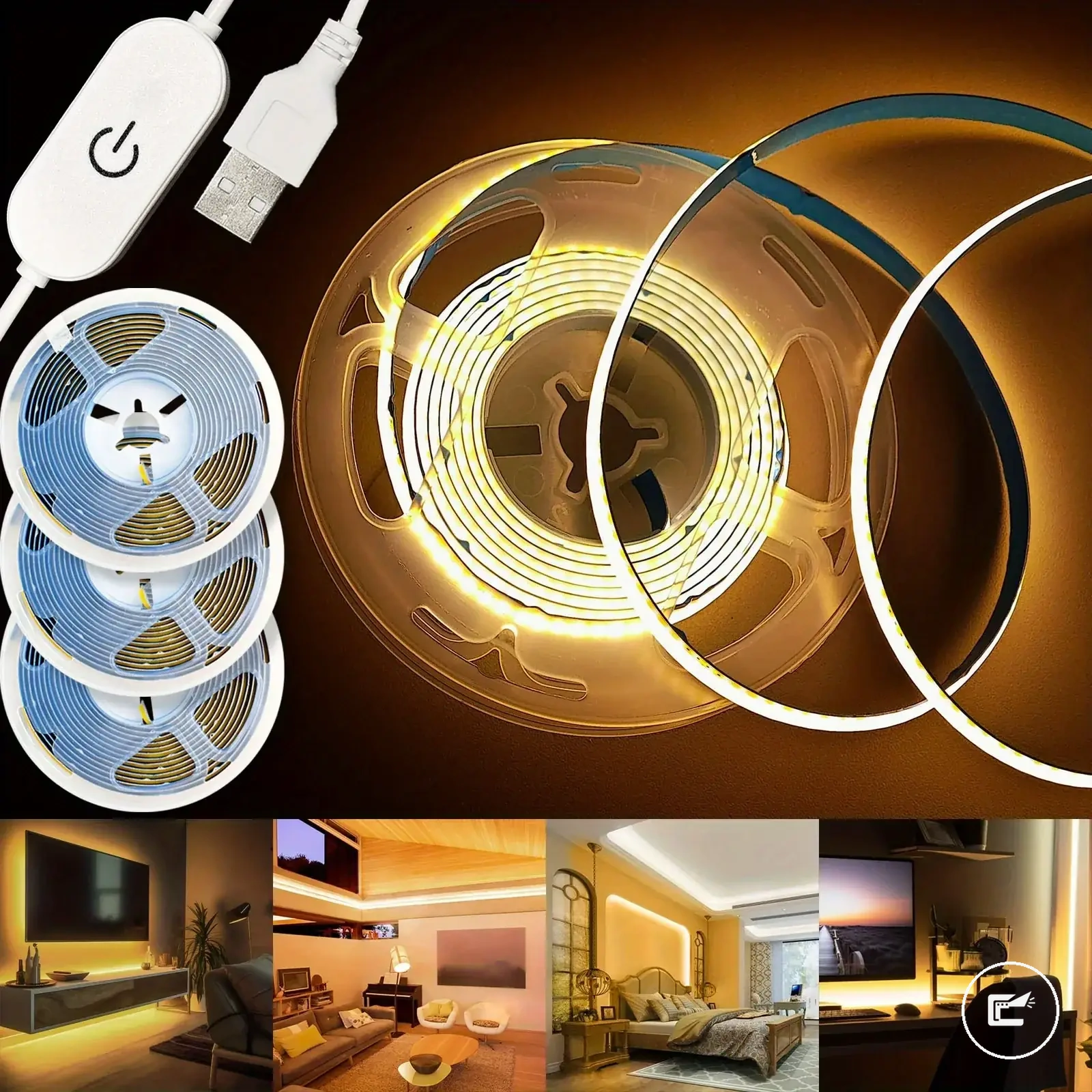
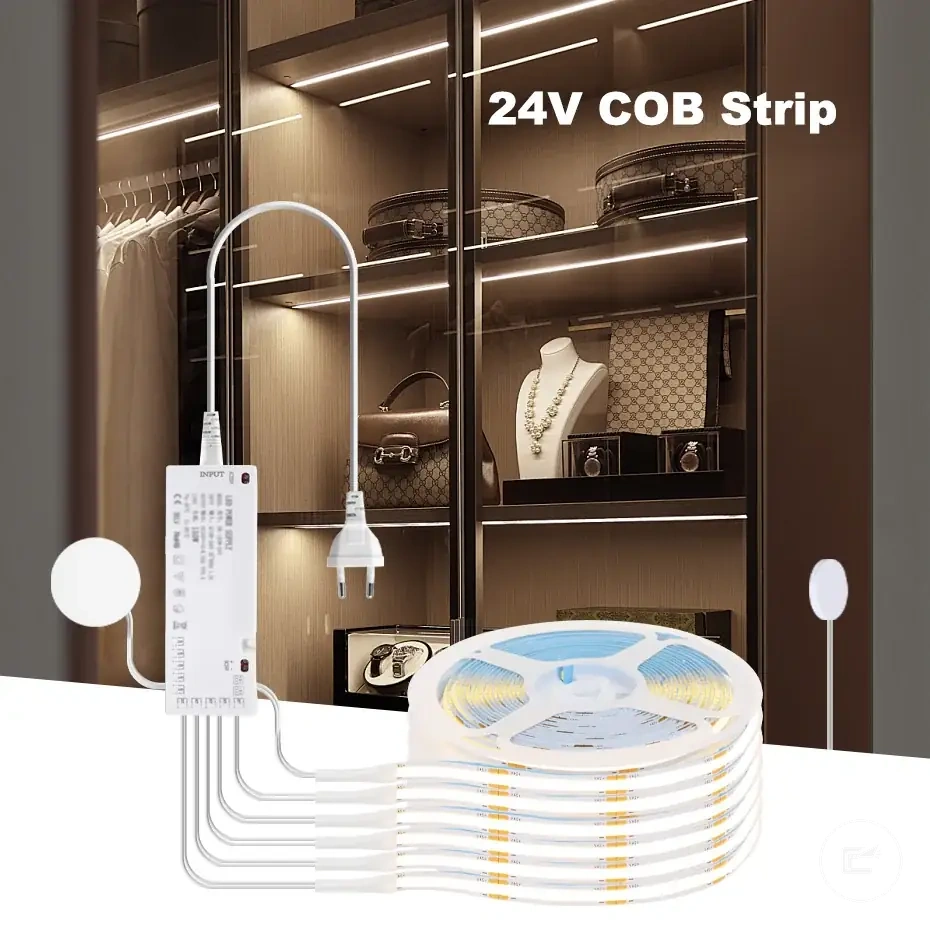
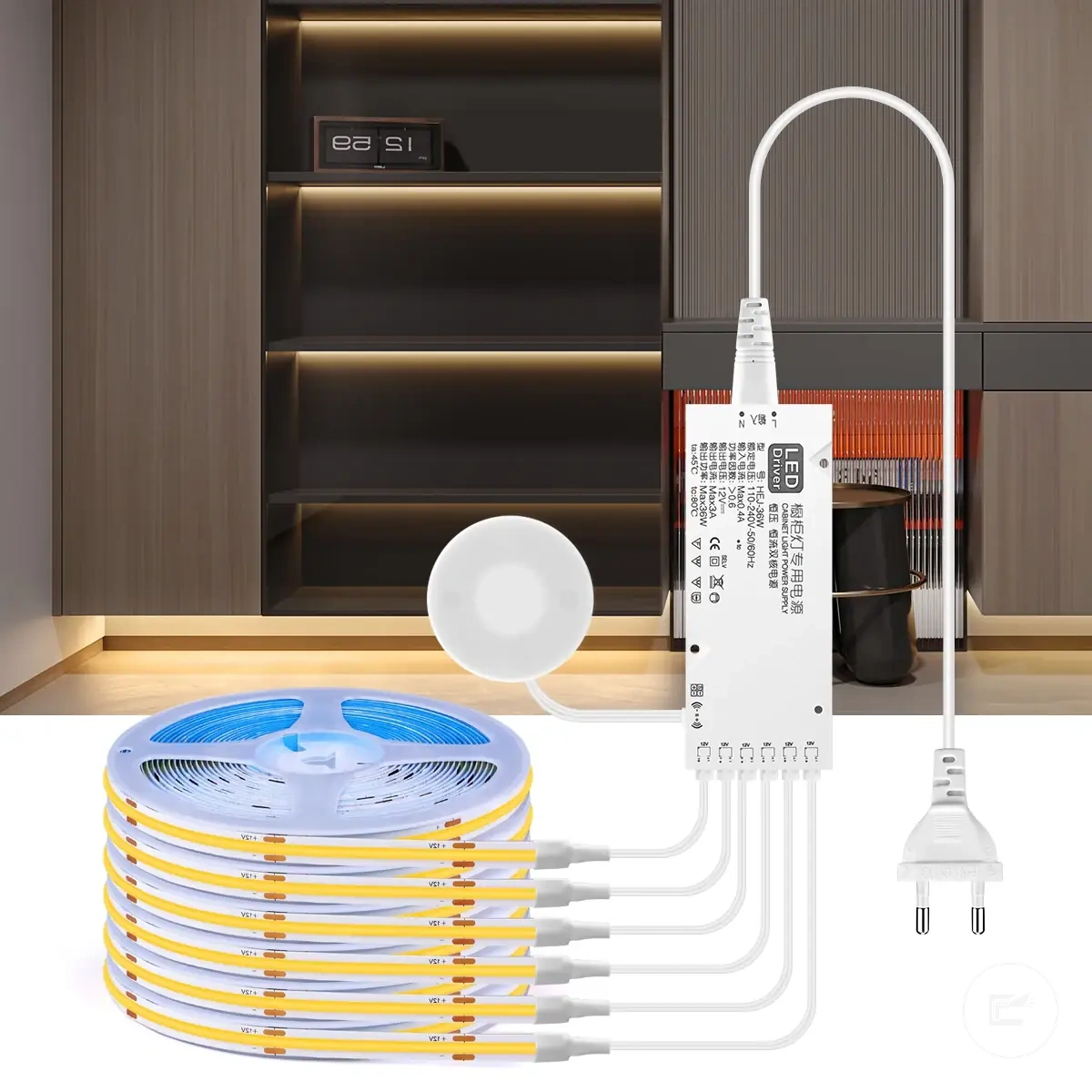
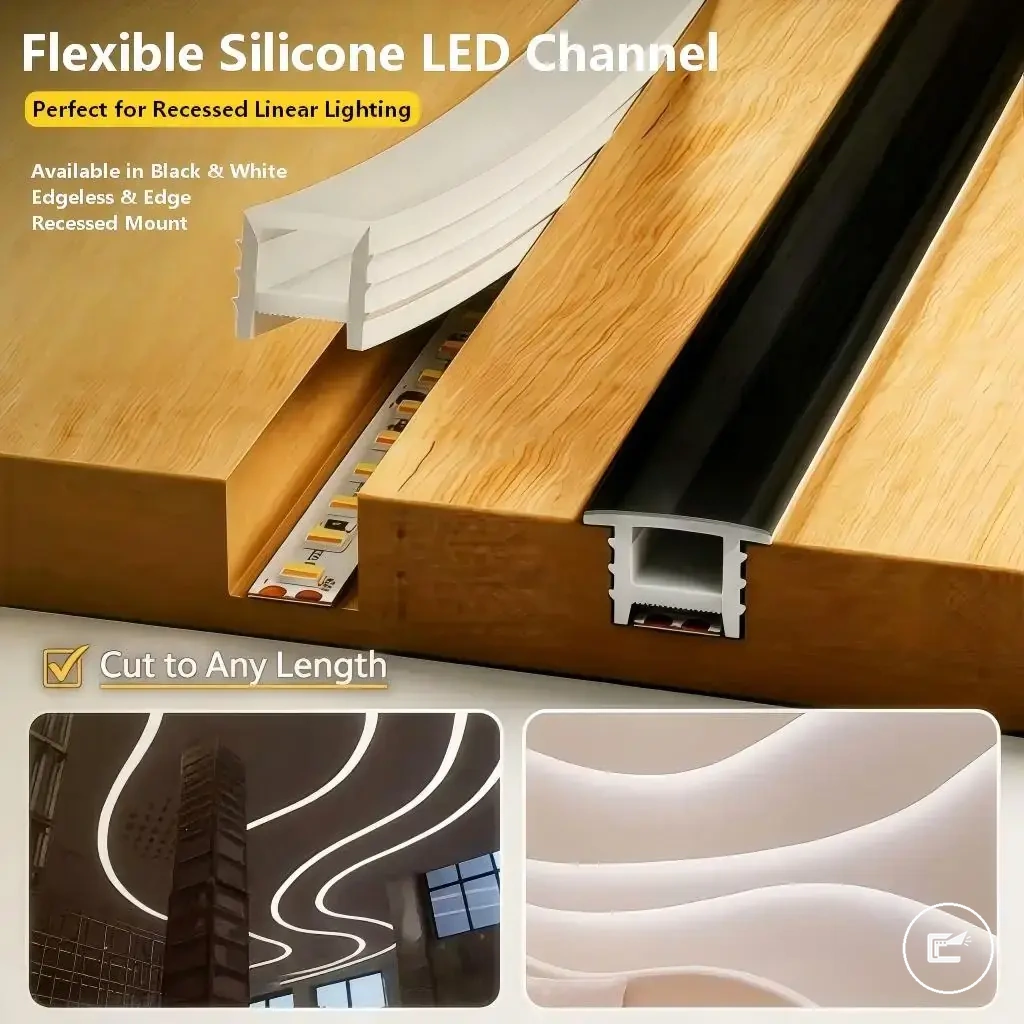
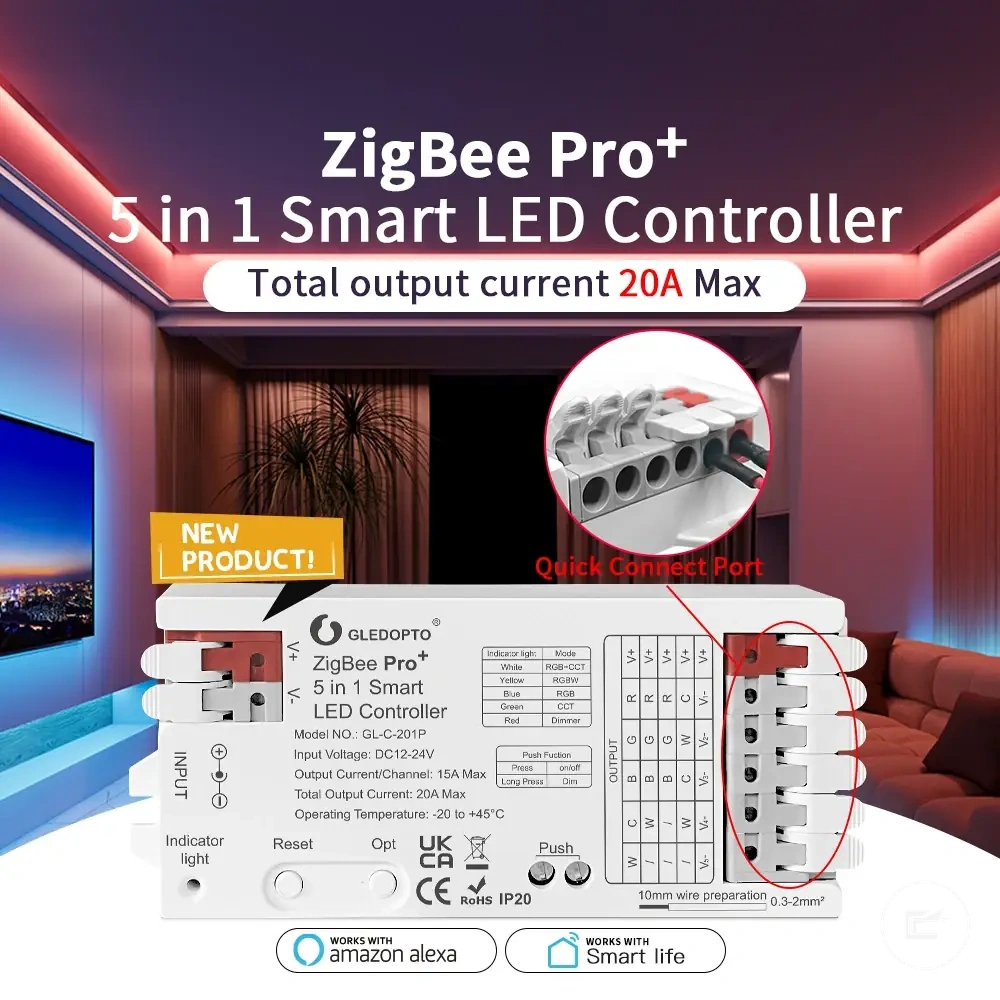
The products below are useful examples for comparing available options. Before buying, check that the compatibility criteria, key features, and product details match your needs.
When a Cabinet LED Lighting Kit Is Enough
A cabinet LED lighting kit is enough when the cabinet run is simple, the included parts match the required specifications, and the layout does not need custom control or separate accessories. The kit should still be checked for sufficient length, matching power supply, included controller, basic mounting parts, and simple dimming support before selection. The local decision factor is whether convenience and basic compatibility outweigh upgrade flexibility.
- If the measured cabinet path is short and direct, a complete kit may provide enough strip length and reduce missing parts risk.
- If the power supply and included controller match the LED tape specifications, basic compatibility may be easier to verify.
- If simple dimming is the only control need, a kit with a suitable dimmer may be more convenient than separate accessories.
- If the mounting surface is straightforward, included parts such as clips or adhesive support may be enough for basic fit.
- If the cabinet path has few corners, gaps, or visibility concerns, a light strip kit may satisfy the setup without extra customization.
When a cabinet layout needs only a clean under-cabinet lighting run, a cabinet light kit can be practical if the included parts match the measured length and specifications. If the layout needs extra channel options, special connectors, or more control flexibility, separate accessories may be more suitable.
When Separate Accessories Give Better Fit and Control
Separate accessories are more appropriate when a cabinet layout needs customization beyond the included parts of a complete kit or lighting bundle. Long runs, unusual corners, diffuser-channel preferences, stronger power planning, or tunable controls may require components selected for a specific cabinet area and lighting purpose. The local decision factor is whether upgrade flexibility and layout-specific fit are more important than convenience.
- If the cabinet path includes long runs, separate accessories may allow power-planning choices that better match the layout and control needs.
- If unusual corners affect strip routing, separate connectors may reduce fit risk by matching the cabinet path more closely.
- If a diffuser channel is preferred for appearance or visibility reasons, separate channel selection may provide more control over the final result.
- If tunable controls are required, separate controllers and related accessory parts may offer more flexibility than the included parts of a complete kit.
- If replacement flexibility is important, separate accessories may make it easier to adjust individual components without changing the entire setup.
When a cabinet layout combines a long run with multiple corner changes, a complete kit may not include the specific connectors or channel options needed for the intended fit. Selecting separate accessories in that situation can reduce mismatch risk when component specifications and layout requirements are checked together.
Final Checks Before Comparing LED Strip Lighting Offers
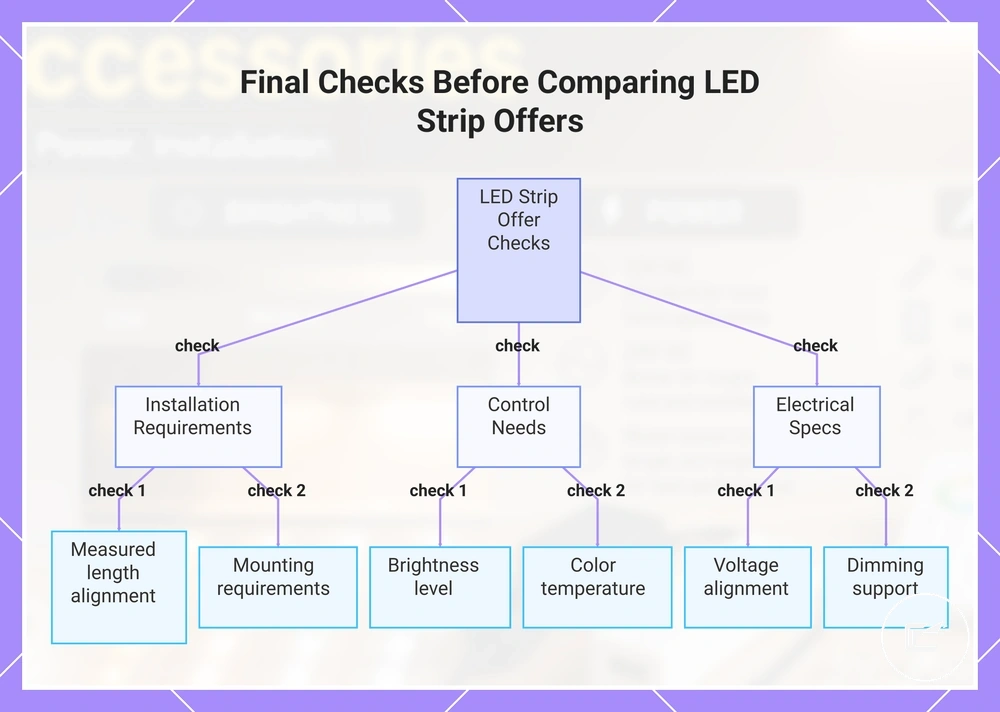
Final checks before comparing LED strip lighting offers help reduce buying friction and lower mismatch risk by verifying the specifications that affect selection. Final checks should confirm that the cabinet light kit, included parts, and intended lighting purpose align with the measured cabinet layout. The main condition that changes the choice is whether the offer clearly matches the installation requirements and control needs.
When two offers appear similar, the differences often come from specification details rather than appearance. Use this buying checklist to verify measured length, brightness, color temperature, dimming support, voltage, power supply, controller, connectors, channels, and mounting requirements before comparing offers. Also check room use, accessory completeness, included parts, missing parts, and compatibility labels where available. Attribute values that match the cabinet area and control need may improve offer fit and reduce selection errors.
- Room use: Verify that the lighting purpose matches the intended cabinet area.
- Measured length: Confirm that the strip length aligns with the planned run.
- Brightness: Check whether the output level suits the task and visibility needs.
- Color temperature: Verify that the light appearance matches the intended environment.
- Dimming: Confirm whether the offer includes compatible dimming support when needed.
- Voltage and power supply: Check that voltage labels and power specifications align.
- Controller and connectors: Verify compatibility labels and included connection parts.
- Channels and mounting: Confirm that mounting accessories and channel preferences are addressed.
- Safety cues: Review specification clarity and installation guidance where provided.
- Return-sensitive uncertainty: Treat unclear specifications or missing parts as a signal to verify details before making a final comparison.
When specification details are incomplete, final checks should focus on offer fit, accessory completeness, and specification clarity rather than assumptions. A cabinet light kit may appear suitable, but uncertain fit, missing parts, or unclear compatibility information can justify additional verification before selection. Guidance depends on the available specifications and the complexity of the cabinet layout.
The products below are useful examples for comparing available options. Before buying, check that the compatibility criteria, key features, and product details match your needs.
This chart shows the key specification checks to verify before comparing LED strip lighting offers to reduce mismatch risk.