
Cabinet lighting types compared for strips, tape lights, pucks, and light bars
Cabinet lighting types differ by format, coverage behavior, fixture profile, and layout fit. LED strips and tape lights are flexible linear lighting formats, puck lights are point lighting fixtures, and light bars are rigid linear fixtures, so this page frames the choice as a format comparison rather than a product catalog.
For under-cabinet lighting, the better format depends on how the cabinet area is used. A task lighting area may need broader coverage across a work surface, while accent lighting may need a more focused beam inside a shelf or display space. Corners, shelves, straight runs, retrofit limits, and power access can change the decision, so the comparison narrows through coverage, fixture shape, cabinet layout, and buying trade-offs.
If the goal is continuous coverage, LED strips or tape lights may fit more flexible cabinet runs; if the goal is focused display lighting, puck lights may make more sense; and if the goal is straight under-cabinet task lighting, light bars may suit a cleaner rigid layout. The first overview section separates these cabinet lighting formats by practical use before the article compares light behavior, layout fit, and value trade-offs in more detail.
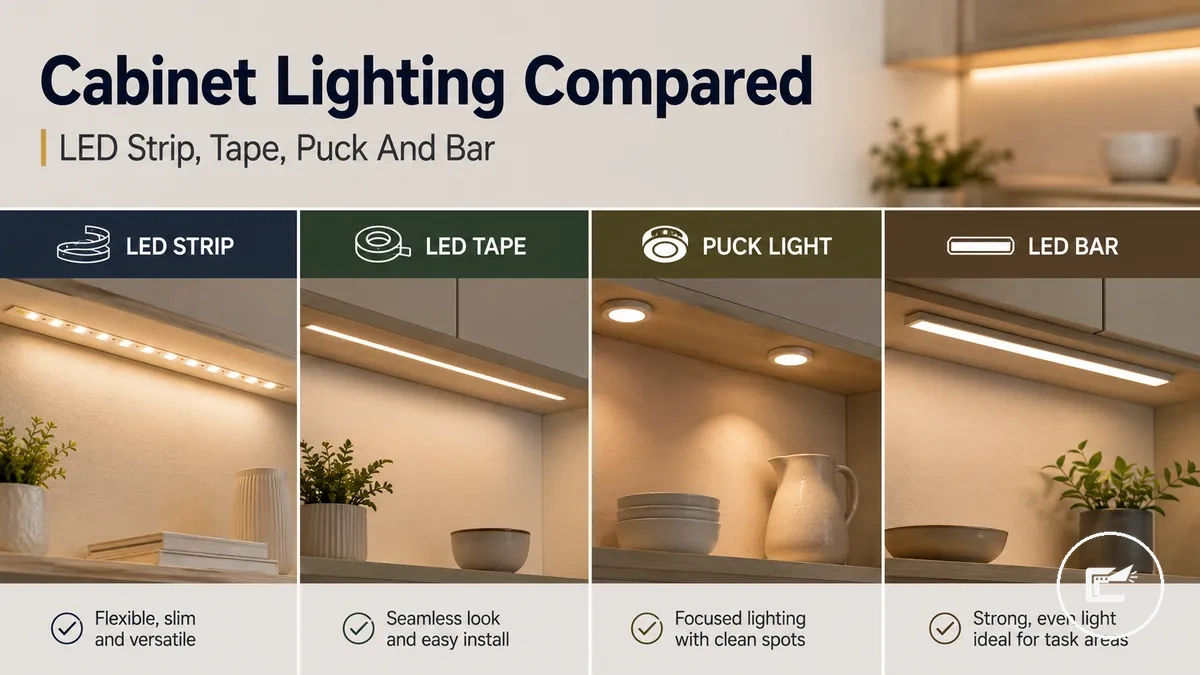
Cabinet lighting types compared in one visual can clarify the visible differences between strips, tape lights, pucks, and light bars before the detailed sections begin.
What each cabinet lighting type is best suited for
Each cabinet lighting type is suited for a different coverage style and cabinet context. LED strips and tape lights usually support continuous coverage, puck lights suit focused lighting or display lighting, and light bars often suit straight under-cabinet lighting for task lighting.
LED strips are flexible linear lights for cabinet runs where a continuous line of light is useful. Tape lights are also flexible and often overlap with strip-style lighting when adhesive backing and a low fixture profile matter. Puck lights act as point light cabinet fixtures where spacing and placement shape the likely outcome, while light bars are rigid under-cabinet fixtures for straight task-lighting areas. What each cabinet lighting type is best suited for is easier to compare when the image labels the visible formats before the table organizes their use cases.
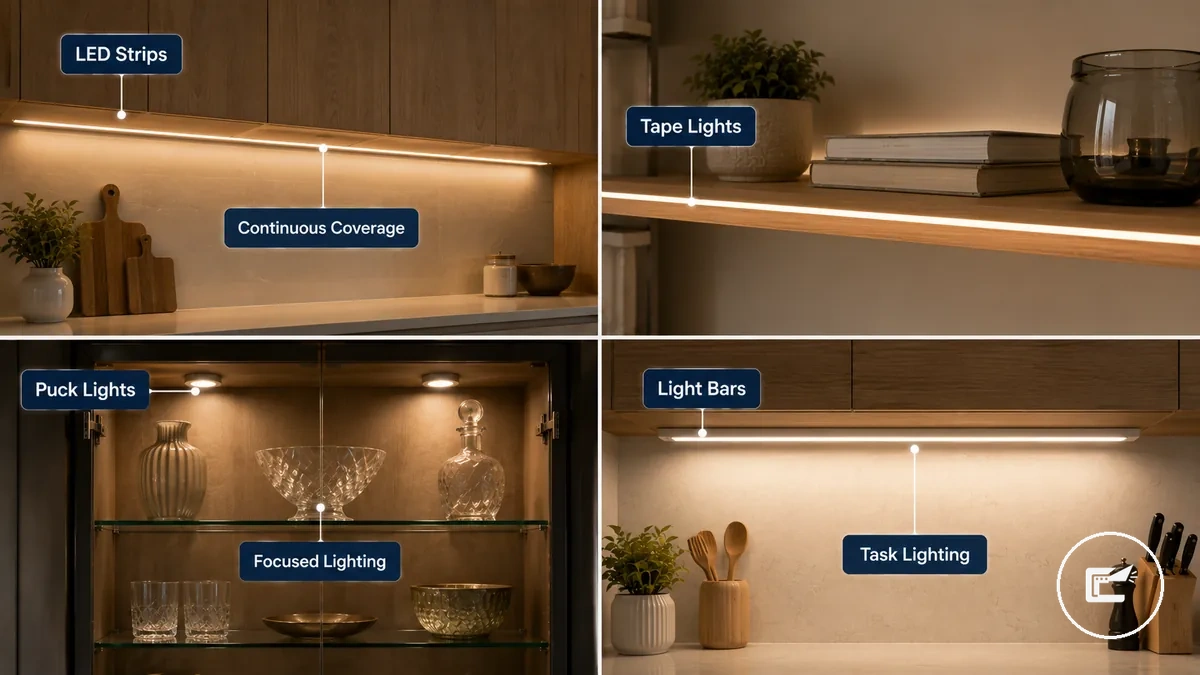
| Lighting type | Best suited for | Main strength | Watch condition |
|---|---|---|---|
| LED strips | Longer cabinet runs that need continuous coverage | Flexible linear light across a wider run | Fit depends on mounting surface, corners, and power access |
| Tape lights | Low-profile cabinet areas where adhesive mounting may help | Flexible, slim coverage for under-cabinet or shelf use | Adhesion and appearance depend on surface condition and fixture visibility |
| Puck lights | Display lighting, accent lighting, and smaller cabinet interiors | Focused lighting that can emphasize objects or zones | Spacing can affect shadows, hotspots, and coverage gaps |
| Light bars | Straight under-cabinet lighting for task surfaces | Rigid fixture shape with a direct task lighting path | Bar length and mounting position need to match the cabinet run |
For a straight work surface, light bars or linear formats may feel more practical; for a shelf or display zone, puck lights or shorter strip sections may fit better when fixture visibility is acceptable. This overview connects back to the home lighting accessories hub before the next sections compare coverage, layout fit, and trade-offs more closely.
LED strips and tape lights for flexible continuous coverage
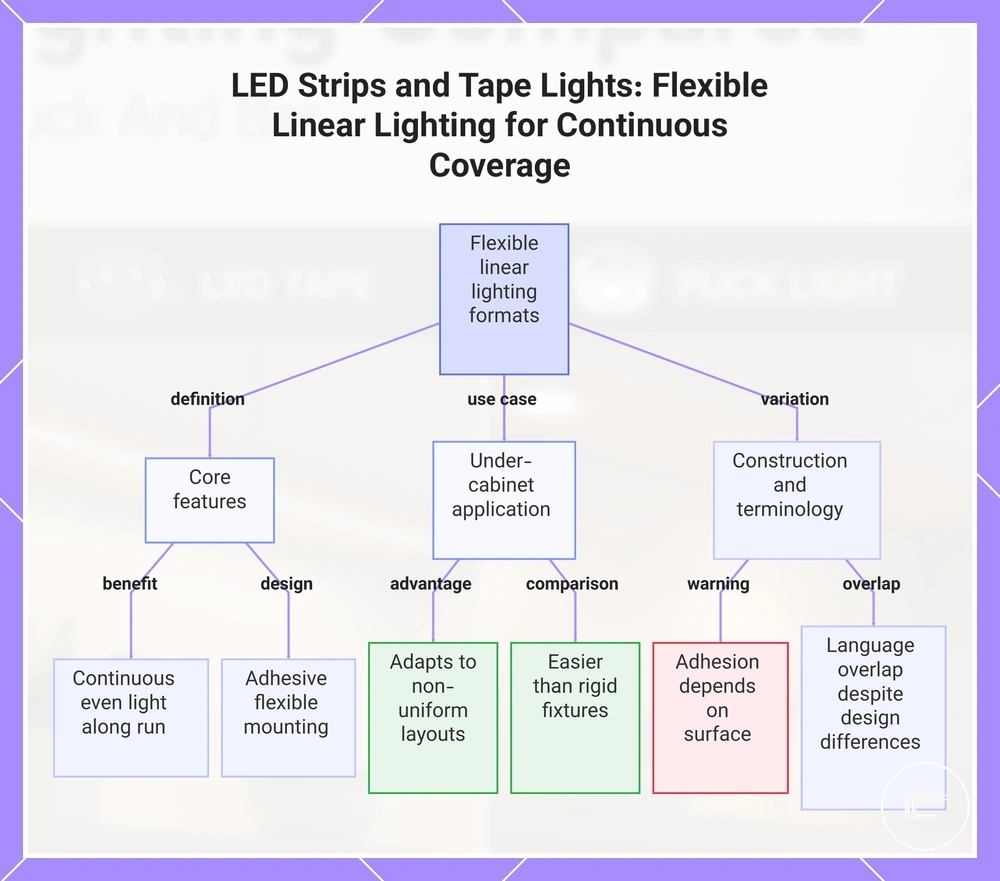
LED strips and tape lights are flexible linear lighting formats used when a cabinet run benefits from an even line of light rather than separate light points. These formats often include adhesive backing for mounting along a cabinet edge, shelf, or under-cabinet lighting surface, although adhesion and layout fit can vary by product design and surface condition. LED strips and tape lights are commonly used because their flexible form can help create continuous coverage across a cabinet run.
When under-cabinet lighting needs to follow a longer or less uniform layout, flexible strip formats may adapt more easily than rigid fixtures. Tape lights and strip lights often overlap in user language even when construction varies, and readers looking for practical examples can explore under cabinet strip lighting use.
This chart explains the key features, primary under-cabinet application, and construction variations of flexible linear lighting formats such as LED strips and tape lights.
Puck lights for focused cabinet and display lighting
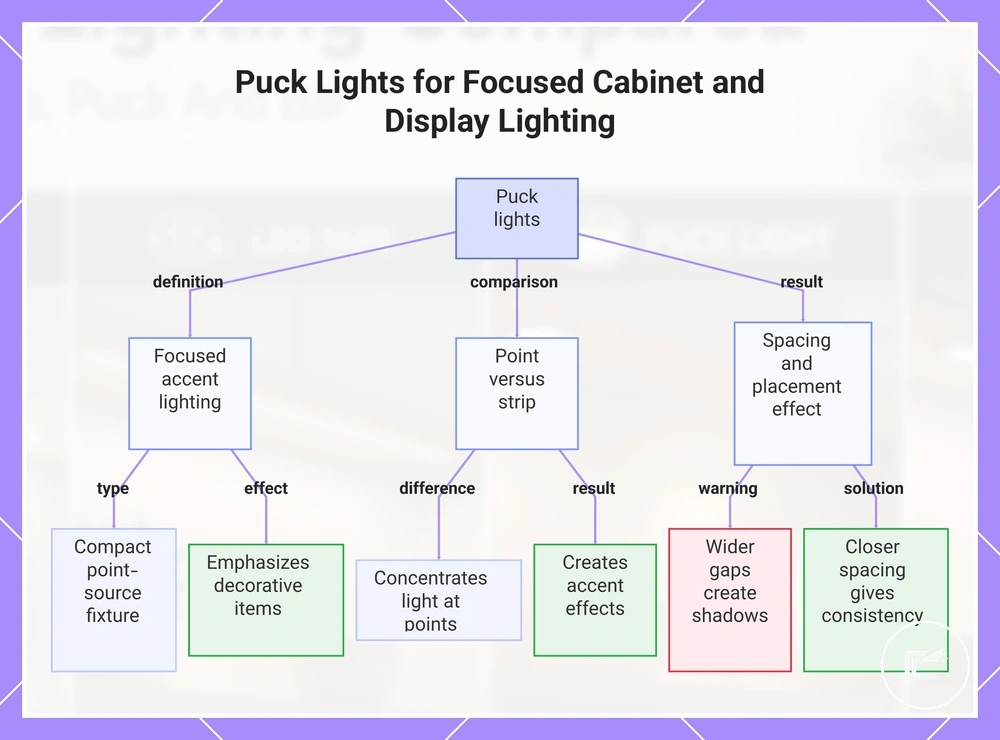
Puck lights are compact point-source fixtures designed for focused lighting inside a cabinet interior or display area. Their beam focus directs light toward a smaller zone, which can help emphasize decorative items, collectibles, or specific storage areas in display lighting. Unlike continuous strip-style lighting that creates a more continuous line of illumination, puck lights concentrate light at individual points for accent effects and object emphasis. The final result depends on spacing and placement, as wider gaps may create shadows while closer positioning can provide more consistent lighting across the cabinet interior.
This chart explains what puck lights are, how they differ from strip lighting, and how spacing affects their lighting result.
Light bars for straight under-cabinet task lighting
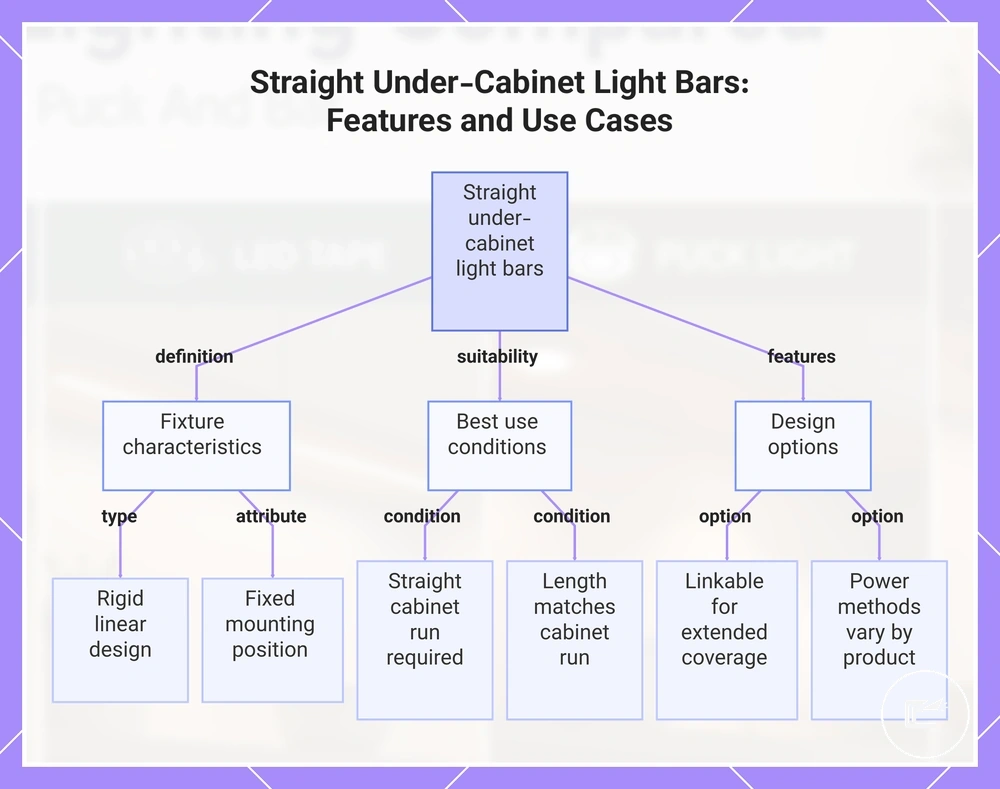
Light bars are a rigid linear fixture used for straight under-cabinet coverage and simple task lighting layouts. Their fixed shape and mounting position can help create a consistent light path along a cabinet edge, while a linkable design may extend coverage when the product supports connection between fixtures. For example, a cabinet light bar with a bar length that closely matches the cabinet run may provide more even task lighting across that area than a shorter fixture. Power methods vary by product, but light bars are often most suitable when the cabinet run is straight and the fixture length fits the layout.
This chart shows the key features of light bars for straight under-cabinet task lighting and the conditions where they perform best.
Tape lights and strip lights as overlapping cabinet lighting formats
Tape lights and strip lights are often overlapping formats in cabinet lighting, and the difference usually depends more on construction, flexibility, adhesive backing, and LED density than on the name itself. A flexible lighting product may be marketed as a tape light or a strip light depending on retailer or manufacturer terminology, so the cabinet lighting label is not always a reliable category boundary.
| Term or feature | How to interpret it |
|---|---|
| Tape light label | Often used for flexible lighting products that may include adhesive backing. |
| Strip light label | Often used for LED strip formats, but the label can overlap with tape lights. |
| Adhesive backing | Provides a clearer indication of mounting style than the product name alone. |
| Flexibility | Helps show how the lighting can adapt to cabinet edges, shelves, or layout changes. |
| LED density | Can influence the visual appearance of coverage and may be more important than the label. |
Tape lights and strip lights are naming terms that may describe similar flexible lighting products. Practical differences often come from construction details, adhesive backing, LED density, or other physical features rather than from the label itself. Because naming varies across manufacturers and retailers, the selection consequence is that physical features usually matter more than the cabinet lighting label when comparing options.
How strips, pucks, and bars differ in light coverage
Strips, pucks, and bars differ in light coverage because their beam pattern, fixture shape, and placement create different lighting outcomes. Strips often produce a broader light spread, pucks create focused lighting zones, and bars provide straight linear coverage along a cabinet run. These differences influence shadows, hotspots, and fixture profile visibility.
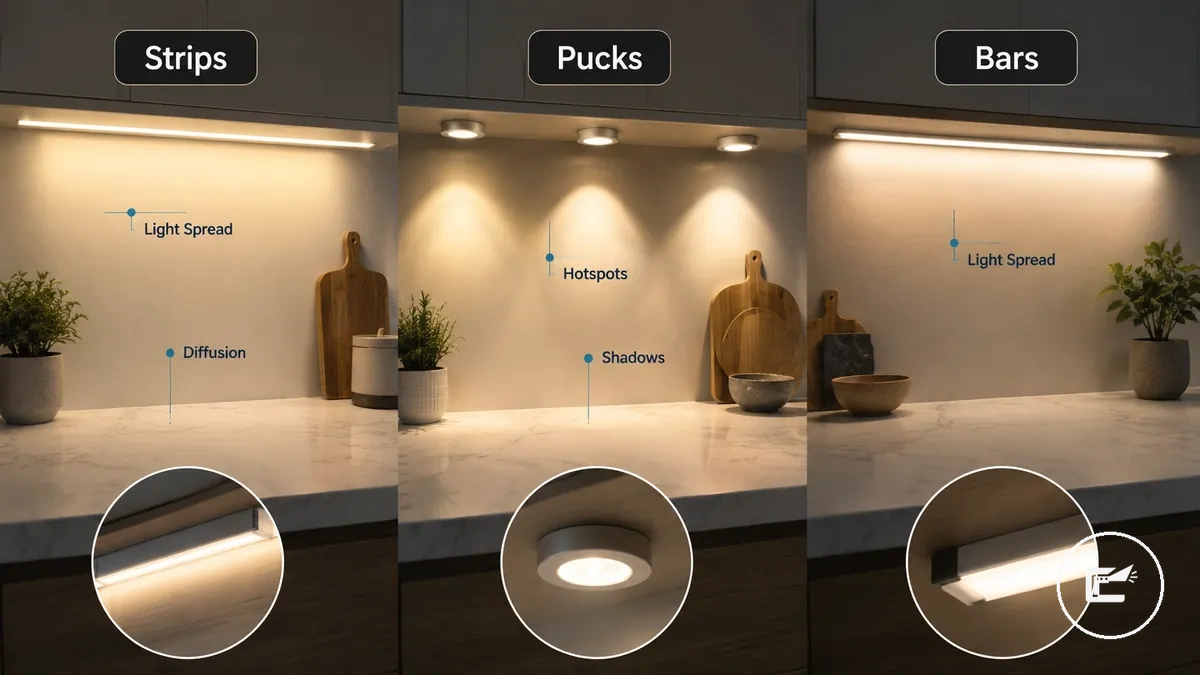
| Format | Coverage pattern | Common risk | Best-fit lighting purpose |
|---|---|---|---|
| Strips or tape | Continuous light spread that may reduce visible gaps when diffusion and placement are suitable | Hotspots may appear when LED density is lower or diffusion is limited | Task lighting and general cabinet illumination |
| Pucks | Focused beam pattern with separated light pools | Shadows and hotspot effects may increase when spacing is wider | Accent lighting and display lighting |
| Bars | Straight coverage from a rigid linear fixture | Coverage may vary when bar length or mounting location does not suit the cabinet run | Task lighting along straight work surfaces |
In a deeper cabinet, placement can change how light reaches the front and rear portions of a shelf or work surface. Strips may appear more continuous when diffusion is present, while pucks can create stronger display emphasis when spacing is intentional. Bars may provide a cleaner linear pattern along a straight surface, but cabinet depth and mounting location can still influence the visual outcome. Placement and diffusion can change the outcome.
When shadows, hotspots, or fixture visibility become noticeable, comparing light quality differences can help explain how diffusion and related factors influence the final lighting effect.
Continuous light versus spotlight effects
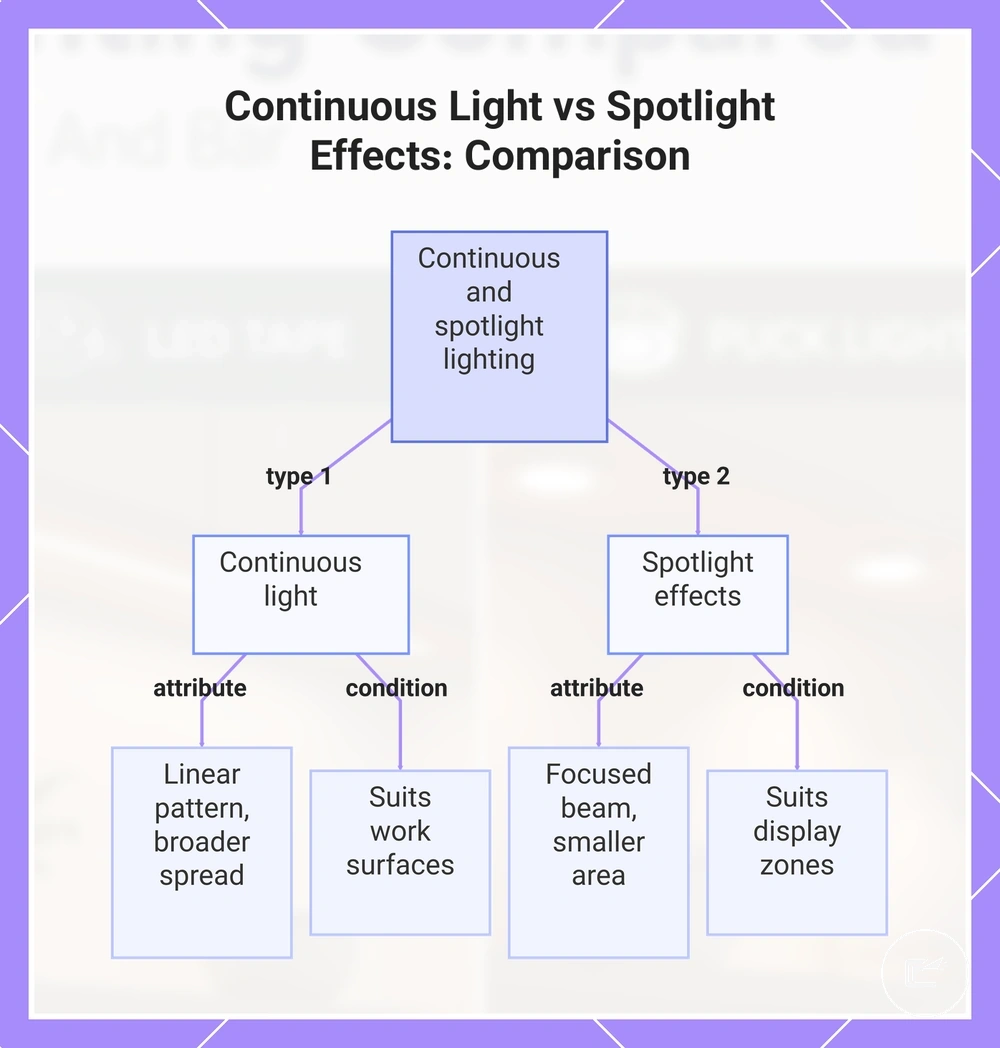
Continuous light creates a linear light pattern with broader spread, while spotlight effects create a focused beam that concentrates light into a smaller area. Continuous light often provides a more consistent line of illumination across a task surface, while spotlight effects can create stronger emphasis within a display zone. The contrast is mainly between linear light spread and focused intensity, with shadows, hotspots, and visual emphasis varying based on placement conditions. For example, continuous light may suit a work surface that benefits from fewer dark gaps, while spotlight effects may suit a display zone where a focused beam draws attention to selected objects.
This chart compares the characteristics and best uses of continuous light and spotlight effects.
Uniform work-surface lighting versus accent emphasis
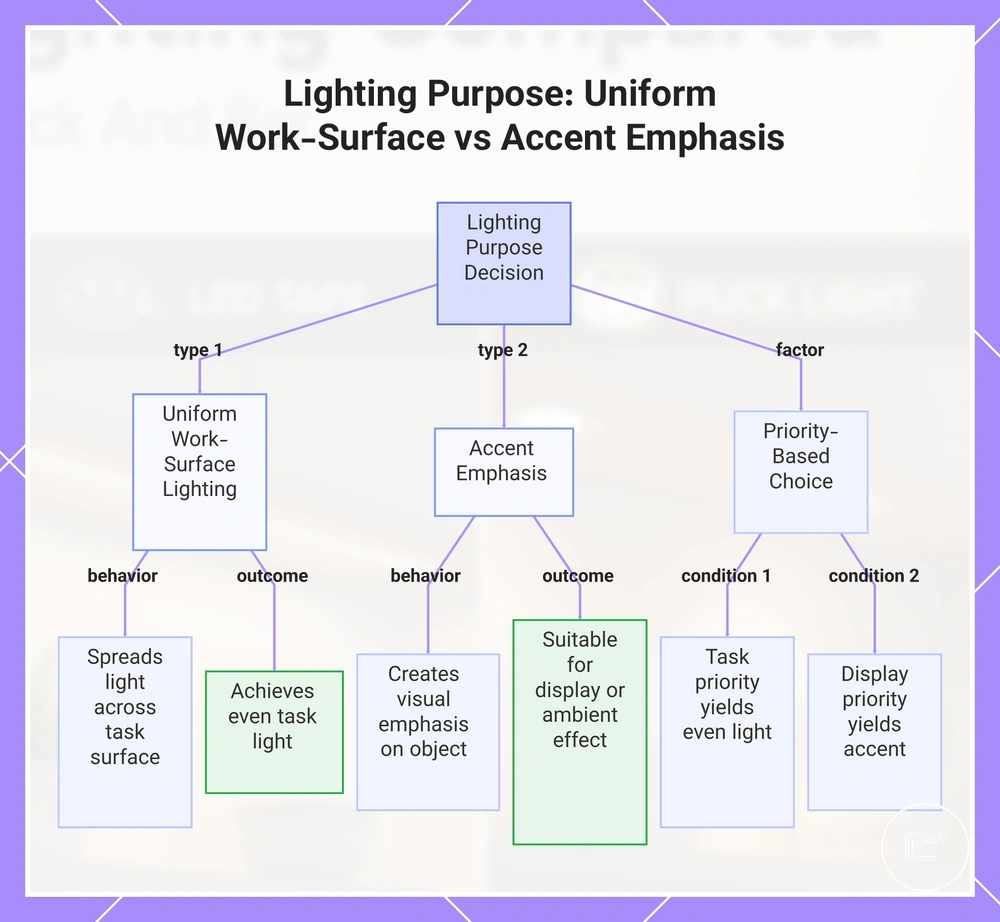
When the goal is uniform work-surface lighting, the desired lighting purpose often favors fixture behavior that spreads light across a task surface rather than concentrating it in one area. When accent emphasis is the priority, fixture behavior that creates visual emphasis around a display object or contributes to an ambient effect may be more suitable. The decision outcome depends on how the lighting purpose aligns with suitable fixture behavior, layout conditions, and fixture placement.
Uniform work-surface lighting is often associated with broader coverage patterns, while accent emphasis is commonly associated with more focused lighting behavior. If task lighting is the priority, even task light across the work surface may be the preferred outcome; if a display object or ambient effect is the priority, accent lighting may be more appropriate.
This chart compares uniform work-surface lighting and accent emphasis, showing how the lighting purpose determines the appropriate choice based on fixture behavior and priority.
Fixture visibility and cabinet appearance
Fixture visibility depends on fixture profile, mounting position, and how the cabinet is viewed from normal sightlines. A slim strip may support better concealment along a mounting edge, while a puck light can remain more noticeable as a visible fixture inside a display cabinet. A rigid bar may create a more defined visible edge because of its housing shape, but the final cabinet appearance depends on cabinet depth, sightlines, and concealment conditions.
| Fixture type | Visibility and appearance outcome |
|---|---|
| Slim strips | Low-profile fixture design may reduce visibility when mounted behind an edge or recessed from common sightlines. |
| Pucks | Visible round fixture shape may remain part of the cabinet appearance, especially in open display areas. |
| Rigid bars | Visible housing and straight fixture profile may be easier to notice when cabinet depth or mounting position offers less concealment. |
Cabinet layout conditions that change the better lighting type
Cabinet layout compatibility depends on how a lighting type fits the physical cabinet layout and desired light path. Cabinet run length, corners, shelves, retrofit constraints, mounting access, and cabinet shape can all change which format provides the most suitable layout fit. Compatibility often depends on cabinet run length, corners, shelves, and retrofit constraints rather than fixture category alone.
Cabinet layout conditions that change the better lighting type are easier to evaluate when straight runs, corners, and shelves are viewed together because each layout condition can favor a different format fit.
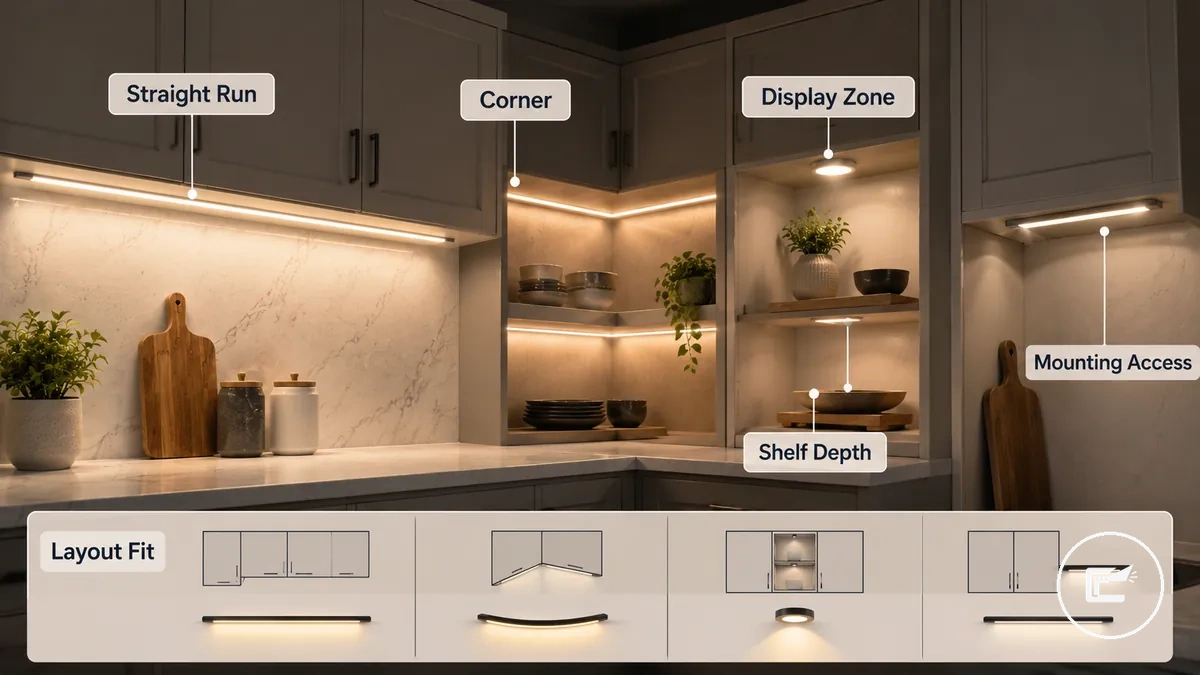
- Straight runs: A long straight section may suit a strip or light bar when continuity along the desired light path is a priority.
- Corners: A flexible strip or tape light may provide a better fit condition when the cabinet layout includes turns or angle changes.
- Shelf depth: Shelf depth can influence placement constraints and may affect which lighting type follows the intended light path more effectively.
- Display zones: A puck light may suit a display area when accent visibility is more important than a continuous lighting path.
- Mounting access: Limited mounting access can reduce format options and change compatibility outcomes.
- Retrofit constraints: Non-permanent or rental-friendly conditions may favor formats that adapt more easily to an existing cabinet layout.
When a cabinet shape combines straight sections, corners, and display shelves, the layout condition often becomes the deciding factor. Evaluating the desired light path before choosing a format can help align the lighting type with the cabinet area, because layout fit depends on physical conditions as much as lighting purpose.
If placement constraints or limited mounting access make selection difficult, a format that adapts to the cabinet shape may offer a more practical fit condition. Wiring and power access can influence compatibility, but they are usually secondary decision cues compared with cabinet layout, mounting access, and the desired light path.
Long cabinet runs and corner sections
Long cabinet runs and corner sections influence format fit because continuity depends on the cabinet shape and lighting path. Straight runs often suit formats that follow an uninterrupted run, while corner sections may benefit from formats that adapt more easily to a turn. Interrupted sections can change continuity outcomes when gaps or cabinet breaks affect placement options. In many cases, strips or tape lights may handle corner turns more flexibly, while light bars can suit longer straight runs when the cabinet run remains relatively uninterrupted.
- Straight runs: A long cabinet run may favor light bars or strips when continuity across a straight section is the primary goal.
- Corner turns: A corner section may provide a more suitable format fit for strips or tape lights when the lighting path needs to follow a turn.
- Interrupted sections: Gaps or layout breaks can affect continuity, so format fit depends on how the cabinet run is divided.
Small cabinets, shelves, and display zones
Small cabinets, shelves, and display zones depend on available space, viewing angle, and object emphasis when determining format fit. In an enclosed cabinet with limited depth, mounting visibility may become a deciding factor because the fixture can remain within the normal viewing angle. For example, a display cabinet used to highlight selected objects may suit a puck light when focused object emphasis is preferred, while shelf lighting may suit a strip when a broader light path is desired. The most suitable format often depends on cabinet depth, mounting visibility, and whether the goal is task light or accent emphasis.
Retrofit and rental-friendly cabinet lighting choices
Retrofit and rental-friendly cabinet lighting choices depend on installation constraints that can limit format selection. Retrofit limits and rental constraints often make non-permanent mounting, power access, and removal needs the primary decision factors before lighting style is considered. These conditions can affect which suitable format fits an existing cabinet setup.
- Removable mounting may be preferred when non-permanent mounting is important.
- A nearby outlet or battery requirement can influence which formats are practical within a retrofit setup.
- Visible cable tolerance may affect format choice when mounting access is limited.
- Surface condition can influence whether a removable setup is likely to be suitable.
- Hardwired assumptions should be avoided when removal needs or rental-friendly constraints are a priority.
When retrofit limits or rental constraints restrict mounting options, a suitable format often depends on outlet access, surface condition, lease-related limits, and product design. Plug-in, battery, and hardwired approaches can influence compatibility, but detailed power-method comparison belongs elsewhere. For a dedicated comparison, see hardwired plug-in and battery options.
Buying trade-offs between strips, tape lights, pucks, and bars
Buying trade-offs between strips, tape lights, pucks, and bars depend on how cost-value is influenced by kit completeness, accessories, setup effort, adjustability, and future expansion. A lower-effort lighting kit may reduce initial setup needs, while a more flexible system may support later layout changes. Cost-value depends on completeness and flexibility rather than price alone.
When a lighting kit includes more of the parts needed for setup, accessory needs may be lower. In other cases, strips, tape lights, pucks, or bars may need additional accessories depending on the intended layout and mounting approach. Kit completeness and accessory needs can therefore shape the value outcome.
| Lighting type | Included or needed parts | Setup effort | Value trade-off |
|---|---|---|---|
| Strips or tape | May need accessories depending on layout goals | Varies by kit completeness and accessory needs | Can support flexibility but may add setup complexity |
| Pucks | May involve multiple fixture components and placement decisions | Can increase when several lighting points are used | May suit focused lighting goals but can require more planning |
| Bars | Often centered around a rigid fixture format | May be lower when the cabinet run matches the fixture shape | Can simplify setup but may offer less adjustability in some layouts |
| Linkable kits | May include parts intended for future expansion | Depends on system design and expansion goals | Can support expandability but may require accessories over time |
When accessory needs change after setup or the cabinet layout evolves, adjustability and future expansion can become more important than the initial package contents. Expandable systems may accommodate later changes more easily, while low-effort kits may prioritize simpler setup. This creates the main distinction between low-effort kits and flexible systems.
If future expansion is unlikely, stronger kit completeness may provide a better cost-value balance because fewer additional parts may be needed. If layout changes, replacement flexibility, or adjustability are expected, a system designed for expansion may provide value through adaptability rather than simplicity. The final decision depends on balancing included parts, accessory needs, setup effort, and future expansion goals.
Here are product examples that may make comparison easier. Before buying, always review the compatibility criteria, essential features, and product details.
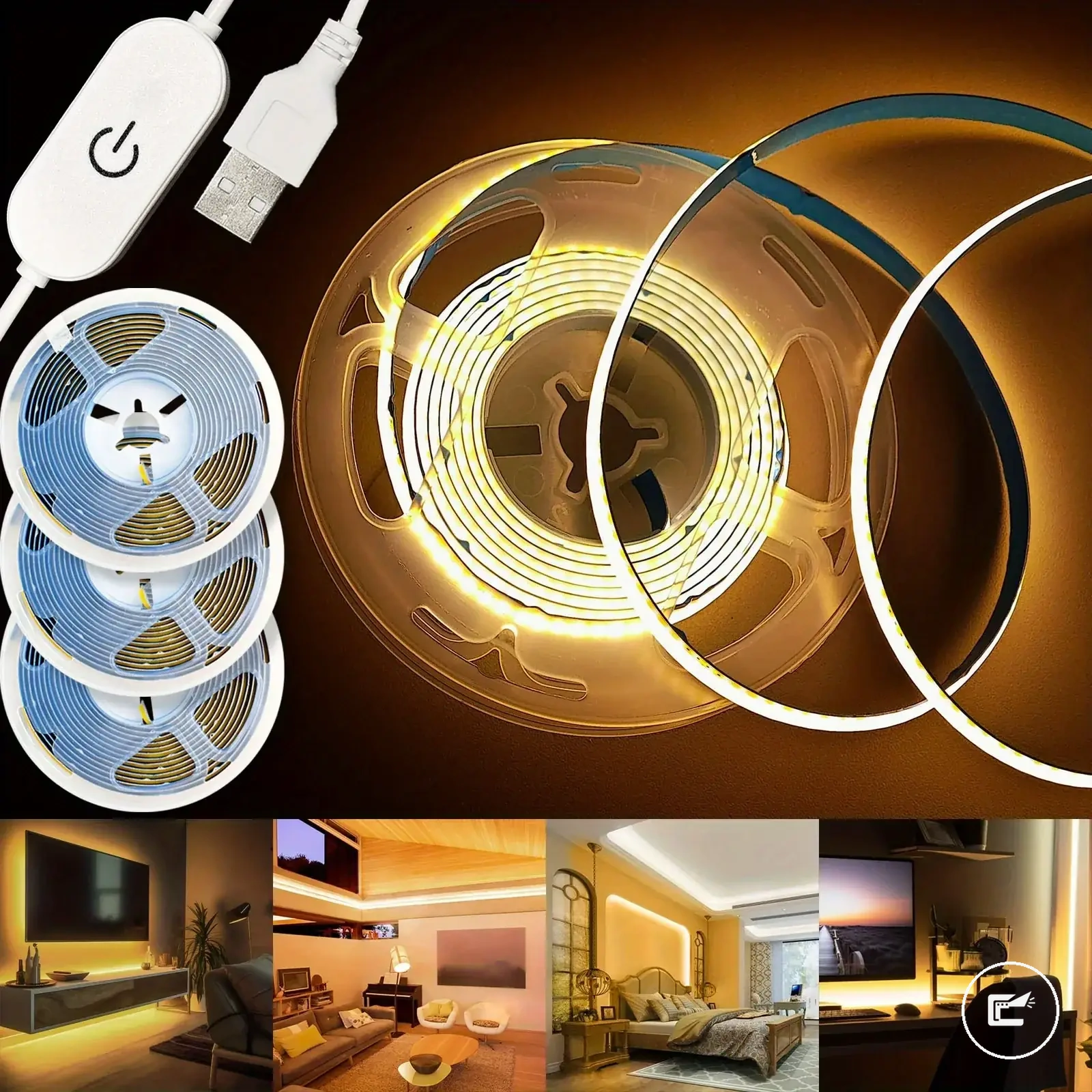
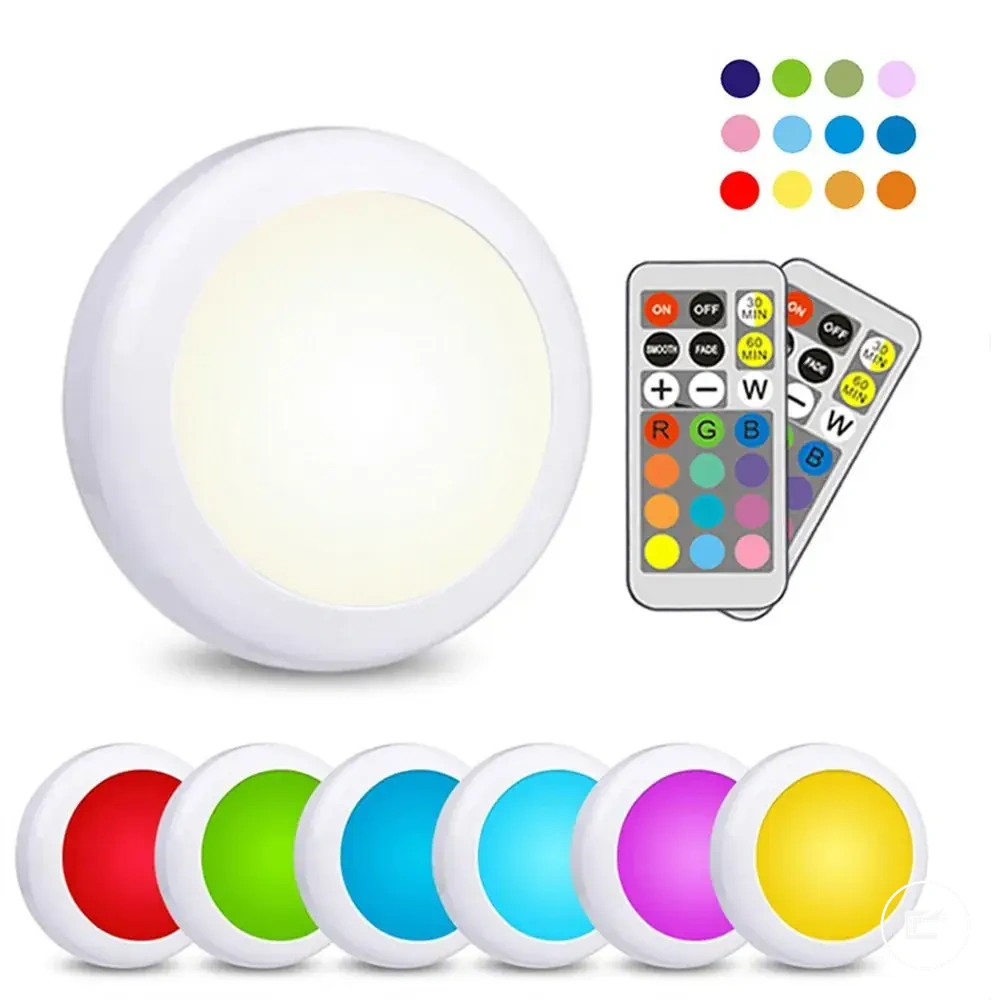
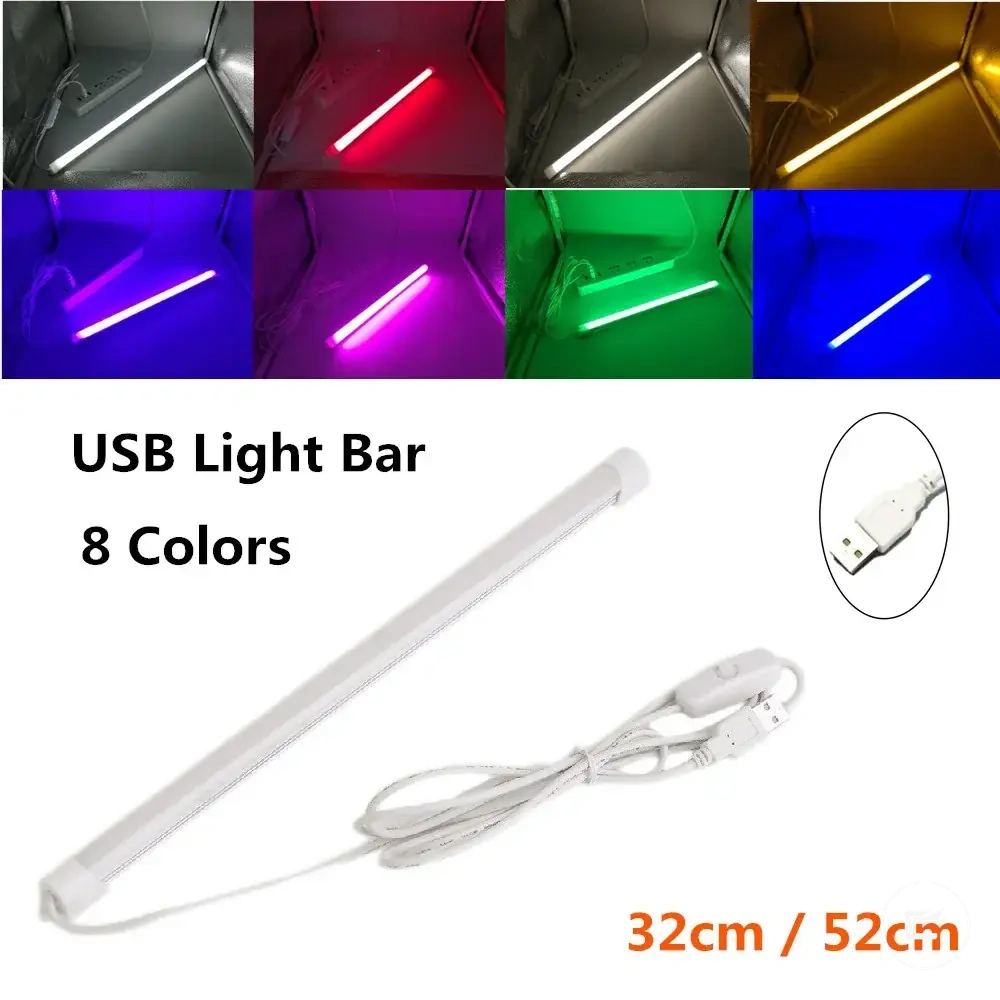
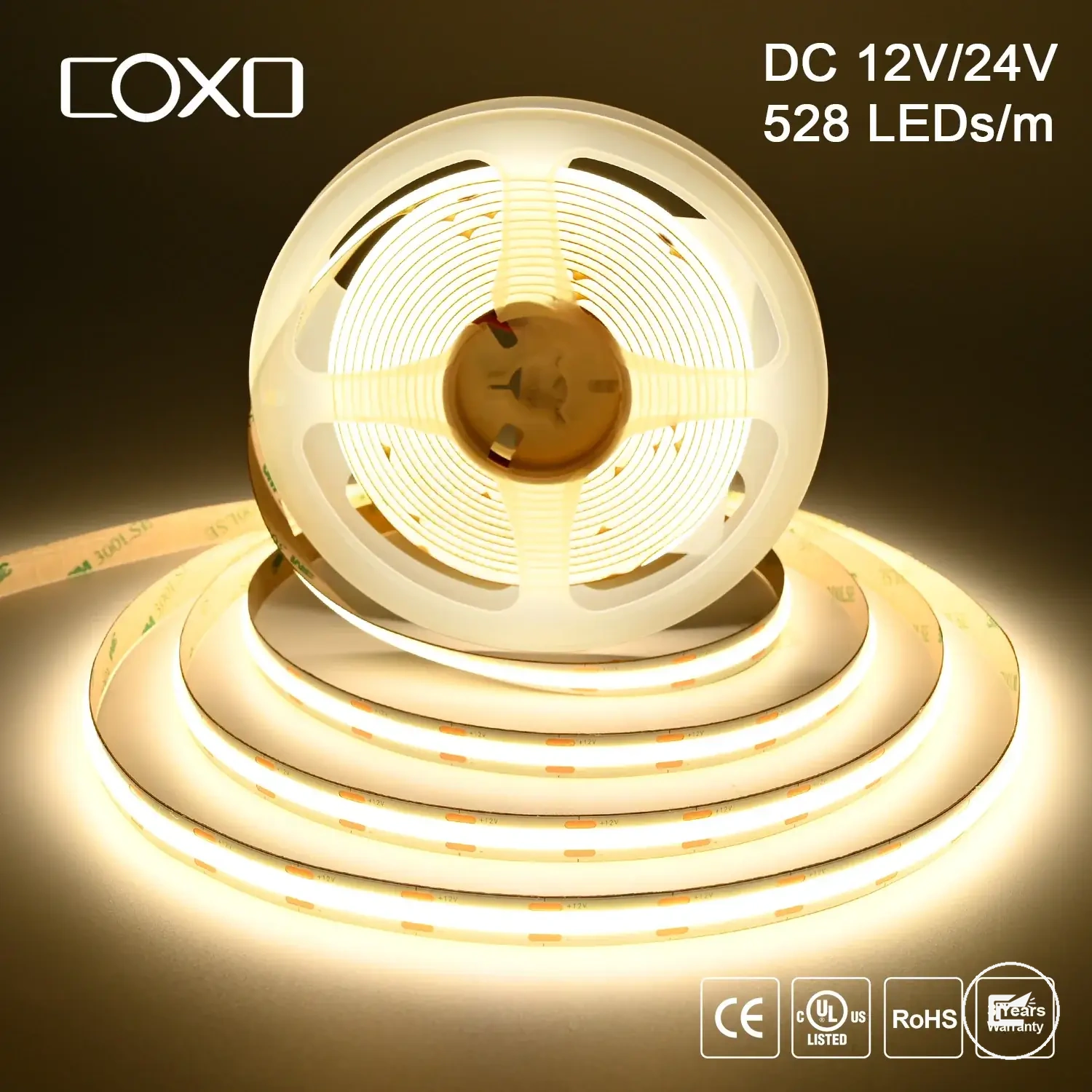
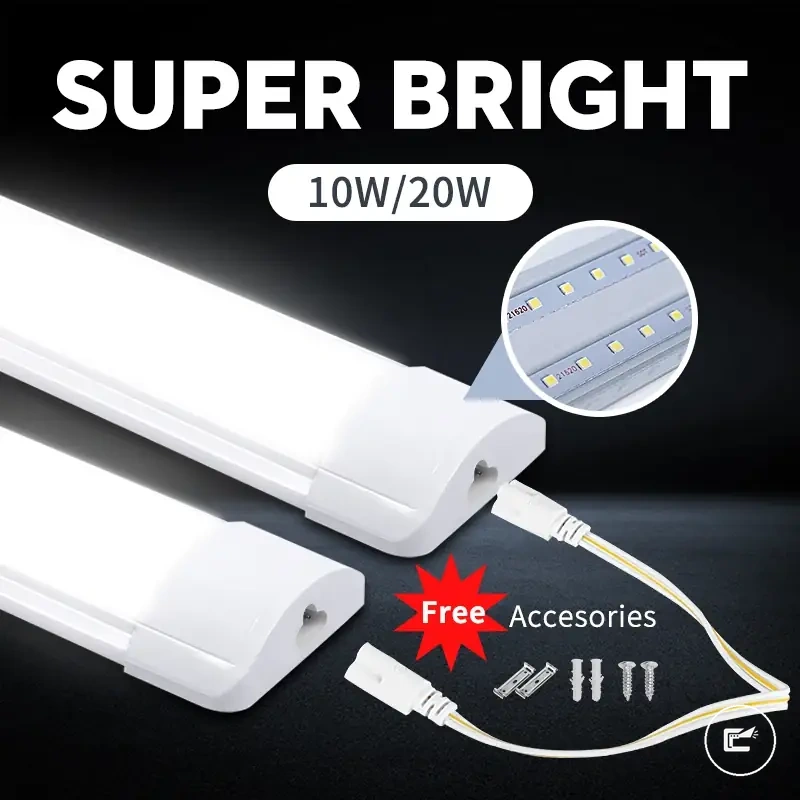
Kit completeness, accessories, and setup effort
Kit completeness depends on whether the included parts match the intended setup, because missing condition items can increase setup effort, require extra accessories, or create a compatibility outcome that needs additional checks. Included parts such as the light source, power part, controller, connector, and mounting accessory influence how much preparation is needed before installation. A lighting kit with fewer missing components may reduce setup complexity. If a cheaper kit lacks a required controller, connector, or mounting accessory, extra accessories may be needed before a usable setup is possible.
- Light source: An included strip or fixture can reduce setup effort when it matches the planned cabinet area.
- Power part: A missing power component may require an extra purchase before installation can proceed.
- Controller: A controller may be necessary depending on the desired control method and lighting kit contents.
- Connector: A missing connector or link cable can affect compatibility when separate lighting sections need to be joined.
- Mounting accessory: A missing mounting accessory may increase setup effort and limit placement options.
Flexibility, replacement, and future expansion
Flexibility, replacement, and future expansion depend on how a lighting format supports adjustability, replaceability, and later changes to the setup. A lighting format with adaptable components may offer greater long-term value when needs change over time, while a more fixed design can create limitations. Long-term convenience often depends on whether replacement options and expansion conditions remain practical. This relationship between flexibility and adaptability can influence long-term value.
- Future expansion: Expandability may depend on connector availability and whether the system uses a linkable design.
- Replacement: Replaceable parts can support long-term convenience when suitable replacement options remain available for the same system.
- Adjustability: An adjustable setup may accommodate a future layout change more easily when the system can be modified safely within its intended design limits.
When a future layout change becomes necessary, replacement and expansion needs can become more important than the original configuration. Long-term value depends on conditions such as connector availability, linkable design, and whether the system can be modified safely without exceeding its intended design boundaries.
Which cabinet lighting type to choose by use case
Choosing a cabinet lighting type depends on lighting purpose, cabinet layout, visibility preference, and setup tolerance. A format that suits one use case may involve different trade-offs in another. The better choice depends on the specific use case and physical conditions.
For under-cabinet task lighting, the goal is often broader and more uniform coverage across a work surface. For display lighting, accent emphasis and viewing angle may be more important than continuous illumination. A rental-friendly setup may prioritize removability and simpler setup expectations, while an expandable system may prioritize future changes. These differences are easier to evaluate through a decision matrix.
| Use case | Likely better format | Why it fits | Trade-off to check |
|---|---|---|---|
| Under-cabinet task lighting | Strip or bar | May support more uniform coverage across a work area | Cabinet layout and visibility preference can affect the result |
| Display lighting | Puck | May create stronger accent emphasis on selected objects | Focused lighting can create visible light pools |
| Small cabinet or shelf | Strip or puck | Use-case fit depends on coverage needs and viewing angle | Fixture visibility may influence the format choice |
| Rental-friendly setup | Plug-in or battery-supported format | May align better with removable setup preferences | Setup tolerance and power access remain important |
| Expandable system | Linkable format | May support future changes when expansion is planned | Expansion depends on connector availability and system design |
If multiple requirements compete, the format choice should follow the primary lighting purpose and physical conditions. Task lighting, display lighting, rental-friendly setup needs, and expandable system goals each shift the selection criteria. For a broader selection approach beyond format comparison, see choose by room and purpose.
Here are product examples that may make comparison easier. Before buying, always review the compatibility criteria, essential features, and product details.