
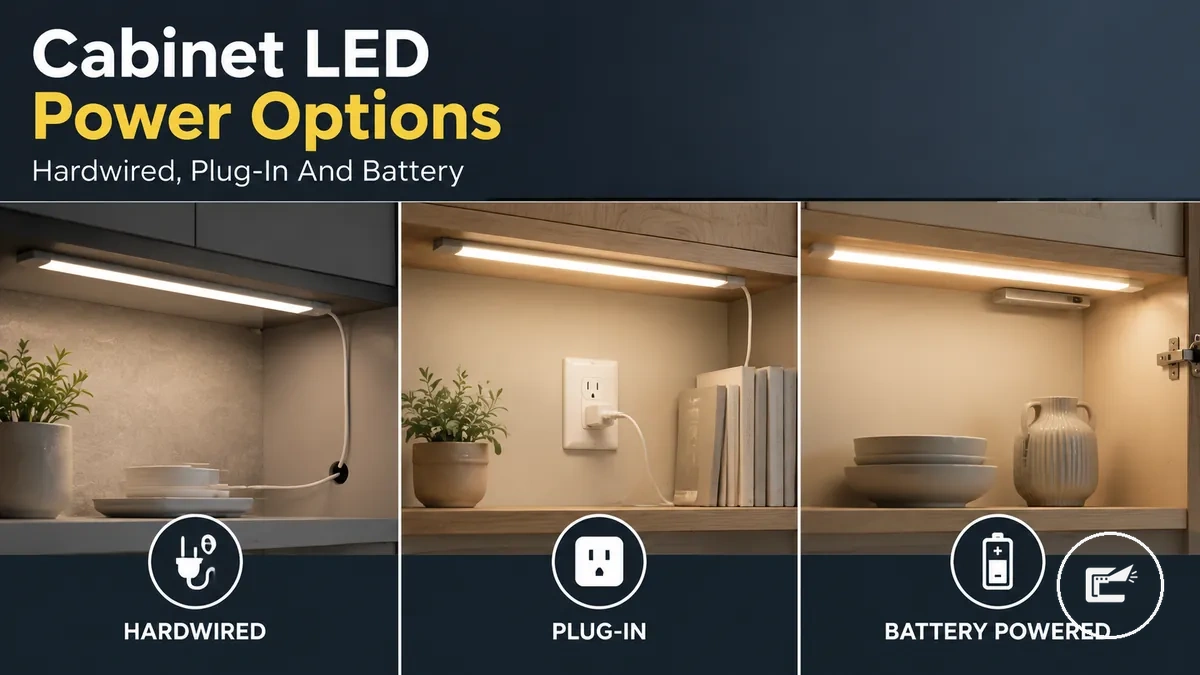
Cabinet LED lighting power methods compared
Cabinet LED lighting power methods depend on permanence, outlet access, wiring tolerance, brightness needs, runtime expectations, and safety constraints. No single power method fits every cabinet setup because cabinet layout, low-voltage requirements, fixture type, and installation conditions can change the right choice. The most suitable decision depends on how the lighting will be powered and used over time.
Power methods are the power-source options that supply cabinet LED lighting, including hardwired, plug-in, battery, rechargeable, and USB-powered setups. A hardwired or direct-wire system receives power through fixed wiring, while a plug-in system uses an outlet, adapter, or power supply. Battery, rechargeable, and USB-powered options rely on stored or supplied power without permanent wiring. Within home LED strip and cabinet lighting accessories, the selected power method can influence installation approach, maintenance expectations, and daily operation.
In a cabinet where hidden wiring is practical, a hardwired setup may align with a more permanent lighting plan. In a space with limited outlet access, temporary use, or changing layouts, a plug-in, battery, rechargeable, or USB-powered solution may provide a different balance between flexibility and runtime. The sections below compare these choices through a decision-focused lens rather than a product-focused one.
A power method should not be confused with the lighting format itself. Cabinet LED lighting can use strips, bars, puck lights, or other fixture styles, while the power method determines how electricity reaches the light rather than how the fixture is shaped or mounted.
What the power method changes in cabinet LED lighting
What the power method changes in cabinet LED lighting is how power reaches the fixture and what conditions come with that power source. A cabinet LED lighting power method can influence installation condition, visibility of cords or hardware, maintenance needs, and available control options.
A power source may use direct wiring, an outlet plug, a battery pack, a rechargeable pack, USB power, or a low-voltage driver. Each power method creates different requirements for wiring access, charging, adapters, switches, or hidden hardware. These differences may affect convenience, maintenance, and control depending on the cabinet layout and use case. Power source selection is different from fixture format, brightness quality, and full installation technique.
What the power method changes in cabinet LED lighting becomes clearer when installation, visibility, reliability, and control are viewed together. Fixture styles are compared separately in cabinet lighting formats, which helps distinguish power methods from fixture formats. The comparison block below organizes the main effect areas without replacing the detailed method-by-method sections that follow.
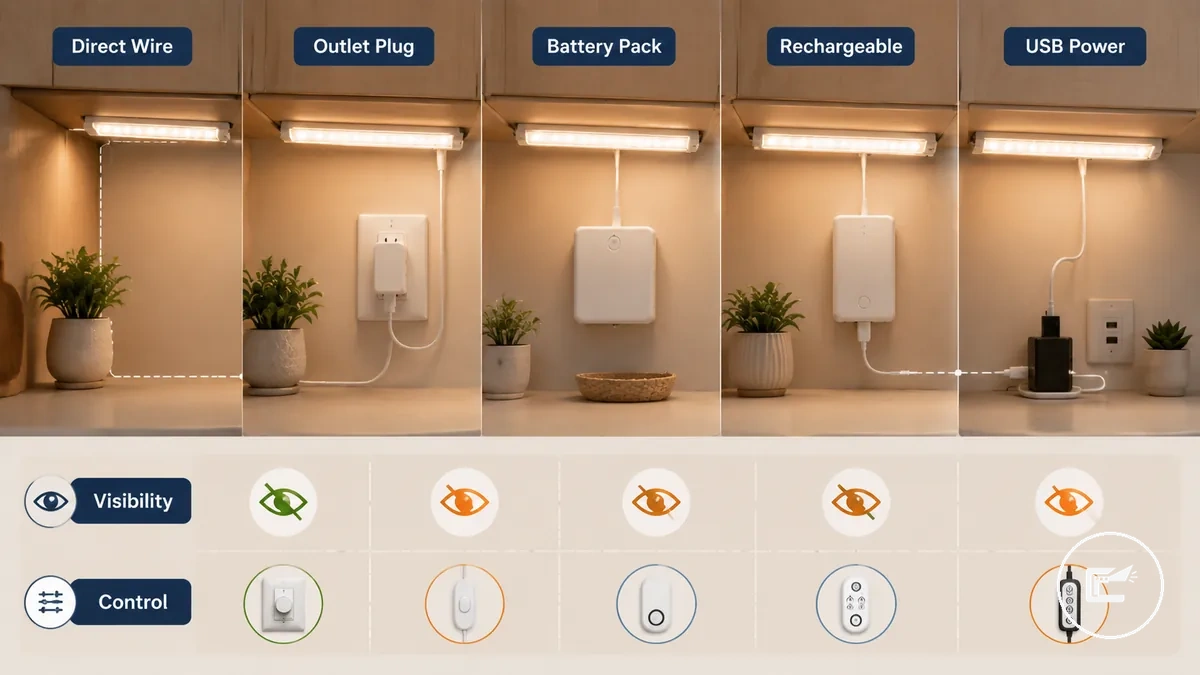
| Power method | What changes | What to check |
|---|---|---|
| Direct wiring | May use hidden wiring and switch-based control with less visible hardware | Wiring access, low-voltage driver requirements, installation condition |
| Outlet plug | Uses an outlet-powered adapter and may leave a visible cord | Outlet location, cord visibility, placement options |
| Battery pack | Runs from stored charge and may increase maintenance needs | Runtime expectations, battery replacement needs |
| Rechargeable pack | Uses rechargeable stored power and requires charging intervals | Charging access, maintenance routine, usage pattern |
| USB power | Receives power from a USB source and may depend on cable routing | USB power availability, cable visibility, control method |
Hardwired cabinet LED lighting for permanent direct-wire setups
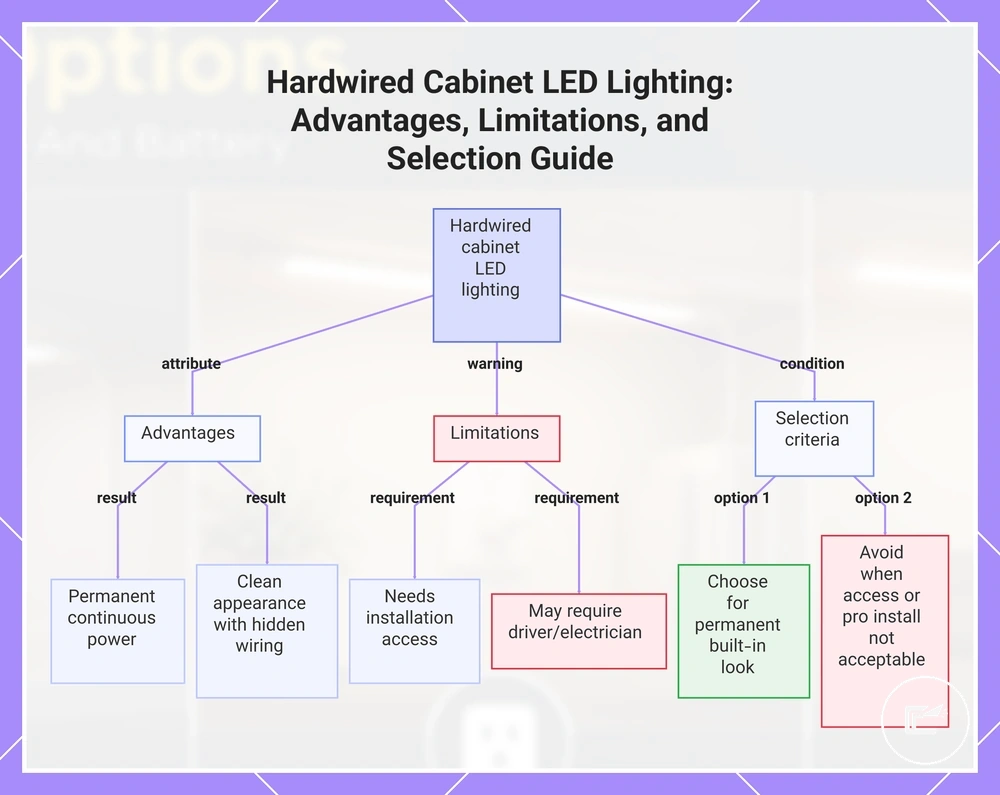
Hardwired cabinet LED lighting fits a permanent setup when continuous power, hidden wiring, and fixed control are priorities. A direct-wire connection can support switch or dimmer integration while reducing visible cables in many cabinet layouts. Hardwired cabinet LED lighting is most suitable for permanent installations when proper installation access is available.
In kitchens, built-in cabinetry, and renovation projects, hardwired cabinet LED lighting is often considered when a clean appearance is important. A mains-connected or driver-based system may keep wiring and related hardware out of sight, depending on cabinet construction and access. Integration with a switch or dimmer can also fit more naturally into a fixed installation plan. Hidden wiring and integrated control are common reasons permanent setups use this power method.
Hardwired cabinet LED lighting depends more on installation access than plug-in or battery-powered alternatives. A low-voltage driver, power supply compatibility, fixture design, and site conditions can affect whether a direct-wire setup is practical. Electrician involvement may be needed in some situations, and safety depends on correct installation, compatible components, and local requirements. When access is limited or professional work is not acceptable, another power method may be easier to accommodate.
Hardwired cabinet LED lighting for permanent direct-wire setups changes the balance between permanence, hidden wiring, control integration, and installation dependency. The points below summarize the main advantages and limitations.
- Advantage: Supports a permanent setup with continuous power availability.
- Advantage: Hidden wiring may reduce visible cords and related hardware.
- Advantage: Can integrate with a switch or dimmer when the system is compatible.
- Limitation: Installation access is usually more important than with plug-in or battery-powered options.
- Limitation: A low-voltage driver or power supply may be required depending on the lighting system.
- Choose hardwired when: The cabinet installation is permanent and a built-in appearance is a priority. Avoid hardwired when wiring access or professional installation involvement is not acceptable.
This chart summarizes the main advantages, limitations, and selection criteria for hardwired cabinet LED lighting in permanent direct-wire setups.
Plug-in cabinet LED lighting for outlet-powered flexibility
Plug-in cabinet LED lighting depends on outlet access and is often suitable when a removable setup is preferred. An outlet-powered adapter supplies power through a nearby outlet, which can make relocation or removal easier in certain cabinet layouts. Plug-in cabinet LED lighting is defined by outlet position, adapter placement, cord routing, and the flexibility available from an outlet-powered connection.
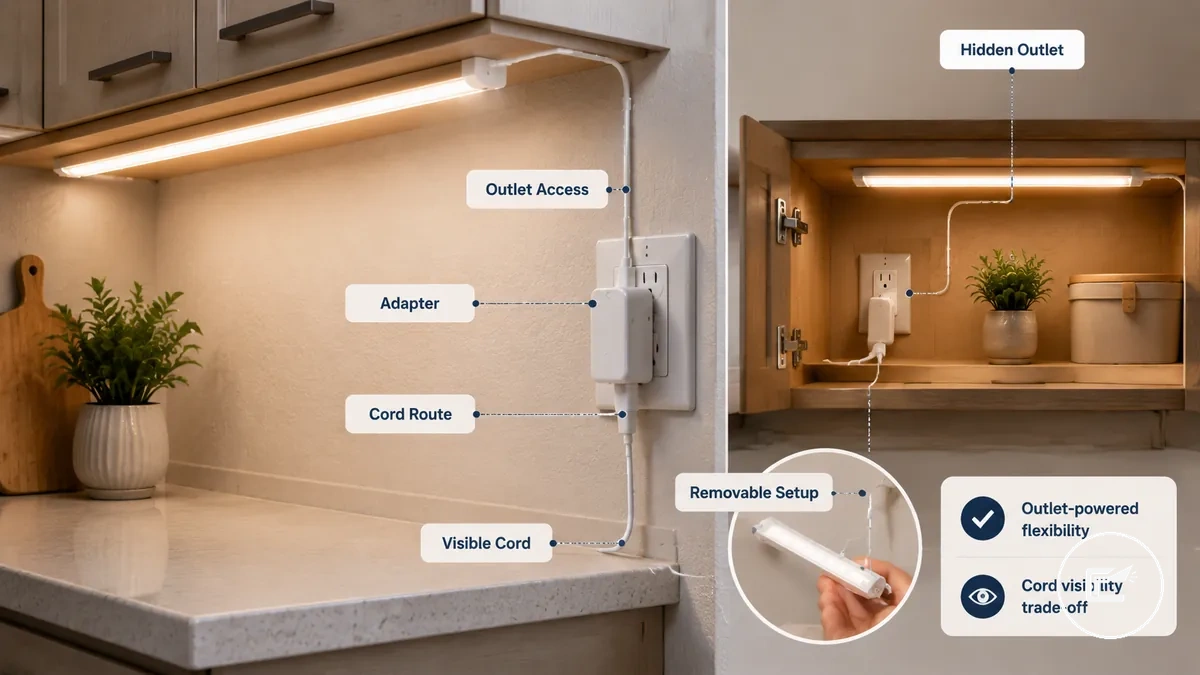
In rental spaces, temporary setups, or cabinets with a nearby hidden outlet, plug-in cabinet LED lighting may fit without requiring a permanent installation approach. A hidden outlet can help reduce the visibility of cords and adapters because more of the power connection may remain out of sight. When the outlet is exposed or positioned farther away, cord routing can become more noticeable. This visible-cord trade-off is often the main compromise behind outlet-powered flexibility.
Plug-in cabinet LED lighting relies on an adapter, outlet position, and cord route working together to support the intended layout. Control convenience may improve when the outlet and adapter are easy to access, while placement constraints can become more noticeable when space is limited. Voltage and load should still be checked before treating different plug-in lighting systems as interchangeable.
Plug-in cabinet LED lighting for outlet-powered flexibility is easier to evaluate when outlet access, cord routing, and adapter placement are viewed together. The table below organizes those trade-offs.
| Condition | Advantage | Limitation |
|---|---|---|
| Nearby hidden outlet | May support a cleaner appearance with less visible hardware | Still depends on outlet access and adapter fit |
| Rental or temporary setup | Removable setup may be easier to relocate or remove | Cord routing may remain visible depending on cabinet layout |
| Accessible outlet position | Can improve outlet-powered convenience | Adapter placement may affect available space |
| Visible or difficult-to-hide outlet | Can still provide power to the lighting system | Cord visibility may become more noticeable |
| Compatible power requirements | Supports normal operation when requirements match | Voltage and load still require verification |
Battery, rechargeable, and USB cabinet LED lighting for wire-free setups
Battery, rechargeable, and USB cabinet LED lighting for wire-free setups depends on placement flexibility, charging expectations, and how often the lighting is used. Battery cabinet LED lighting, rechargeable cabinet LED lighting, and USB-powered options can fit locations where wiring access is limited or a low-commitment installation is preferred. These wire-free setups are often most suitable when placement freedom matters more than continuous output.
Battery cabinet LED lighting uses stored power that is replaced when depleted, while rechargeable cabinet LED lighting uses a rechargeable pack that requires periodic charging. USB-powered lighting receives USB power from a wall adapter, cable connection, or portable power source, depending on the design. Motion sensor operation may influence runtime and charging frequency, while brightness stability can vary with power capacity and usage conditions. These characteristics help distinguish disposable battery, rechargeable, and USB-powered behavior.
In closets, display cabinets, dark corners, and motion-triggered areas, wire-free lighting may be selected because placement is not limited by fixed wiring. Battery-operated and cordless options can improve placement flexibility where cable routing is inconvenient, while USB-powered lighting may suit locations with access to USB power. Runtime and charging limits remain relevant because power availability depends on the selected power source and usage pattern.
Battery, rechargeable, and USB cabinet LED lighting for wire-free setups is easier to compare when runtime, charging, and placement flexibility are considered together. The table below summarizes the main differences.
| Wire-free option | Power behavior | Main trade-off | Best-fit use |
|---|---|---|---|
| Battery cabinet LED lighting | Uses replaceable stored power | Runtime depends on battery condition and usage | Dark corners and occasional-use cabinets |
| Rechargeable cabinet LED lighting | Uses a rechargeable pack with recurring charging | Requires charging intervals | Closets, display cabinets, and regular-use areas |
| USB-powered wall connection | Receives USB power from a nearby source | Placement depends on cable reach | Cabinets near accessible USB power |
| USB power bank connection | Uses portable stored USB power | Power source still requires recharging | Temporary or movable cabinet lighting |
| Magnetic charging designs | Allow removal for charging and reattachment | Charging access remains necessary | Motion sensor and low-commitment setups |
Comparison criteria for cabinet lighting power methods
Comparison criteria for cabinet lighting power methods depends on cabinet conditions, usage patterns, and installation constraints rather than a single preferred option. Installation access, outlet position, low-voltage compatibility, wire visibility, brightness stability, runtime, charging burden, controls, safety, cost, and upkeep can each influence the final decision. These comparison criteria provide the safest way to compare power methods.
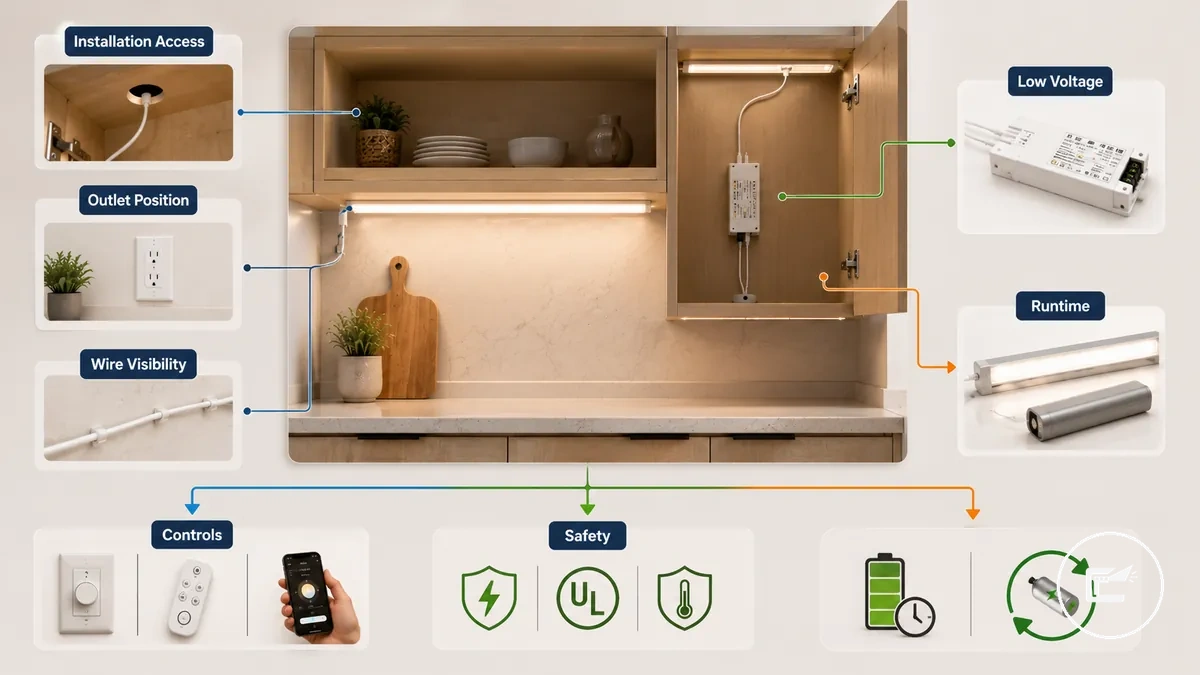
In a cabinet with limited wiring access, installation access may affect the decision more than runtime. In a cabinet with concealed outlet access, outlet position and wire visibility may matter less than controls or upkeep. Comparison criteria for cabinet lighting power methods become easier to evaluate when each condition is connected to the decision it changes, as shown in the table below.
| Criterion | What to check | Power methods affected | Decision effect |
|---|---|---|---|
| Installation access | Available access for wiring, drivers, or electrical work | Hardwired and plug-in | May determine whether a fixed installation is practical |
| Outlet position | Distance, visibility, and accessibility of the outlet | Plug-in and USB-powered | Can affect cord routing and placement options |
| Low-voltage compatibility | Power supply, driver, and system compatibility | Hardwired and selected plug-in systems | May influence system suitability |
| Wire visibility | Ability to conceal cords, adapters, or wiring | Hardwired, plug-in, and USB-powered | Can affect appearance-related decisions |
| Brightness stability | How power conditions may influence lighting consistency | Battery, rechargeable, and USB-powered | May affect expectations for regular use |
| Runtime | Available operating time before replacement or recharging | Battery and rechargeable | Can influence maintenance burden |
| Charging burden | Frequency and convenience of charging access | Rechargeable and selected USB-powered systems | May affect long-term convenience |
| Controls | Available switch, dimmer, sensor, or control options | All power methods | Can influence daily operation preferences |
| Safety | Power-source requirements, voltage compatibility, and installation conditions | All power methods | May affect which setup is appropriate for the location |
| Cost and upkeep | Replacement, charging, or maintenance burden over time | All power methods | Can influence long-term ownership considerations |
Comparison criteria are most useful when each factor is evaluated against the actual cabinet layout and daily use pattern. The importance of any threshold depends on cabinet conditions, usage frequency, and the level of upkeep that is acceptable.
Installation access and electrical work
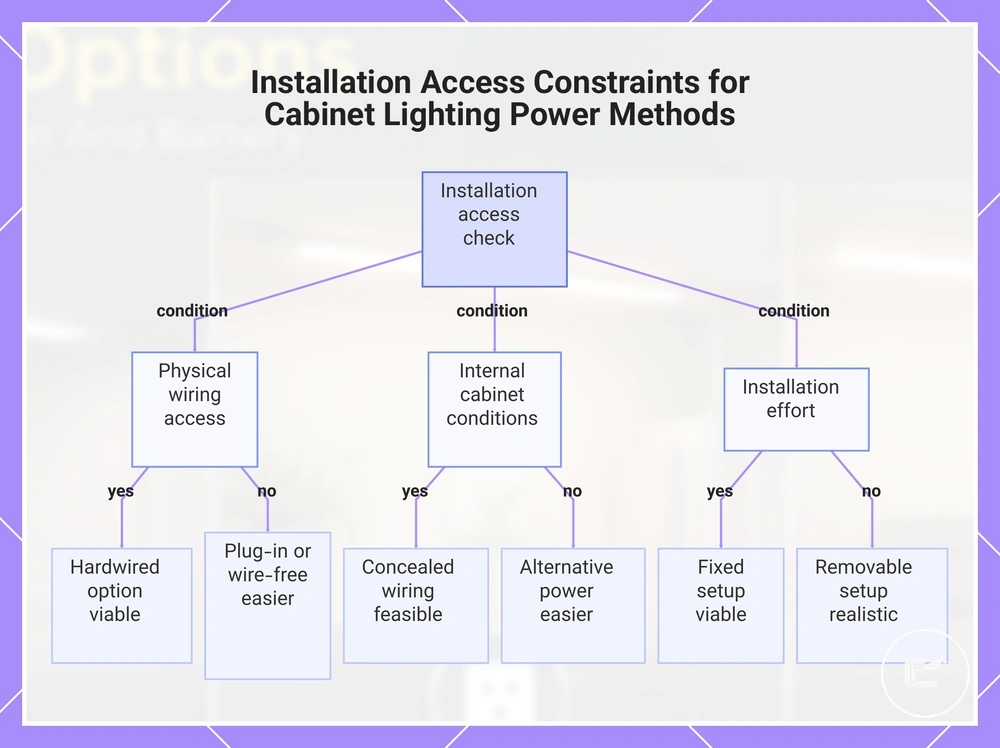
Installation access and electrical work determine whether hardwired, plug-in, or wire-free cabinet lighting is a realistic option. Cabinet back access, wall proximity, outlet proximity, driver location, and mounting surface conditions can limit or expand the available choices. These access constraints often narrow the power-method decision before other criteria are considered.
When wiring access is limited, a non-invasive setup may be more practical than a fixed setup. When cabinet construction supports concealed wiring and suitable driver location, additional installation paths may remain available. Installation access and electrical work become easier to evaluate when each access constraint is checked against the available options. For broader installation requirements, use the checklist below as an initial feasibility check.
- Yes: Cabinet back access is available → a hardwired option may remain realistic when hidden wiring is preferred. No: Plug-in or wire-free options may be easier to accommodate.
- Yes: Wall proximity supports power routing → more fixed setup options may remain available. No: Access constraints may favor less invasive alternatives.
- Yes: Outlet proximity is convenient → a plug-in option may be practical. No: Cord-routing limitations may affect feasibility.
- Yes: Driver location can be accommodated within the layout → hardwired systems may remain under consideration. No: Other power methods may be easier to manage.
- Yes: The mounting surface supports the intended fixture placement → more installation choices may remain available. No: Fixture and power-method options may become more limited.
- Yes: Professional work is acceptable if needed → fixed installation approaches may remain viable. No: A removable setup may be the more realistic direction.
This chart shows how different installation access conditions influence the feasibility of hardwired, plug-in, or wire-free cabinet lighting options.
Cord visibility and outlet placement
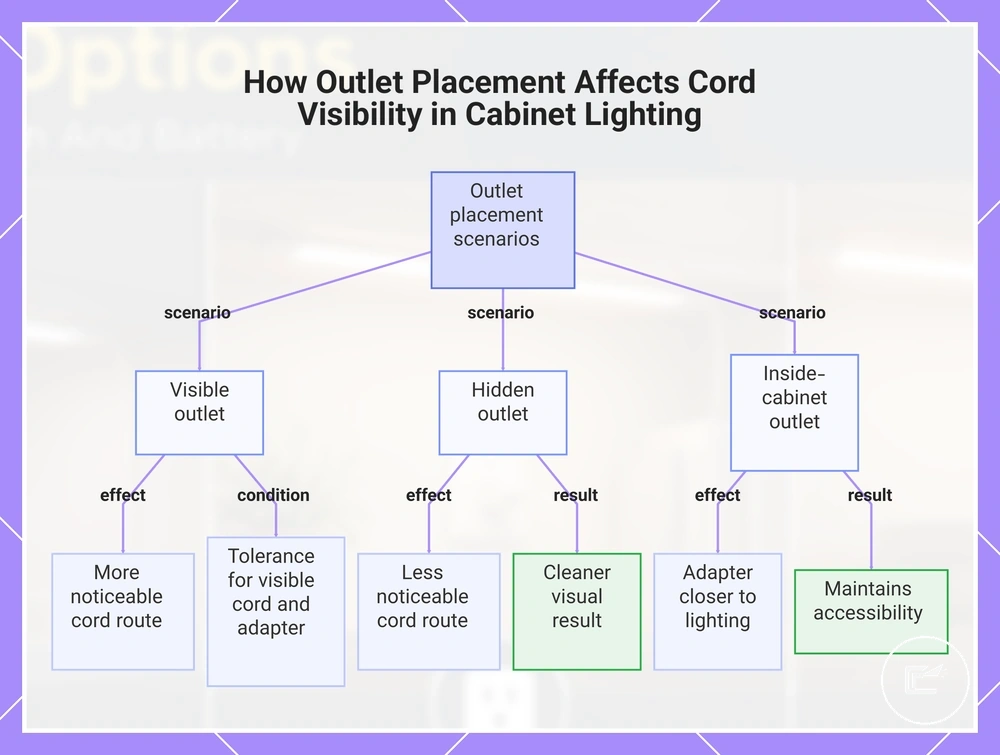
Cord visibility and outlet placement affect the practical appeal of plug-in and low-voltage cabinet lighting because outlet location determines the cord route. The cord route influences the visual result, adapter placement, and how noticeable a visible cord may become in daily use. Outlet placement directly affects cord visibility.
When outlet location changes, the cable path and adapter position often change as well. Cord visibility and outlet placement are easiest to evaluate through common outlet scenarios because each condition creates a different balance between visual result, installation tolerance, and potential safety risk. The list below organizes outlet conditions by their practical effect.
- Visible outlet: Outlet location may create a more noticeable cord route, and the visual result depends on tolerance for a visible cord and exposed adapter.
- Hidden outlet: A hidden outlet may allow a shorter or less noticeable cord route, which can contribute to a cleaner visual result when access remains practical.
- Inside-cabinet outlet: An inside-cabinet outlet may keep the adapter and cable path closer to the lighting system while maintaining accessibility.
- No nearby outlet: A longer cord route may be required, which can increase cord visibility and may introduce additional practical or safety considerations depending on the layout.
This chart shows how different outlet placement scenarios affect cord visibility, adapter placement, and visual result in plug-in and low-voltage cabinet lighting.
Voltage, transformer, and power supply fit
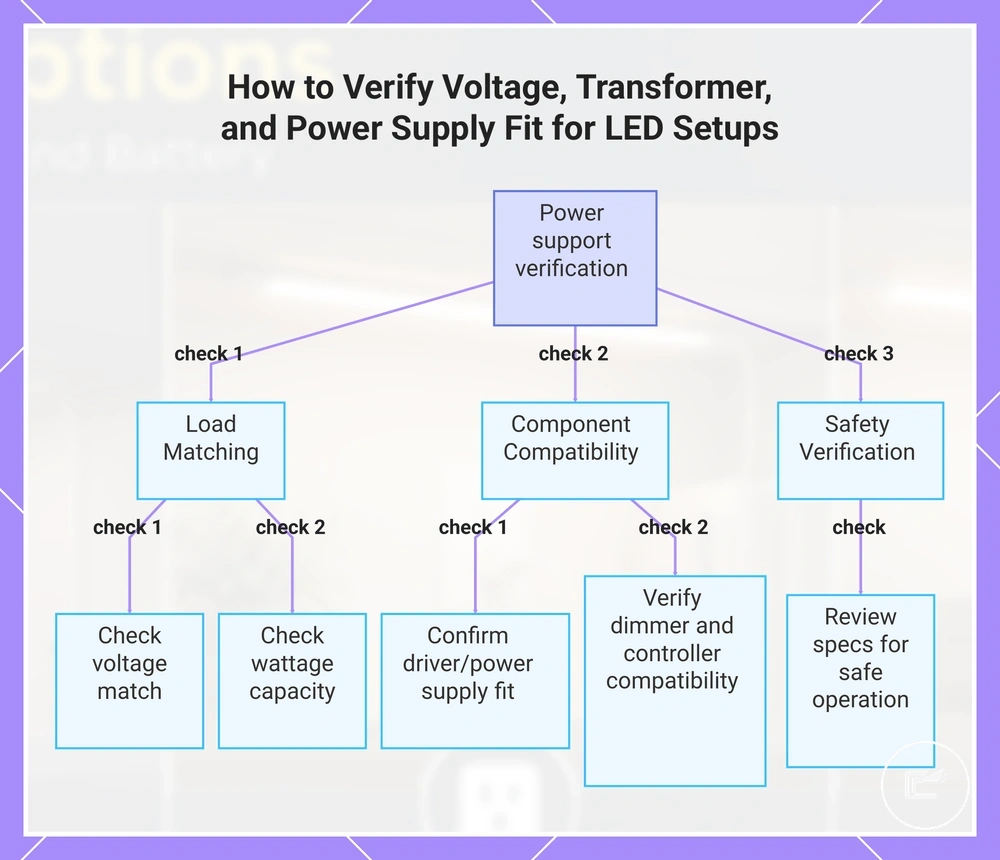
Voltage, transformer, and power supply fit depend on whether the selected LED strip or fixture matches the supporting power components. The voltage, wattage requirement, driver, transformer, and power supply should be evaluated together because a mismatch can affect operation, control behavior, or suitability. Voltage and power supply fit are compatibility checks, not brand claims.
Voltage, transformer, and power supply fit refers to verifying that the selected LED setup can be supported by the available power source and control components. A low-voltage driver, power adapter, adapter capacity, dimmer compatibility, and controller compatibility should be checked against the product specification before a power method is treated as suitable. The checklist below verifies the main compatibility conditions.
- LED strip or fixture: Verify that the voltage requirement matches the intended transformer, driver, or power supply before selecting a power method.
- Wattage requirement: Check whether the load requirement remains within the adapter capacity or driver capacity specified for the setup.
- Driver or power supply: Confirm that the low-voltage driver or power supply is intended for the selected LED configuration and operating conditions.
- Dimmer compatibility: Verify that the dimmer is compatible with the driver and LED setup if adjustable brightness is required.
- Controller compatibility: Check that any controller is supported by the selected power components because compatibility can affect control behavior.
- Safe operation: Review product specifications for voltage, load capacity, and supply fit before treating the combination as suitable for regular use.
Detailed connector selection, channel planning, and broader power and voltage compatibility evaluation belong to the compatibility context, while this section only verifies whether the chosen power method can support the selected LED setup.
This chart outlines the main compatibility checks to ensure the selected LED strip or fixture works with the power source, driver, dimmer, and controller.
Brightness, runtime, and charging limits
Brightness, runtime, and charging limits depend on available power and the way cabinet lighting is used. LED density, fixture output, battery size, sensor mode, strip length, and available power can influence brightness stability, runtime, and recharge frequency. Brightness and runtime therefore depend on power availability and use pattern rather than a fixed outcome.
For task lighting, output consistency may be more important because lighting is often used for longer or more frequent periods. For occasional lighting in closets, display cabinets, or accent applications, charging burden and runtime limits may be easier to accommodate. The table below compares output stability and charging burden across common power methods.
| Power method | Brightness behavior | Runtime or charging factor | Best-use condition |
|---|---|---|---|
| Battery-powered | Brightness stability may vary as available power decreases | Runtime depends on battery size, sensor mode, strip length, and usage pattern | Occasional lighting, closets, or low-commitment installations |
| Rechargeable | Light output may remain relatively consistent between charging cycles depending on design | Recharge frequency depends on capacity, usage, and operating conditions | Regular-use cabinets where periodic charging is acceptable |
| USB-powered | Brightness consistency depends on the available USB power source | Charging burden or power availability varies by connection method | Cabinets with convenient access to USB power |
| Plug-in | Brightness stability may support more consistent output when suitable power is continuously available | Not dependent on battery drain or recharge frequency | Task lighting and longer operating periods |
| Hardwired | Output consistency depends on compatible power components and installation conditions | Not limited by battery charging requirements | Permanent installations and frequent-use task lighting |
Motion sensors, dimming, and control options
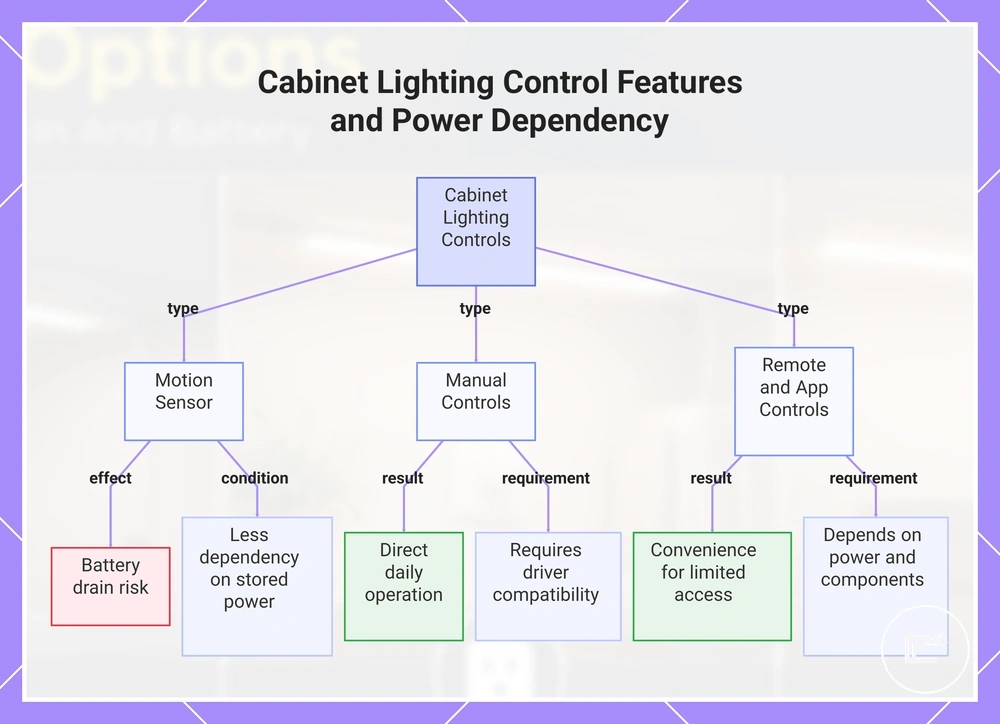
Motion sensors, dimming, and control options are control features that affect how cabinet lighting is activated, adjusted, and used. These features can influence daily usability, standby behavior, battery drain, and placement limits, while the control method remains separate from the power source. The same control method may behave differently depending on whether the lighting uses battery, rechargeable, USB-powered, plug-in, or hardwired power.
In a motion-triggered closet, a motion sensor may improve convenience by reducing the need for manual operation. In dimmable kitchen task lighting or occasional display lighting, dimming, switch control, or remote operation may affect usability differently based on the available power source. The points below separate control behavior from power source considerations.
- Motion sensor: A motion sensor uses sensor mode to activate lighting automatically. In battery-powered setups, standby behavior and motion-activated use may influence battery drain, while plug-in or hardwired systems are usually less dependent on stored power.
- Dimming: Dimming adjusts light output and may depend on driver, dimmer, or controller compatibility. Dimming support can vary by power method and lighting configuration.
- Remote: A remote can improve convenience when fixture access is limited. Remote behavior may depend on the power requirement of the lighting system and the control hardware used.
- Switch control: A switch provides direct operation and can support daily usability. Hardwired and plug-in setups may accommodate switch control differently depending on installation conditions.
- App control: App control can provide additional adjustment options when supported by the lighting system. App support, standby behavior, and placement limits depend on the selected power method and compatible control components.
- Control method comparison: The same control option may create different usability outcomes across battery, rechargeable, USB-powered, plug-in, and hardwired lighting because power availability and standby behavior can vary.
This chart shows how motion sensors, dimming, switches, remotes, and app controls affect usability, standby behavior, and power dependency in cabinet lighting.
Cost, upkeep, and safety considerations
Cost, upkeep, and safety considerations depend on how a power method balances upfront cost, ongoing maintenance burden, and operating conditions. Electrical work, replacement parts, charging requirements, batteries, heat, and power capacity can each influence long-term value. Cost should be evaluated as both initial setup effort and future upkeep.
Each power method introduces a different cost driver and ownership burden over time. Hardwired systems may involve electrical work, while battery-powered and rechargeable systems depend more on batteries, replacement parts, or charging routines. The table below organizes cost, upkeep, and safety burden into practical decision signals.
| Power method | Cost or upkeep driver | Safety consideration | Decision signal |
|---|---|---|---|
| Hardwired | Electrical work and installation requirements | Power capacity, wiring condition, and installation quality should be reviewed | May suit permanent kitchens when long-term use is expected |
| Plug-in | Adapter-related upkeep and occasional component replacement | Heat, cable routing, and adapter suitability may require a safety check | May support a balance between flexibility and regular use |
| Battery-powered | Batteries and replacement cycles | Battery condition and correct use remain relevant | May suit low-commitment trials or occasional lighting |
| Rechargeable | Charging routines and battery maintenance | Charging practices and battery condition may influence upkeep | May fit recurring use when charging is acceptable |
| USB-powered | Power-source access and cable management | Power capacity and connection suitability should be verified | May suit locations with convenient USB power access |
Safety and maintenance conditions vary by installation environment and power source. No cabinet lighting power method should be treated as risk-free because heat, power capacity, component condition, and installation quality can affect outcomes. Additional safety considerations may help when evaluating setup conditions.
The products below are useful examples for comparing available options. Before buying, check that the compatibility criteria, key features, and product details match your needs.
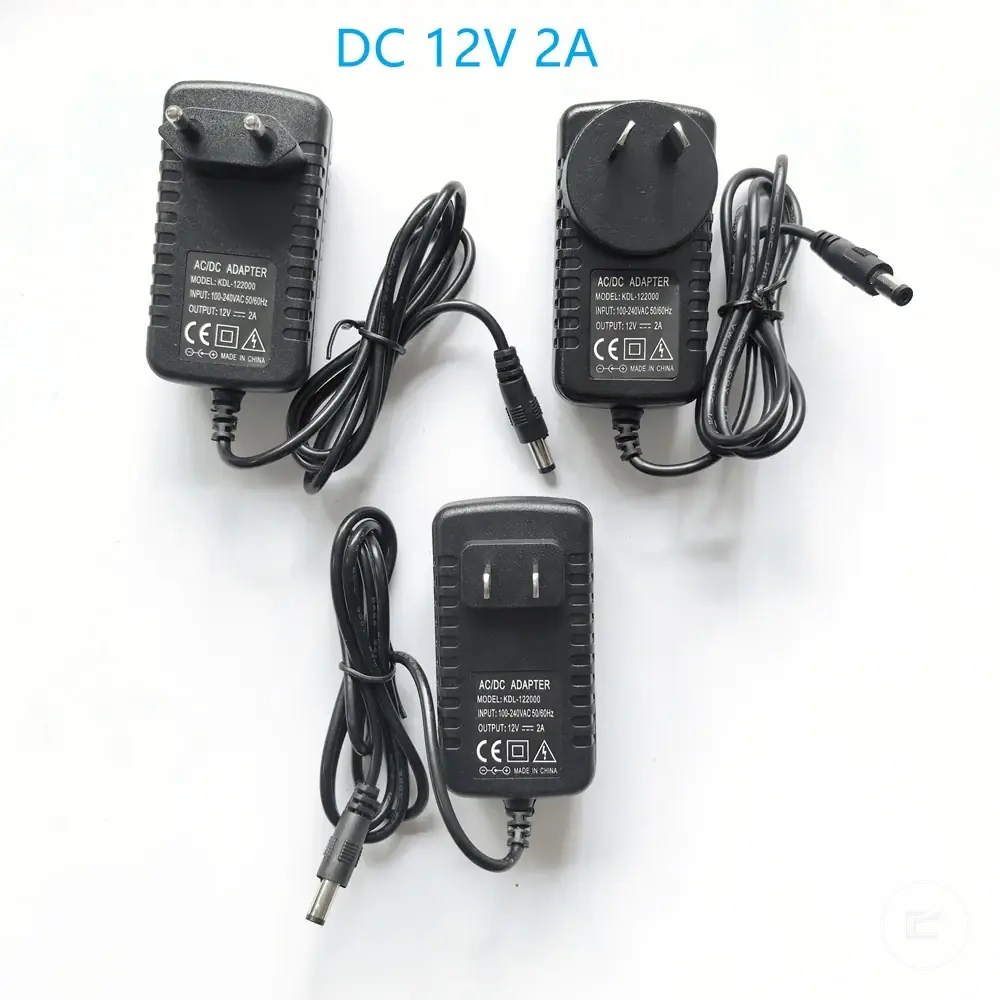
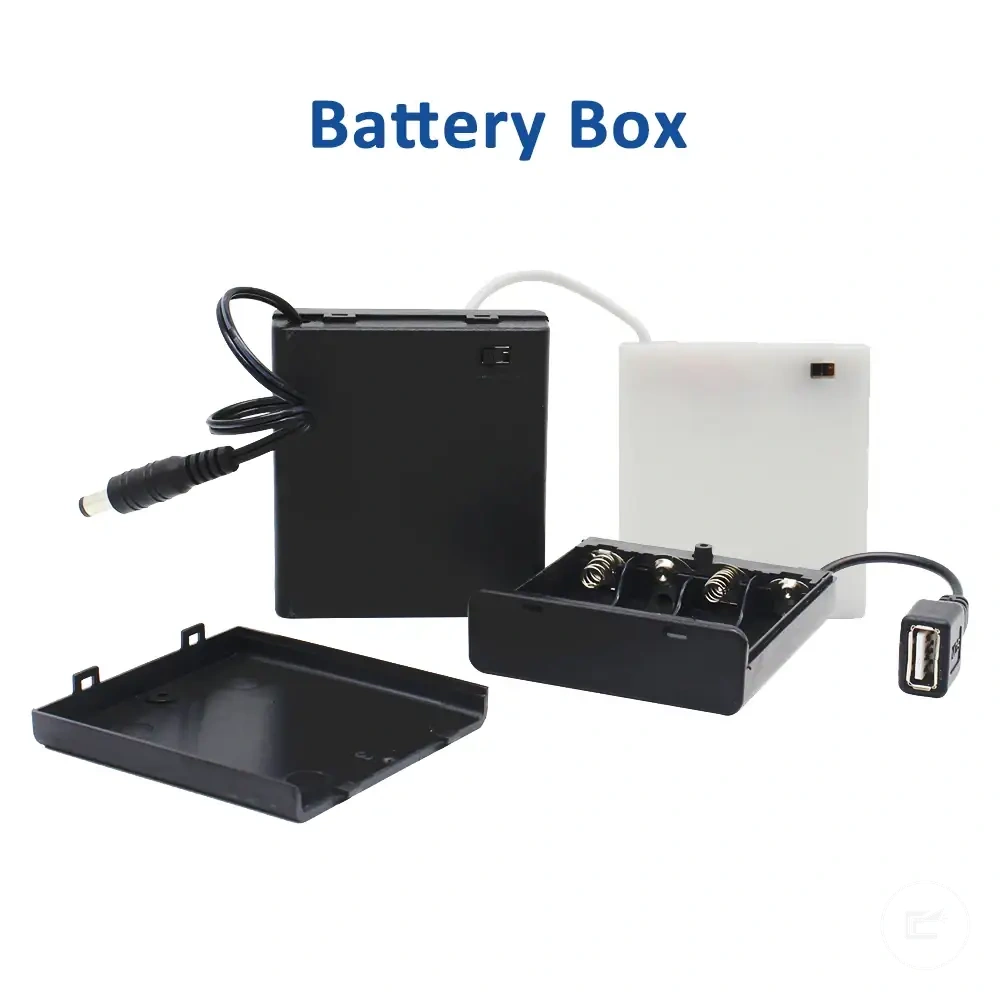
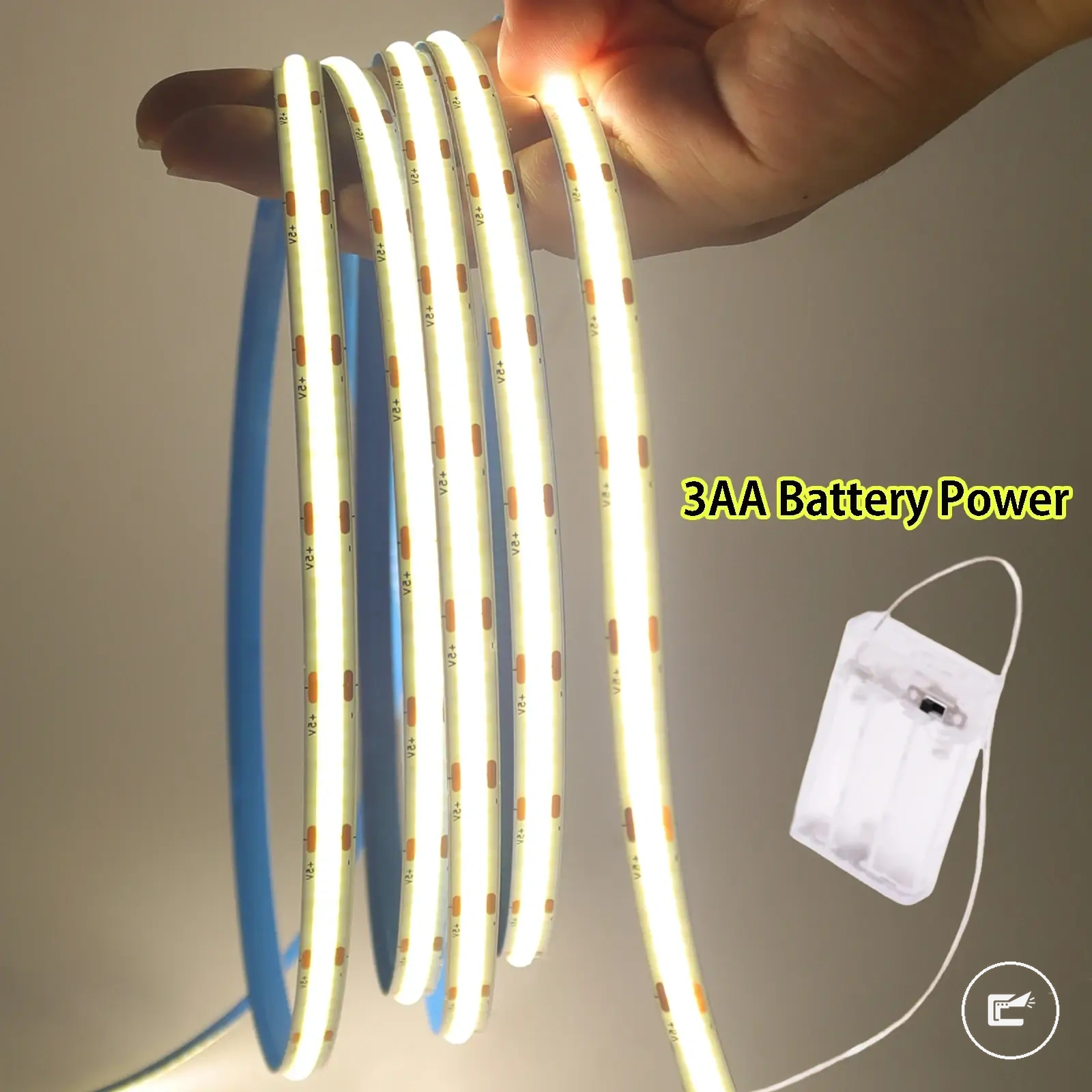
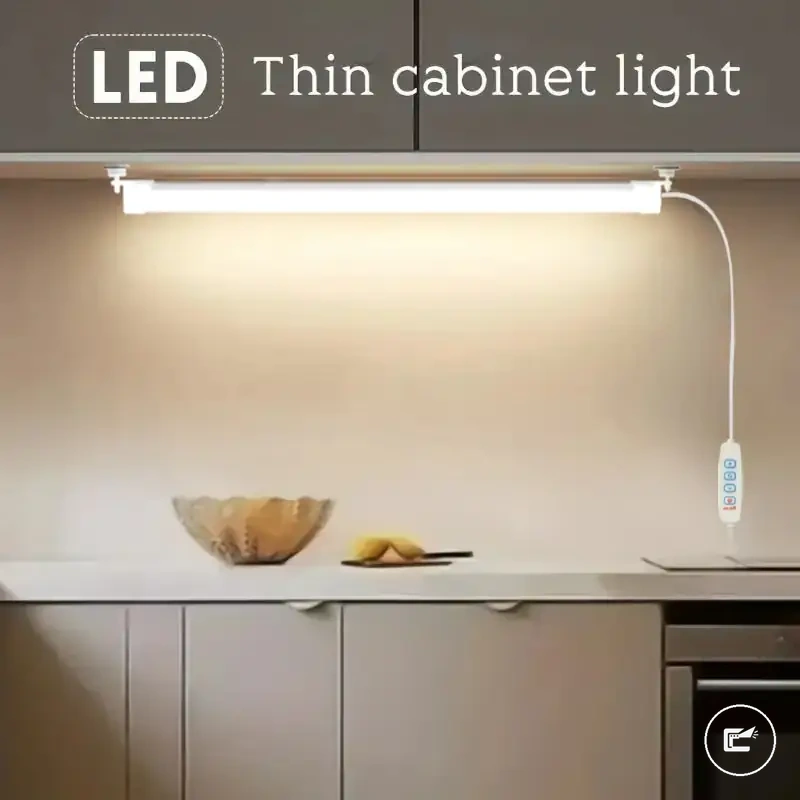
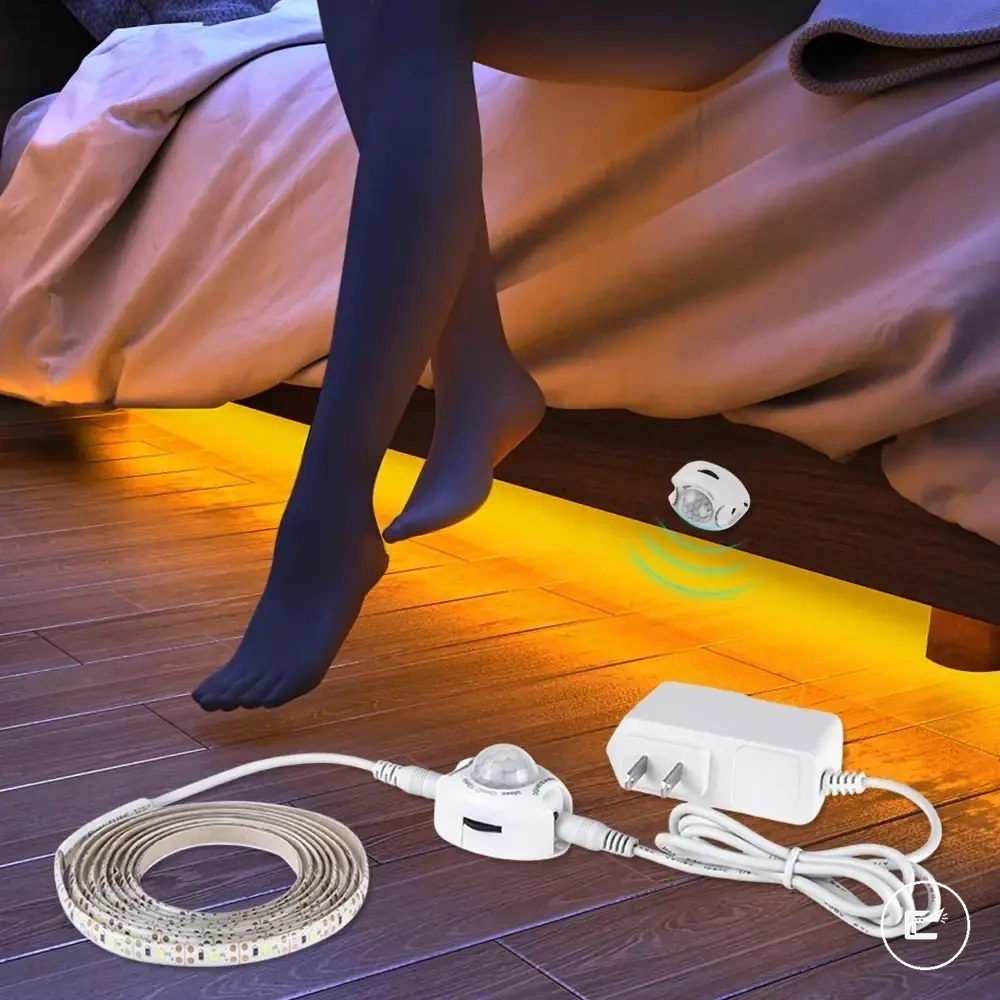
Low-commitment trials may favor power methods with less installation dependency, while permanent kitchens may justify additional upfront cost when frequent use is expected. High-use task lighting may place greater emphasis on power availability and upkeep than occasional-use lighting. Long-term value depends on how use frequency, maintenance burden, and safety trade-offs align with the selected power method.
Best cabinet LED lighting power method by use case
Best cabinet LED lighting power method by use case depends on the use case, cabinet conditions, and acceptable maintenance. A best-fit power method should match how often the lighting is used, available power access, and the level of upkeep that is acceptable. Use case and cabinet conditions decide the fit.
Best cabinet LED lighting power method by use case becomes easier to evaluate when common cabinet scenarios are mapped to power-method decisions. The decision table below connects each scenario to a likely best-fit method, the main reason, and a practical watch-out.
| Use case | Likely best-fit method | Main reason | Watch-out |
|---|---|---|---|
| Kitchen task lighting | Hardwired or plug-in | May suit frequent use and high-brightness needs when continuous power is preferred | Installation access, outlet position, and power compatibility should be checked |
| Display cabinets | Rechargeable, USB-powered, or plug-in | May support flexible placement and accent lighting goals | Charging access, cable visibility, or output expectations can vary |
| Closets | Battery or rechargeable | Often fits occasional or motion-triggered use where wiring access is limited | Runtime and charging frequency depend on usage patterns |
| Shelves | USB-powered, rechargeable, or plug-in | Can support flexible placement under different cabinet conditions | Cable routing or charging access may affect convenience |
| Rentals | Plug-in or wire-free | May fit removable setups with lower installation commitment | Visible cords or charging requirements may remain |
| Renovation projects | Hardwired | May suit permanent layouts where hidden wiring can be planned | Electrical work and component placement require planning |
| No-outlet locations | Battery or rechargeable | Often fits when outlet access is unavailable | Runtime, charging needs, and power availability become more important |
| Motion-triggered use | Battery or rechargeable with motion sensor | May improve convenience where automatic activation is preferred | Sensor behavior and standby operation can affect battery drain |
Kitchen task lighting and renovation projects often benefit from evaluating permanent power access first, while closets, display cabinets, and no-outlet locations may place more importance on placement flexibility. Rentals and motion-triggered use may favor lower-commitment approaches when installation changes are undesirable.
For detailed purchasing checks after the power-method fit is identified, use a criteria-led buying checklist rather than relying on product-specific claims.
The products below are useful examples for comparing available options. Before buying, check that the compatibility criteria, key features, and product details match your needs.
Final selection should remain criteria-led rather than SKU-led. Match the use case, cabinet conditions, power access, control preferences, and maintenance expectations before comparing individual options. The most suitable method depends on scenario requirements rather than a universal choice.