
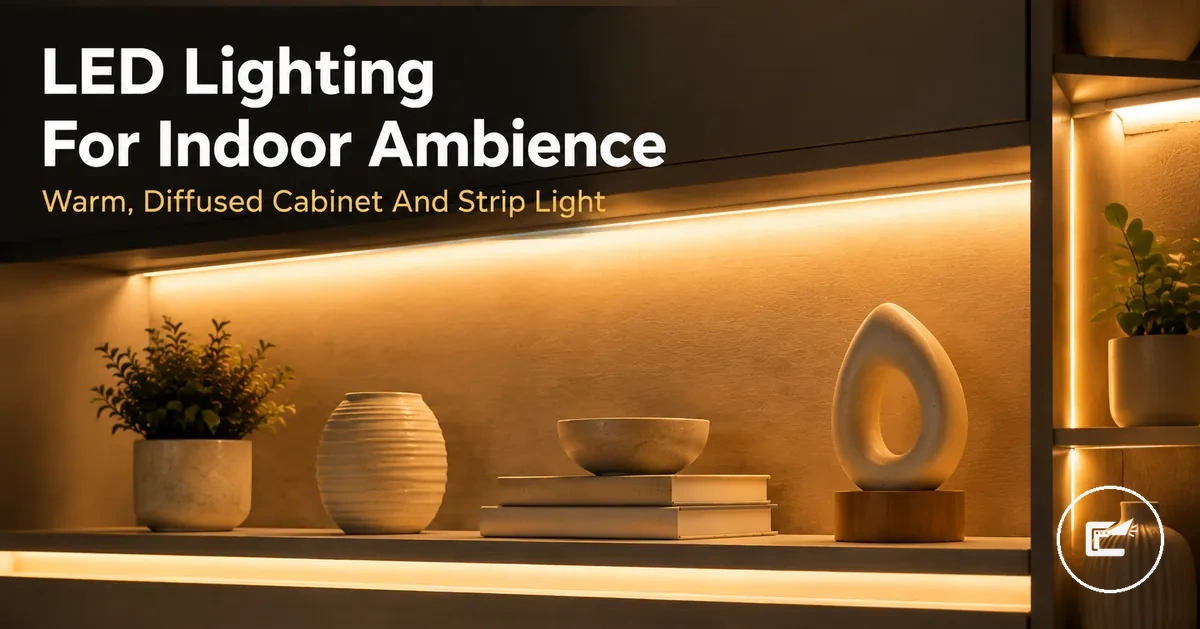
LED Strip and Cabinet Lighting Accessories for Indoor Ambience
LED strip and cabinet lighting accessories are tools for shaping indoor ambience with controlled light, subtle placement, and softer visual edges. In this page, indoor ambience means the room feeling created by ambient light, mood lighting, accent lighting, warm white tone, diffused light, dimming, and glare-free placement.
A kitchen shelf, cabinet edge, display area, or room corner can feel different when strip lights are hidden from direct view and aimed toward a surface. The goal here is not installation instruction or buying direction; it is to explain how LED strip lighting can support room ambience before any product-like choice is considered.
Light tone affects warmth, diffusion can soften visible hotspots, dimming changes brightness intensity, and a controller may adjust color or light level when the setup supports it. Cabinet lighting accessories such as channels, diffusers, connectors, and control parts remain secondary to the main ambience task: placing indirect light where it supports comfort without overpowering the room.
Ambient light is different from task light because ambient light shapes the background feel of a space, while task light is aimed at a work surface. The same strip lights may feel ambient or task-oriented depending on brightness, viewing angle, surface reflection, and placement, so later sections separate ambience behavior from focused cabinet lighting use.
How LED Strip and Cabinet Lighting Creates Ambient Indoor Light
LED strip lighting and cabinet lighting create ambient indoor light by adding a controllable light layer that supports broader room illumination rather than drawing attention to a single point. Indirect light can soften visual contrast and reduce harsh brightness transitions. When positioned appropriately for the space, this approach supports the ambient-light role and can influence overall room mood.
How LED Strip and Cabinet Lighting Creates Ambient Indoor Light becomes clearer when the light source is directed toward surrounding surfaces instead of directly toward the viewer. The image below highlights how indirect light, low-glare direction, and controlled brightness contribute to a softer visual effect and help explain the difference between visible light sources and visible illumination.
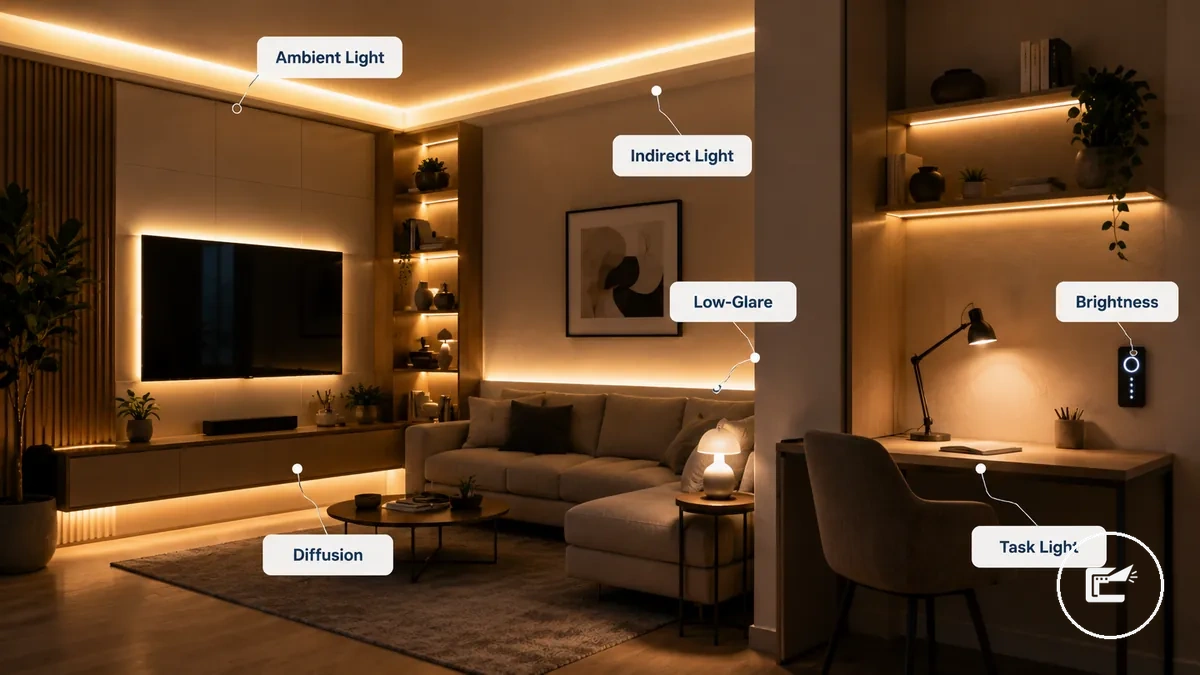
Placement affects where light appears, direction influences perceived softness, and diffusion can help with glare control by spreading brightness more evenly. Within home LED strip and cabinet lighting accessories, ambient lighting refers to lighting that shapes the overall visual atmosphere of a room. For example, light reflected from a cabinet edge or shelf surface may appear softer than a directly exposed source, depending on brightness and surface reflection.
The comparison below clarifies the distinction between ambient lighting and task lighting when their roles overlap in the same space.
| Ambient Lighting | Task Lighting |
|---|---|
| Uses indirect lighting and a broader light layer to support room mood and overall visual comfort. | Directs light toward a specific activity area where focused visibility is the primary objective. |
Mood light and accent light are commonly associated with ambient indoor light, while task lighting is intended for work-surface visibility. Although both can exist together, perceived comfort and ambience may vary based on placement, brightness, diffusion, and surrounding room surfaces.
Ambient Light Versus Task Light Around Cabinets
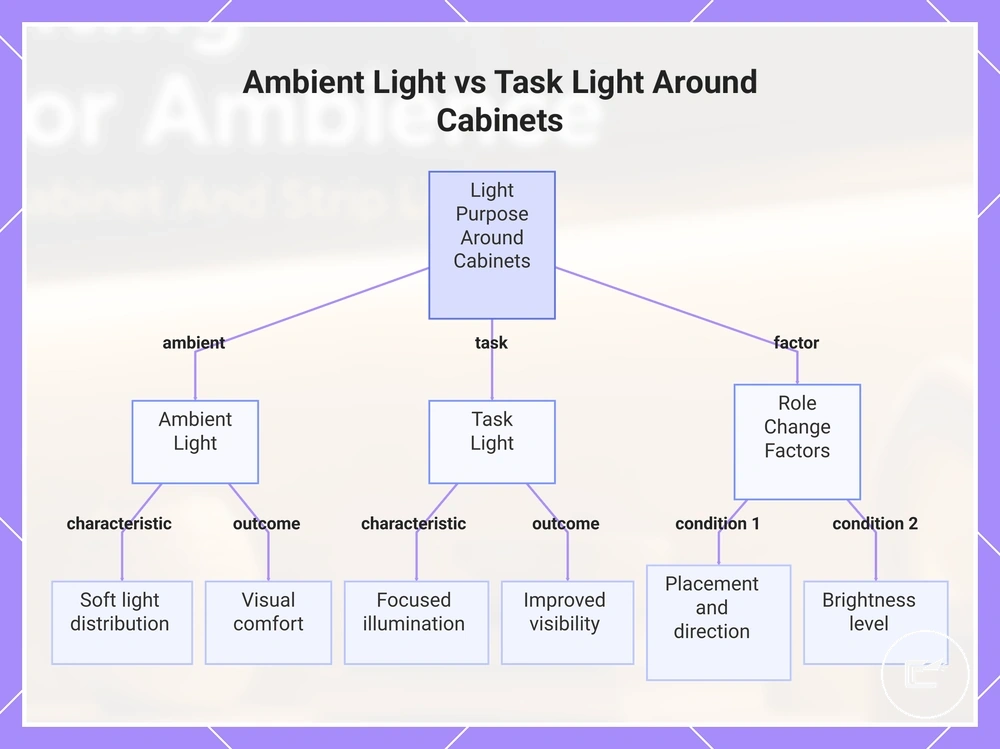
Ambient light around cabinets is light that supports the overall feel of a cabinet area rather than providing focused illumination for a specific activity. It creates a softer light distribution that can contribute to visual comfort, while task light uses focused light to improve visibility on a work surface. The difference is primarily one of purpose.
For example, the same LED strip may function as ambient light when its brightness level is moderate and its direction spreads a soft glow across nearby surfaces. The same strip may become more task-oriented when intensity increases and the light is directed toward a work surface. Its role can change depending on placement, direction, and brightness level.
This chart compares the purpose and characteristics of ambient and task light around cabinets, and explains how the same LED strip can change role based on placement, direction, and brightness.
Indirect Lighting, Accent Layers, and Room Mood
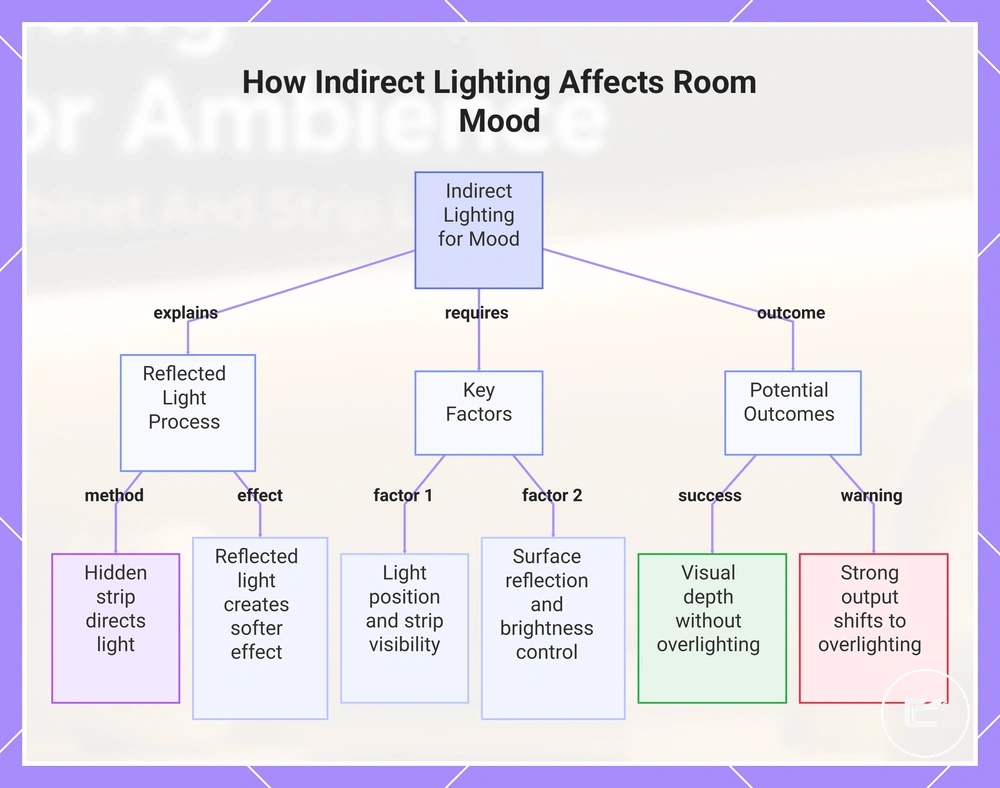
Indirect lighting and accent layers can influence room mood when a hidden strip directs light onto nearby surfaces instead of exposing the light source itself. In a cabinet area, reflected light from a wall or cabinet edge may create a softer visual effect than direct illumination. This approach can add visual depth without contributing to overlighting when brightness remains controlled.
Indirect lighting and accent layers depend on light position, hidden strip visibility, and surface reflection. A hidden strip behind a cabinet edge may create wall glow through reflected light, while an under-shelf glow can form a subtle accent layer across the surrounding area. Reflection changes how light is perceived on room surfaces, and the ambience effect may vary with direction and brightness. When light output becomes too strong for the space, the result can shift toward overlighting rather than a balanced room mood.
This chart shows how indirect lighting and accent layers influence room mood through reflected light, key factors, and potential outcomes.
Warm White, Soft White, and Tunable White Ambience
White-light tone is the color temperature characteristic of an LED strip light that influences how light is perceived within a room. Different white-light tones can affect comfort, visual softness, and mood without changing the lighting layout itself. Because perception varies with room color, surface finish, time of day, and use case, color temperature remains an important ambience variable.
Warm white is often associated with a more relaxed mood, particularly when dimming reduces light intensity. Soft white can support comfort by balancing brightness and surface appearance across different room surfaces. Tunable white allows adjustable white-light tone control, making it easier to adapt color temperature to changing activities or preferences. The perceived room outcome of each option depends on conditions rather than on a universally preferred setting.
| Light tone | Typical ambience role | Useful condition | Caution |
|---|---|---|---|
| Warm white | Supports a warmer tone and relaxed light effect | Often used when a softer mood is preferred | May appear differently depending on room color and surface finish |
| Soft white | Balances comfort and visual clarity | Can suit a range of indoor ambience goals | Perceived softness varies with surrounding surfaces |
| Tunable white | Adapts to changing ambience needs | Useful when lighting preferences change over time | Results depend on adjustment choices and dimming conditions |
A fixed warm white LED strip light may be suitable when the desired mood remains relatively consistent, while tunable white may be a better fit when flexibility is a priority. Decisions about brightness and color choices are usually more effective when they consider room color, surface finish, dimming behavior, and intended ambience rather than relying on a single white-light tone for every situation.
Warm and Soft White Ranges for Relaxed Indoor Spaces
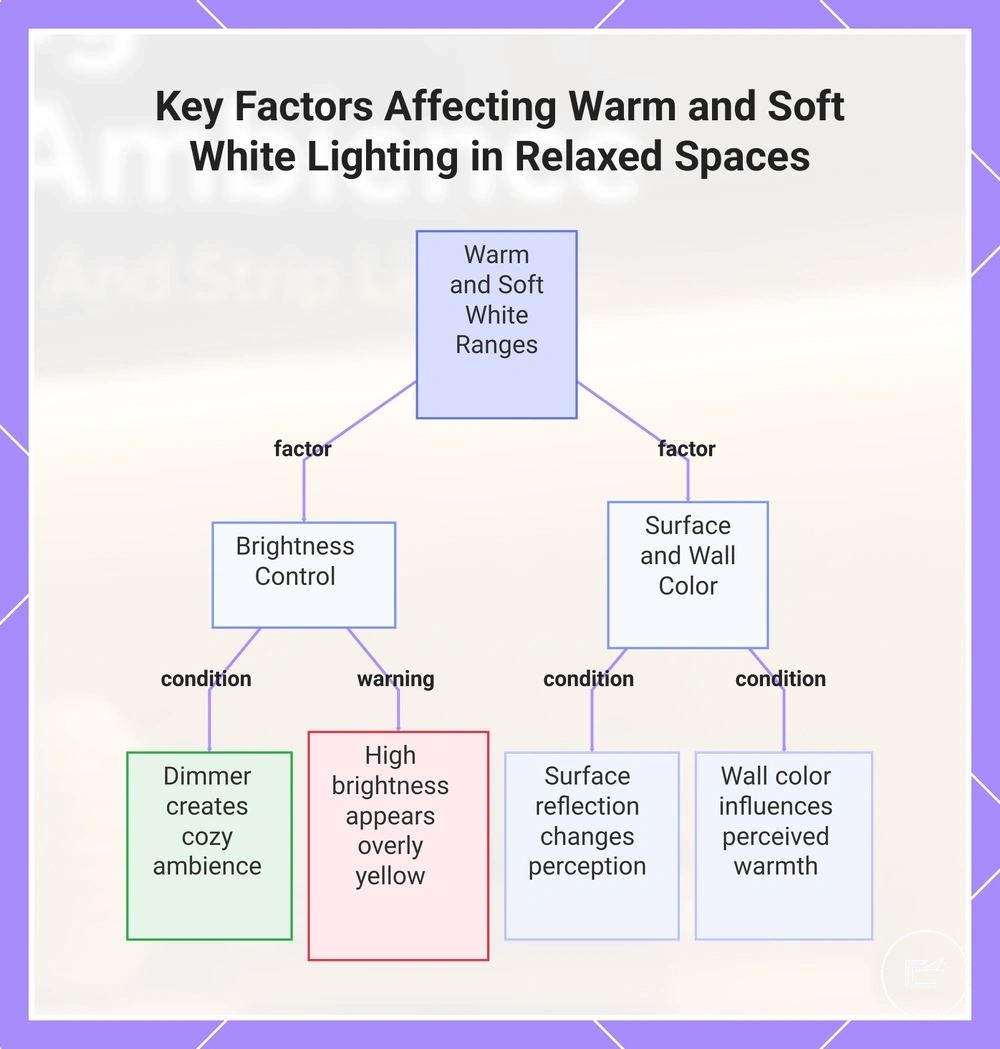
Warm white and soft white ranges can support relaxed indoor spaces when brightness control is matched to the room and intended ambience. A warmer tone often creates a gentler visual character, while soft white may provide a balanced appearance across different surfaces. The perceived mood outcome depends on strip color tone and brightness control working together.
Warm white and soft white ranges can appear different depending on surface reflection, wall color, and personal preference. A dimmer setting may help warm white create a cozy ambience, while the same tone can appear overly yellow when brightness and reflective surfaces increase perceived warmth. Soft white may support comfort on certain room surfaces, but the result still depends on surface reflection, brightness level, and user preference. In relaxed indoor spaces, these conditions often influence perceived warmth as much as the color tone itself.
This chart shows the main conditions that influence how warm and soft white light ranges create the intended mood in relaxed indoor spaces.
Tunable White for Changing Room Use and Mood
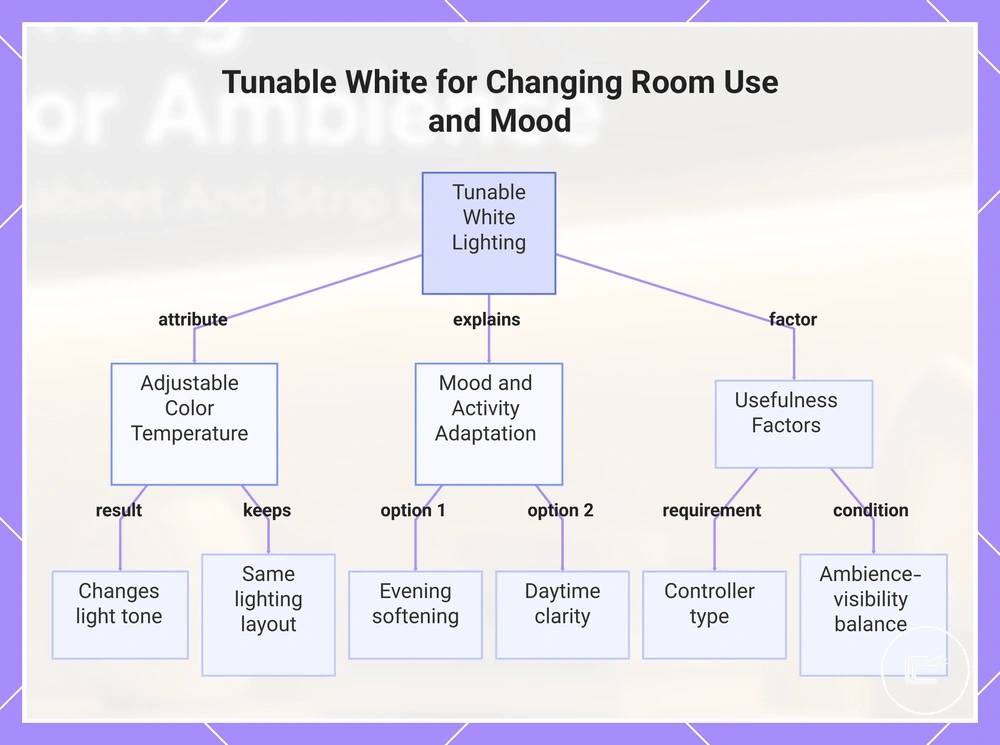
Tunable white can help one indoor area shift between relaxed ambience and clearer lighting because its adjustable color temperature allows the light tone to change without changing the lighting layout. A suitable controller provides flexibility to adapt light output to different room activity needs and preferences. This approach is most useful when the same space serves different purposes throughout the day.
Tunable white supports mood change by adjusting light tone according to time of day and room activity. During evening softening, a warmer adjustable color temperature may support a more relaxed ambience around LED strip and cabinet lighting areas. During periods that benefit from daytime clarity, a different light tone may provide clearer lighting within the same space. The usefulness of tunable white depends on controller type, desired mood change, room activity, and the balance between ambience and visibility.
This chart shows how tunable white lighting uses adjustable color temperature to shift between relaxed ambience and daytime clarity, and what factors affect its usefulness.
Diffused and COB LED Strip Light for Smooth Ambience
Diffused LED strip light and COB LED strip help create smooth ambience by reducing the visibility of individual light points and producing a more continuous light effect. Smoothness matters because visible dots and hotspots can make the light source more noticeable than the ambient glow itself. When light appears more even across a surface, the result can support a smoother ambience and a cleaner visual outcome.
Diffused and COB LED Strip Light for Smooth Ambience can be easier to understand when the visual differences are compared directly. The image below contrasts visible-dot strip effects, diffuser-based smoothing, and COB-style continuous light on cabinet and shelf surfaces.
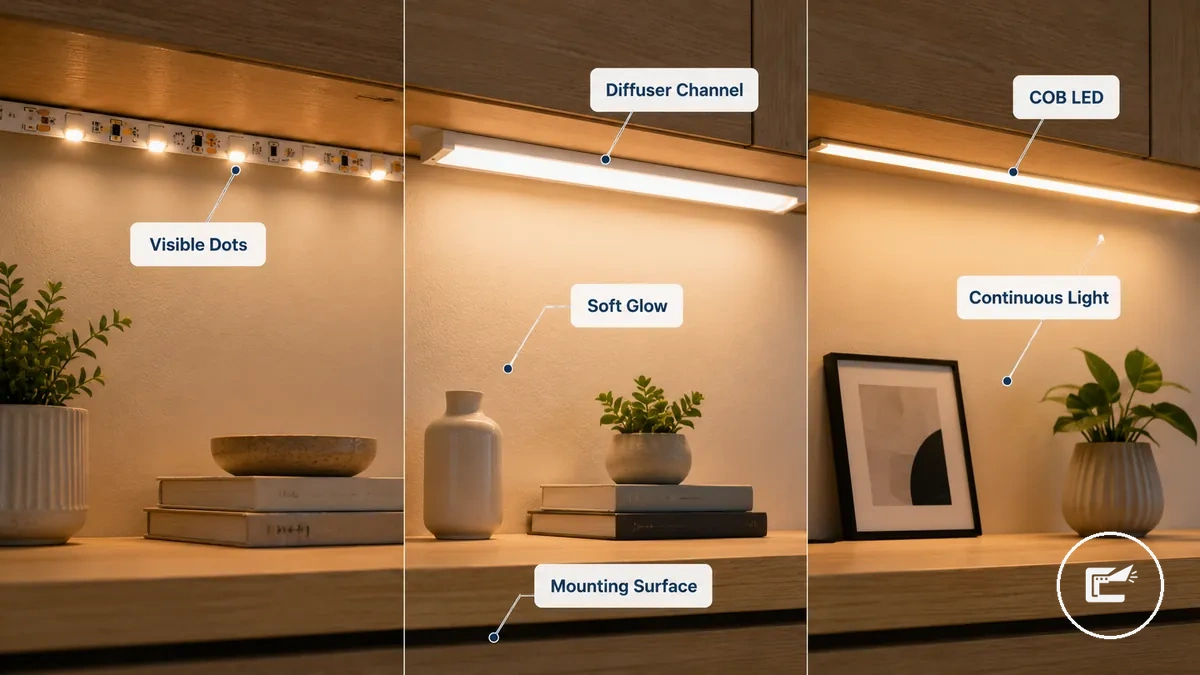
A diffused LED strip light uses a diffuser channel and diffuser cover to spread light and help reduce hotspots. The smooth-light outcome depends on factors such as LED spacing, viewing angle, brightness, and mounting surface reflection. Wider LED spacing can make visible dots easier to notice, while a diffuser channel may create a smoother glow and more even light appearance.
A COB LED strip and a diffused LED strip light achieve smoothness through different approaches. A COB LED strip is designed to create more continuous light with a dot-free look, while a standard strip combined with a diffuser channel can also reduce visible dots when LED spacing and viewing conditions are favorable. Perceived smoothness may vary with the mounting surface, reflection, and viewing angle, so neither approach is automatically superior in every setting.
| Option | Visual effect | Useful condition | Trade-off |
|---|---|---|---|
| Diffused LED strip light | Reduced visible dots with a smooth glow | When a diffuser channel helps soften hotspots | Results may vary with LED spacing and viewing angle |
| COB LED strip | Continuous light with a more dot-free look | When visible smoothness is a primary ambience goal | Perceived improvement depends on brightness and mounting surface conditions |
Diffuser Channels for Softer Light and Fewer Hotspots
Diffuser channels help create softer light by reducing the visibility of individual LED points and spreading light more evenly across indoor accent areas. A diffuser channel combines a diffuser cover and channel profile to soften direct light output. Hotspot reduction depends on strip brightness, channel depth, and viewing angle.
Diffuser channels vary in effectiveness based on the relationship between the diffuser cover, channel depth, and light source. Higher diffuser cover opacity can soften visible LED points more effectively, but it may also reduce perceived brightness. Greater channel depth can help improve hotspot reduction by increasing the distance between the LEDs and the diffuser cover, while viewing angle influences how visible individual light points appear. If perceived brightness becomes lower after diffusion, adjusting strip brightness or placement may help maintain the desired lighting effect.
- Diffuser cover opacity: can increase softening while reducing perceived brightness.
- Channel depth: can help spread light before it reaches the diffuser cover.
- Strip brightness: influences how noticeable hotspots remain after diffusion.
- Viewing angle: affects how visible LED points appear through the diffuser channel.
COB Strips for Continuous Dot-Free Light
COB strip lighting depends on the desired level of visual smoothness, viewing conditions, and diffusion need when compared with a conventional LED strip. A COB strip is designed to produce continuous light with reduced dot visibility, while a conventional LED strip may show individual light points depending on surface reflection, viewing distance, and brightness perception. This contrast can support a more continuous-light effect when visible-edge ambience is the priority.
A COB strip may improve visible-edge ambience along open shelves or cabinet edges where continuous glow and dot-free light are more noticeable. A conventional LED strip may still provide sufficient visual smoothness when diffusion reduces visible dots and the viewing angle makes individual light points less apparent. The trade-off depends on brightness perception, bend area conditions, surface characteristics, and the level of continuous light desired rather than on either strip type being suitable for every room condition.
RGB, Dimming, and Controllers for Adjustable Indoor Ambience
RGB LED strip lighting, dimming, and controller options allow indoor ambience to change without replacing the lighting layout. By adjusting color mode, brightness, and preset behavior, the same lighting setup can support different room moods and visual preferences. The main benefit is adjustable ambience through control rather than physical lighting changes, providing greater adjustability.
RGB LED strip systems use color mode selection to influence mood change, while dimming adjusts brightness to support different comfort levels and ambience outcomes. A controller manages these adjustments through a remote, app control, or another control method, and may include a preset or preset scene for faster transitions between lighting styles. The usefulness of each control method depends on user preference, brightness range, room context, and the intended adjustable ambience.
The criteria below compare fixed white, tunable white, and RGB options when the goal is to change ambience through control rather than through a different lighting layout.
| Control option | What changes | Best ambience use | Caution |
|---|---|---|---|
| Fixed white | Brightness through dimming | When a consistent light tone is preferred | Mood change is limited to brightness adjustment |
| Tunable white | Brightness and white-light tone | When adjustable mood is needed within white-light settings | Color mode flexibility is limited to white-tone variation |
| RGB LED strip | Brightness, color mode, and preset selection | When broader mood change and color variation are desired | Preferred settings depend on room context and user preference |
Fixed white may suit spaces where a stable light appearance is the priority. Tunable white may be more appropriate when mood changes depend on adjusting white-light tone rather than introducing color. RGB may be suitable when color-changing effects are part of the intended ambience, but the preferred controller, preset behavior, and control method depend on user preference and the desired mood change.
Color-Changing Effects Without Overpowering the Room
Color-changing effects depend on saturation, brightness, and placement when the goal is comfortable indoor ambience. An RGB strip can support adjustable color effects without dominating the room when color intensity remains controlled. The control condition is maintaining room balance through restrained use of saturation and brightness.
Saturation, brightness, and placement influence how color-changing effects are perceived within a space. A softer setting may suit accent use, display lighting, or evening use when the color effect complements surrounding decor rather than becoming the primary visual focus. Comfort depends on how the RGB strip interacts with room context, viewing position, and existing light levels, so stronger color effects may not suit every indoor setting.
- Keep saturation moderate when comfort and room balance are priorities.
- Adjust brightness to fit the surrounding light level and intended use.
- Consider placement so the RGB strip supports the space without drawing constant attention.
- Use accent color selectively for accent use, display areas, or evening use.
- Evaluate color mode choices according to room context rather than relying on a single setting.
Dimmers, Remotes, and App Controls for Mood Changes
Control methods change ambience by adjusting brightness, tone, or color when a different room atmosphere is desired. A controller provides access to these adjustments through different input methods, and the usefulness of each option depends on how often lighting preferences change. The right control method can make mood changes easier throughout the day.
Dimmer, remote, and app control options differ in dimming precision, preset access, and ease of adjustment. A simple dimmer may be suitable when brightness adjustment is the primary goal, while a remote or app control may provide quicker access to multiple settings when ambience needs vary. The preferred option depends on controller features, user preferences, and the desired mood outcome.
- Dimmer: Focuses on brightness adjustment and may support comfort through straightforward dimming precision.
- Remote: Can provide convenient preset access and easier adjustment from a distance through a remote control.
- App control: May offer broader adjustment flexibility and app-based access to presets when mood changes occur more frequently.
Indoor Ambience Ideas for Cabinets, Shelves, Coves, and Room Edges
Indoor ambience ideas often rely on how light interacts with surfaces rather than on the visibility of the light source itself. Cabinets, shelves, coves, and room edges can create different ambience effects when light direction, surface reflection, brightness, and strip visibility are adjusted for the space. These examples illustrate controlled ambience patterns rather than a complete placement guide.
Indoor Ambience Ideas for Cabinets, Shelves, Coves, and Room Edges are easier to understand when placement and light effect are viewed together. The image below highlights hidden strip locations, light direction, and visible glow outcomes across common indoor surfaces.
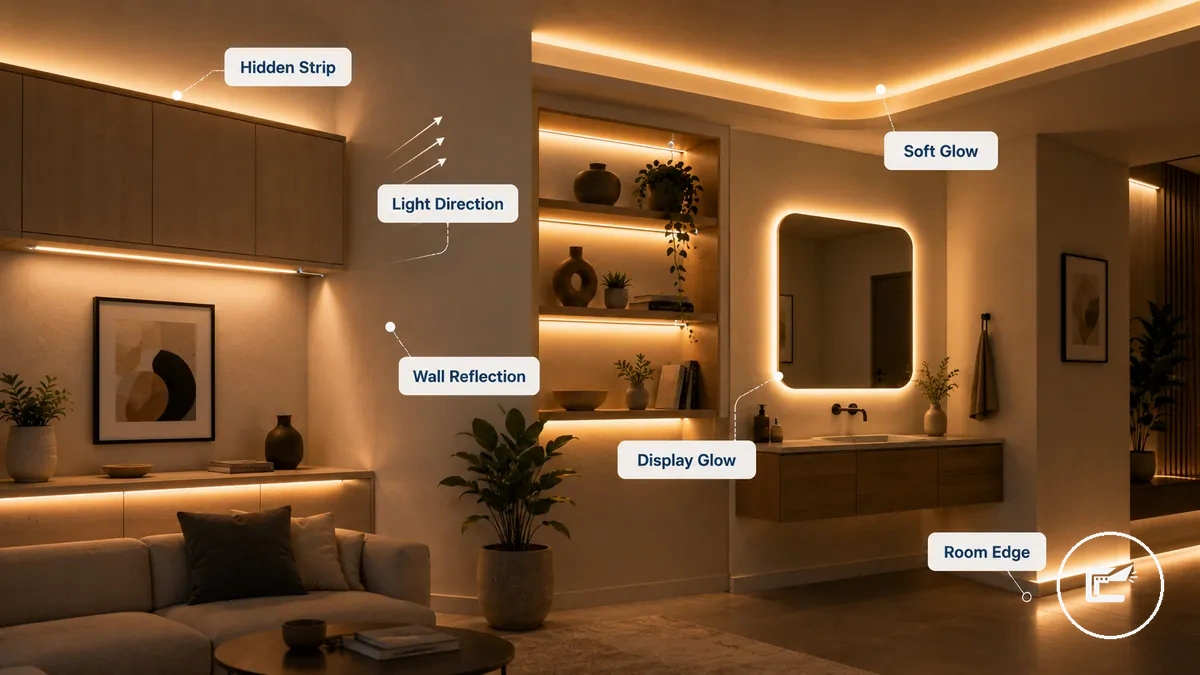
- Cabinet undersides: A hidden strip can direct light downward to create a soft glow beneath cabinets, with the mood outcome varying by brightness and surface reflection.
- Cabinet tops: Indirect glow directed upward may support a softer mood when light reflects from nearby surfaces instead of remaining directly visible.
- Shelves and display areas: A hidden strip behind or beneath shelves can create a display effect and display glow while keeping attention on the illuminated objects.
- Coves and room edges: Light directed toward walls may create ambience through wall reflection, while comfort depends on light direction, brightness, and viewing angle.
- Mirror lighting: Light directed around a mirror edge can create a surrounding glow that contributes to the overall mood outcome when balanced with nearby lighting.
These indoor ambience ideas show how cabinets, shelves, coves, mirror lighting, and room edges share the same underlying principles of light direction and boundary control. Broader placement ideas can be explored in the indoor placement guide, but the ambience result often depends on hidden strip visibility, reflection, brightness, and viewing conditions rather than on location alone.
Under-Cabinet and Above-Cabinet Ambient Effects
Under-cabinet and above-cabinet placements create different ambient effects because visibility, reflection, and brightness level change how light is perceived around a cabinet surface. Strip position influences whether the glow is directed toward nearby surfaces or remains more visible within the room. Above-cabinet placement may create a softer floating effect through reflected light, while under-cabinet placement may create a more noticeable lower glow.
An above-cabinet strip position can direct light toward a wall or ceiling, where wall reflection may produce an upper glow that appears softer when the light source remains partially hidden. An under-cabinet strip position can direct light toward a backsplash or nearby cabinet surface, where backsplash reflection and brightness level influence the spread and visibility of the glow. The resulting ambience depends on cabinet position, reflected light, surface characteristics, and viewing conditions rather than on placement alone.
Shelf, Display, Mirror, and Cove Lighting Effects
Shelf lighting, display lighting, mirror lighting, and cove lighting create different ambience effects because hidden strip location, reflection surface, diffusion need, and visible object placement influence how light is perceived. A hidden strip can produce a display glow, reflected glow, or indirect light effect depending on where the light interacts with nearby surfaces. As a result, the ambience outcome may vary even when the same lighting source is used.
- Shelf lighting: A hidden strip beneath or behind a shelf can create shelf glow around a visible object, with the ambience outcome influenced by object placement and nearby reflection surfaces.
- Display lighting: Light positioned out of direct view may emphasize displayed items, while diffusion need and reflected glow can affect visual comfort and perceived brightness.
- Mirror lighting: A concealed light source around a mirror can create softer light through reflection, with the effect depending on the reflection surface and surrounding finishes.
- Cove lighting: An indirect cove light directed toward a wall or ceiling can contribute to room mood through reflected light, with the ambience outcome varying by surface characteristics and strip visibility.
When an example extends into more specialized storage or showcase applications, the dedicated shelf closet and display lighting page provides narrower context. Within this section, the focus remains on how hidden-strip placement, reflection surface behavior, and diffusion need influence ambience outcome across shelf, display, mirror, and cove lighting effects.
Keeping Indoor Accent Lighting Comfortable and Glare-Free
Comfortable accent lighting depends on controlling brightness, line of sight, reflective surfaces, and color intensity together rather than relying on a single lighting feature. Indoor accent lighting is more likely to appear glare-free when the light source is less exposed to direct view and the dimming level suits the surrounding environment. The main comfort criteria are brightness, visibility, diffusion, reflection, and evening comfort.
Indoor accent lighting can appear harsh when brightness is high and the light source falls directly within the line of sight. Reflective surfaces may increase perceived glare through reflected light, especially when brightness remains unchanged across different room conditions. A diffuser can support hotspot reduction and a softer appearance, while an appropriate dimming level may improve visual comfort when viewing angle, reflection, and color intensity are considered together.
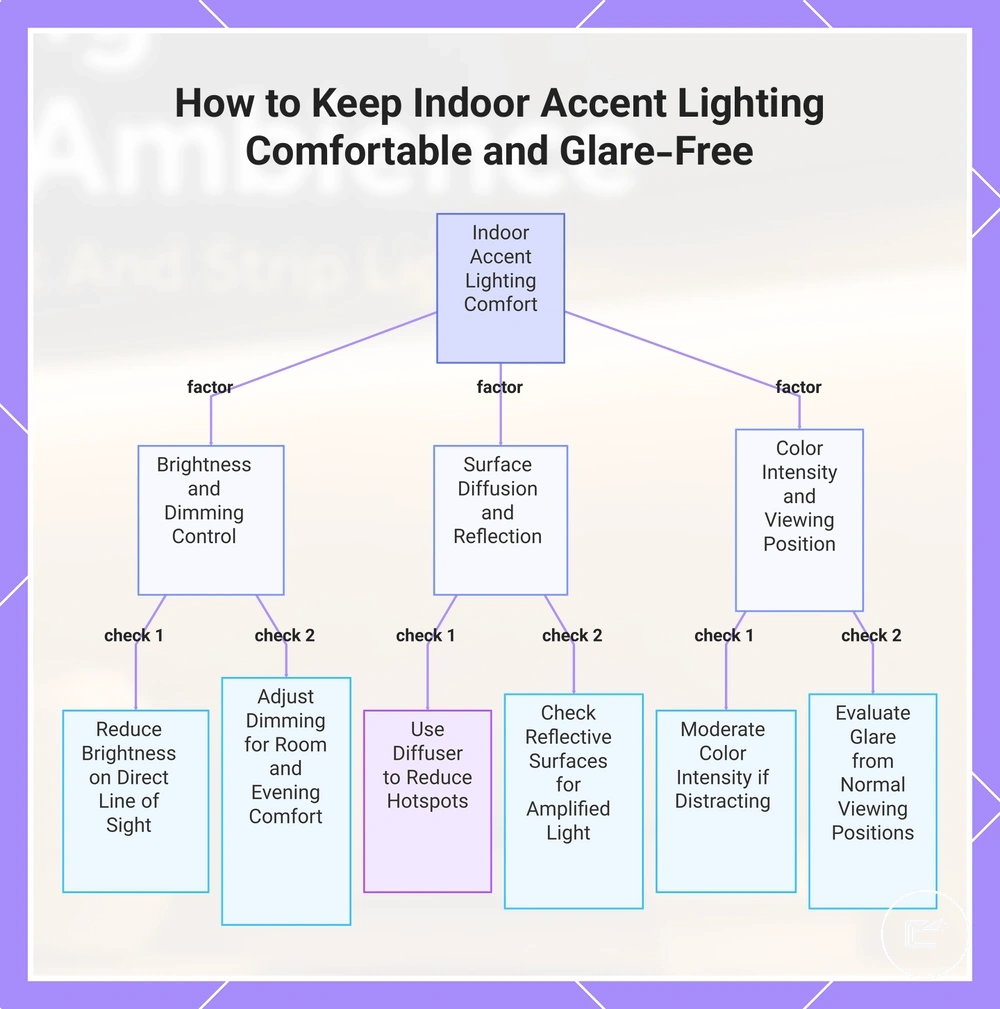
Keeping Indoor Accent Lighting Comfortable and Glare-Free requires evaluating multiple conditions before adjusting the lighting effect. The checklist below highlights practical decision signals that may help reduce harshness while maintaining the intended ambient effect.
- Reduce brightness when direct line of sight makes glare more noticeable.
- Use a diffuser when visible hotspots reduce softness or increase visual distraction.
- Check reflective surfaces that may amplify reflected light and affect visual comfort.
- Adjust the dimming level according to room conditions and desired evening comfort.
- Moderate color intensity when stronger lighting effects appear distracting within the space.
- Evaluate glare control from normal viewing positions rather than from the light source itself.
This chart shows the main decision signals for reducing harshness and achieving glare-free indoor accent lighting.
Brightness, Beam Spread, and Surface Reflection
Brightness, beam spread, and surface reflection determine whether indoor accent light appears soft or harsh because these criteria influence how light is distributed and perceived within a space. Higher lumen output, a narrower beam direction, or stronger surface reflection may increase glare under certain conditions, while diffuser presence and appropriate strip distance can support visual softness. Together, these factors shape perceived comfort.
Brightness, beam spread, strip distance, and reflective material should be evaluated as local conditions rather than fixed rules. A glossy surface or a close viewing angle may make light output appear more intense, while a diffuser can help distribute light more evenly across a surface. The table below organizes the main criteria used to evaluate glare, reflection, and perceived comfort.
| Criterion | Condition | Possible effect | Adjustment cue |
|---|---|---|---|
| Brightness | Higher lumen output in a visible area | May increase glare or visual intensity | Reduce light output or adjust dimming level |
| Beam spread | Narrow beam direction toward a surface or viewer | May create concentrated brightness | Use a wider spread or redirect the beam |
| Strip distance | Light source positioned close to the viewing area | May make brightness appear stronger | Increase strip distance when practical |
| Diffuser presence | Diffuser installed over the light source | May improve softness and reduce hotspots | Consider diffusion when glare is noticeable |
| Surface reflection | Glossy or highly reflective material | May amplify reflected light and glare | Adjust beam direction or brightness |
Color Intensity and Evening Comfort
Color intensity and evening comfort depend on saturation, brightness, color temperature, and room activity. Higher color intensity or brightness can make ambient lighting feel more visually prominent, while a softer setting may create a more restrained mood effect. The balance between these factors often influences eye comfort and evening comfort.
During evening use, adjustment choices depend on the intended activity and the desired ambience. Lower brightness, moderated saturation, and an appropriate dimming level may reduce visual intensity when the room activity involves quiet or low-focus tasks, while stronger settings may suit more active use. Practical adjustment cues include:
- Reduce saturation when color strength becomes more noticeable than the intended mood effect.
- Use a lower brightness setting through dimming when a softer evening ambience is preferred.
- Adjust color temperature according to room activity and the desired visual atmosphere.
- Evaluate eye comfort based on the combined effect of brightness, saturation, and viewing conditions rather than a single setting.
Choosing Accessories That Match the Intended Ambience
Choosing accessories depends on matching the ambience goal to the appropriate accessory type and control needs. The intended room effect should determine whether the setup requires a specific LED strip type, a diffuser channel, a COB option, a dimmer, or a controller. This selection frame keeps the focus on light tone, smoothness, control fit, and practical placement conditions.
Light tone influences mood direction, diffusion influences smoothness, and control options influence how easily the ambience can change. A diffuser channel can improve visual softness when visible light points are undesirable, while a COB option may suit setups where continuous light appearance supports the intended room effect. A dimmer or controller may be justified when brightness adjustment or color mode flexibility is part of the ambience goal, and power mention remains relevant because power access can affect clean ambience and practical fit.
Choosing Accessories That Match the Intended Ambience becomes easier when the selection criteria are organized around ambience goals, accessory choices, operating conditions, and decision cues.
| Ambience goal | Accessory choice | Condition | Decision cue |
|---|---|---|---|
| Simple warm ambience | Warm white LED strip type with dimmer | Consistent light tone and limited adjustment needs | May be sufficient when the intended room effect remains stable |
| Smooth visible glow | Diffuser channel or COB option | Visible light points or exposed lighting edges | Choose based on the desired level of diffusion and smoothness |
| Adjustable white ambience | Tunable white strip with controller | Room activity changes throughout the day | May suit spaces that benefit from changing light tone |
| Color-based ambience | RGB setup with controller and color mode options | Accent color supports the ambience goal | Consider when color variation contributes to the intended room effect |
A simple warm white setup may be enough when a steady ambience is the primary objective. Tunable white may be justified when room activity requires greater flexibility in light tone, while RGB control may fit situations where color mode changes support the intended room effect. The practical trade-off is selecting only the accessory types needed to achieve the ambience goal without adding unnecessary control complexity.
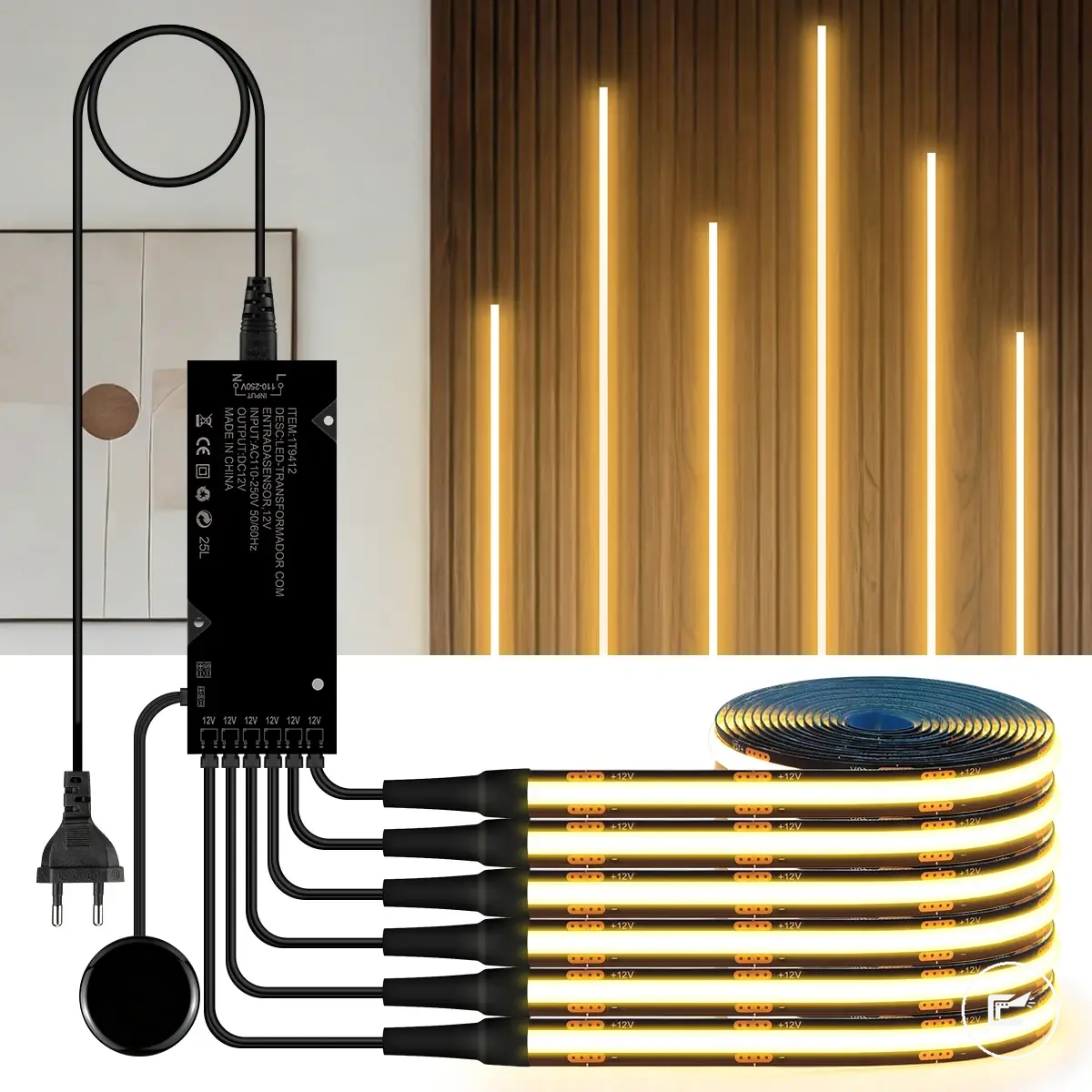
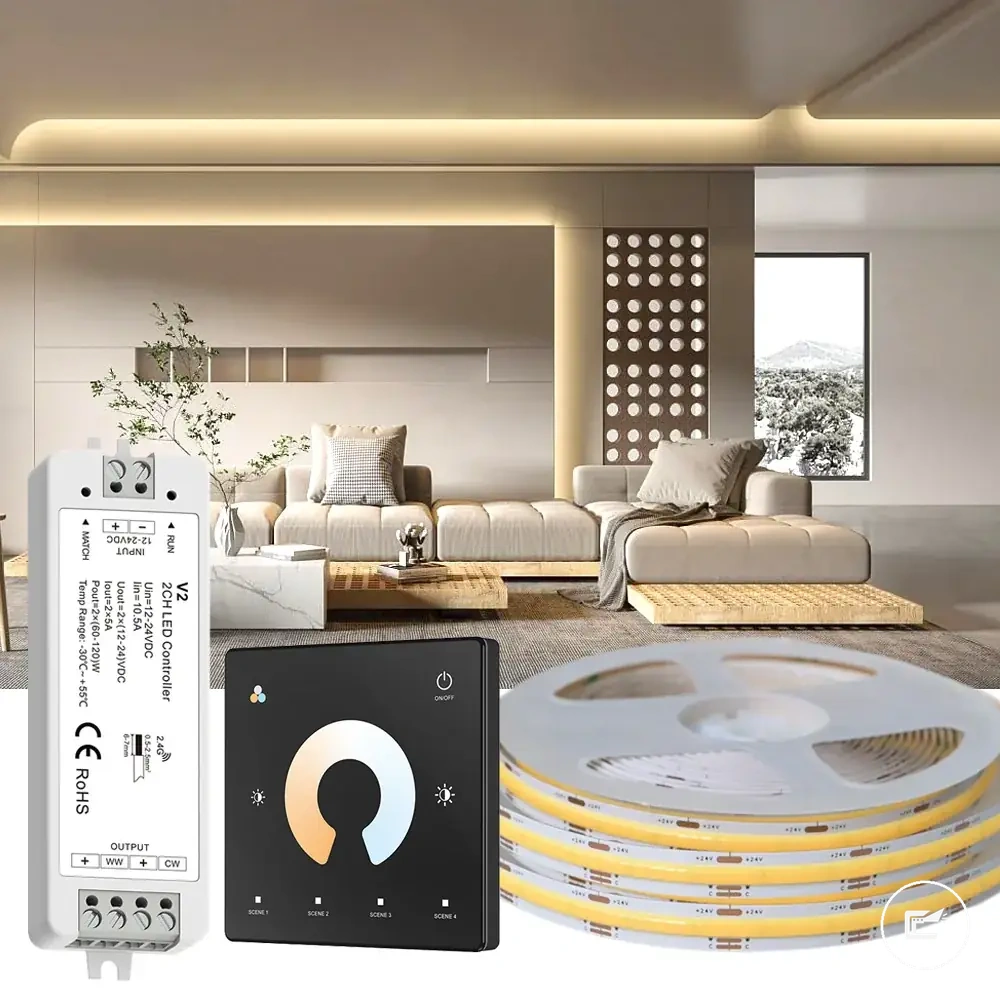
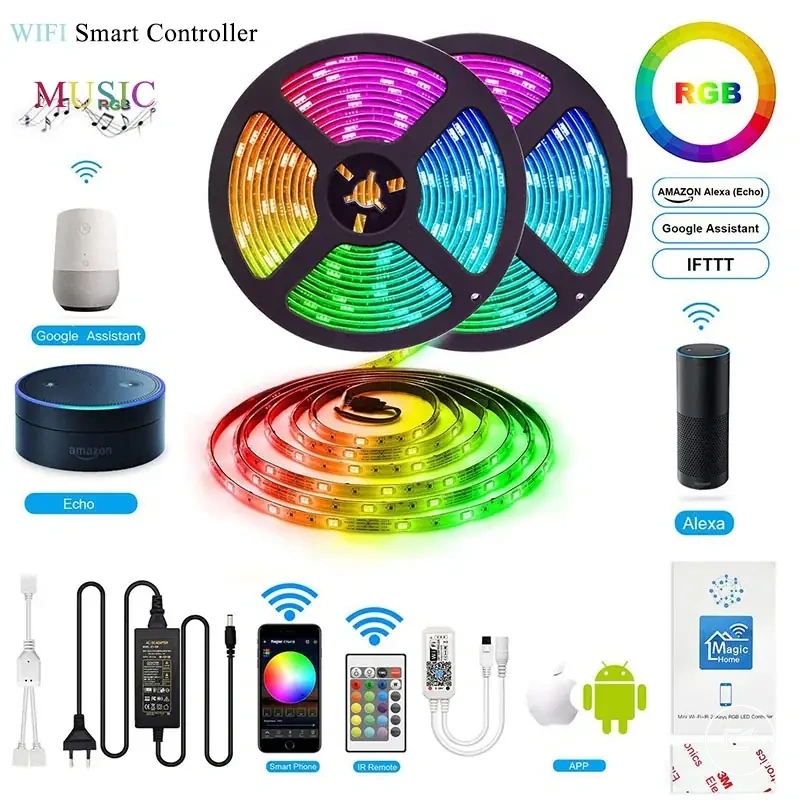
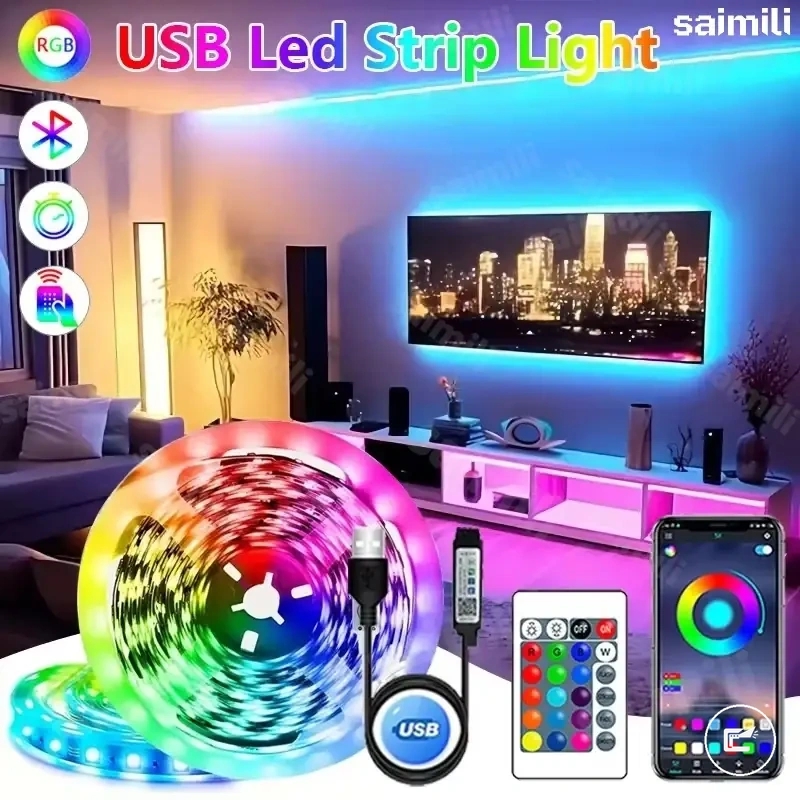
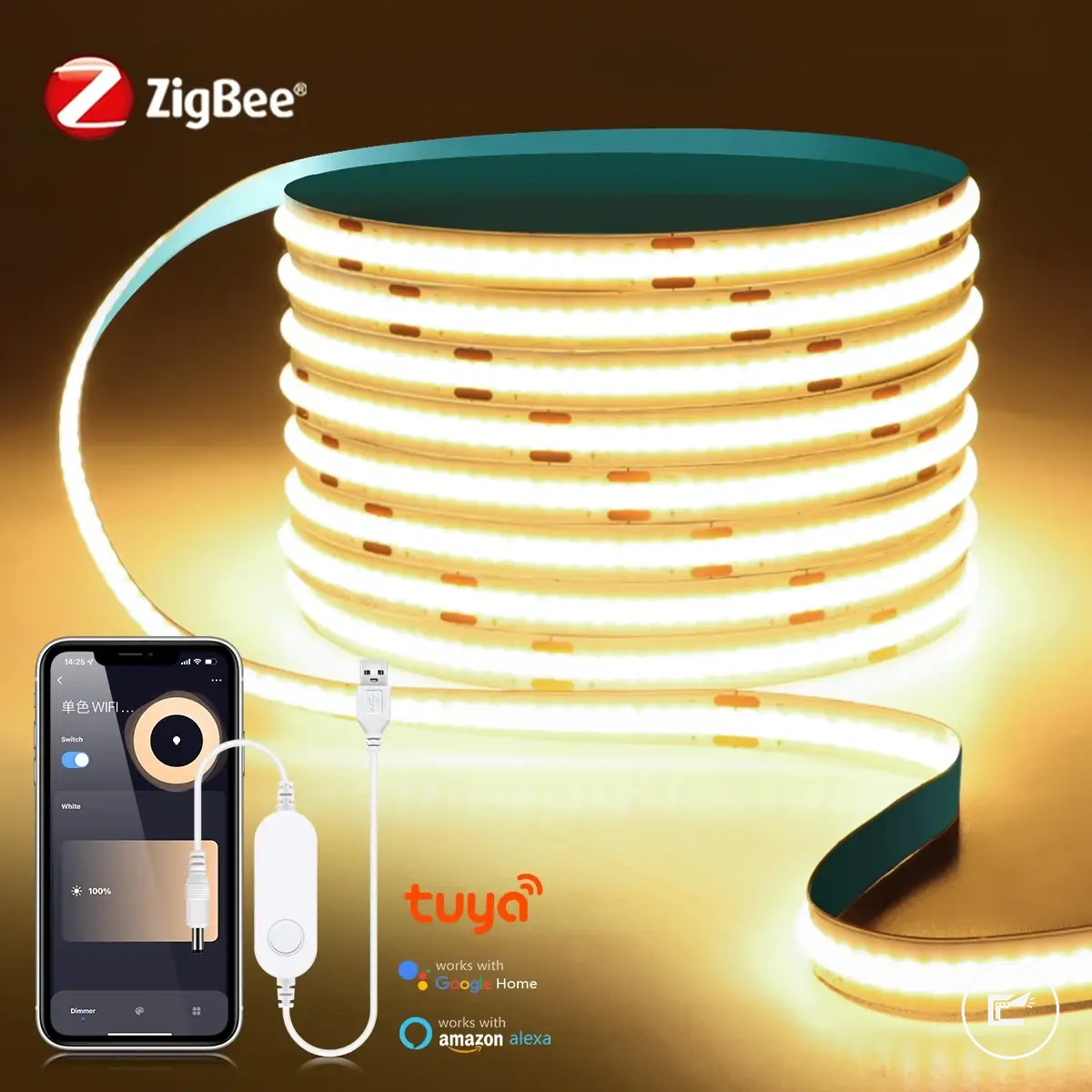
Here are product examples that may make comparison easier. Before buying, always review the compatibility criteria, essential features, and product details.
Strip Type, Diffusion, Dimming, and Control Fit
Strip type, diffusion, dimming, and control fit depend on how these elements work together to support the desired ambience outcome. Strip format influences the appearance of the light source, the diffuser method influences perceived smoothness, and brightness control influences how strongly the lighting effect is experienced. Controller compatibility matters when dimming or color adjustments are required, and the overall control fit depends on the combined accessory match rather than a single component.
A compact example is an ambience goal focused on a soft and unobtrusive glow. In that condition, a strip type combined with an appropriate diffuser method, suitable brightness control, and compatible controller may create a closer setup fit than changing only one element. Strip Type, Diffusion, Dimming, and Control Fit can be checked through these conditions:
- Confirm that the strip format supports the intended ambience outcome.
- Choose a diffuser method when smoothness choice is more important than direct light visibility.
- Verify that brightness control provides the adjustment range needed for the room effect.
- Check controller compatibility when dimming or color-control functions are part of the setup.
- Evaluate control fit based on the combined accessory match and the desired ambience outcome.
Power Method Mentions Without Expanding Into Installation
Power method compatibility depends on whether power access, controller placement, and the low-voltage setup support the intended ambience planning goals. These factors can influence cable visibility, controller location, and the overall visual outcome of the lighting arrangement. Within this section, the power method serves only as a practical planning boundary rather than an installation workflow.
Power access and controller placement may affect how easily a clean ambience is maintained, particularly when a visible cable becomes part of the viewing area. Cable visibility, room layout, and the location of the power access point can influence the practical fit of the setup, while low-voltage setup conditions may shape compatibility considerations. The following cues help keep power method mentions aligned with ambience planning:
- Consider power access and controller placement as factors that may influence clean ambience.
- Assess visible cable risk according to placement, room layout, and visual outcome.
- Evaluate low-voltage setup conditions as a compatibility boundary rather than an installation decision.
- Use power method considerations as a setup constraint for ambience planning.
Boundary cue: installation details, wiring discussions, and detailed compatibility checks belong to more specialized topics, while this subsection remains focused on ambience fit.