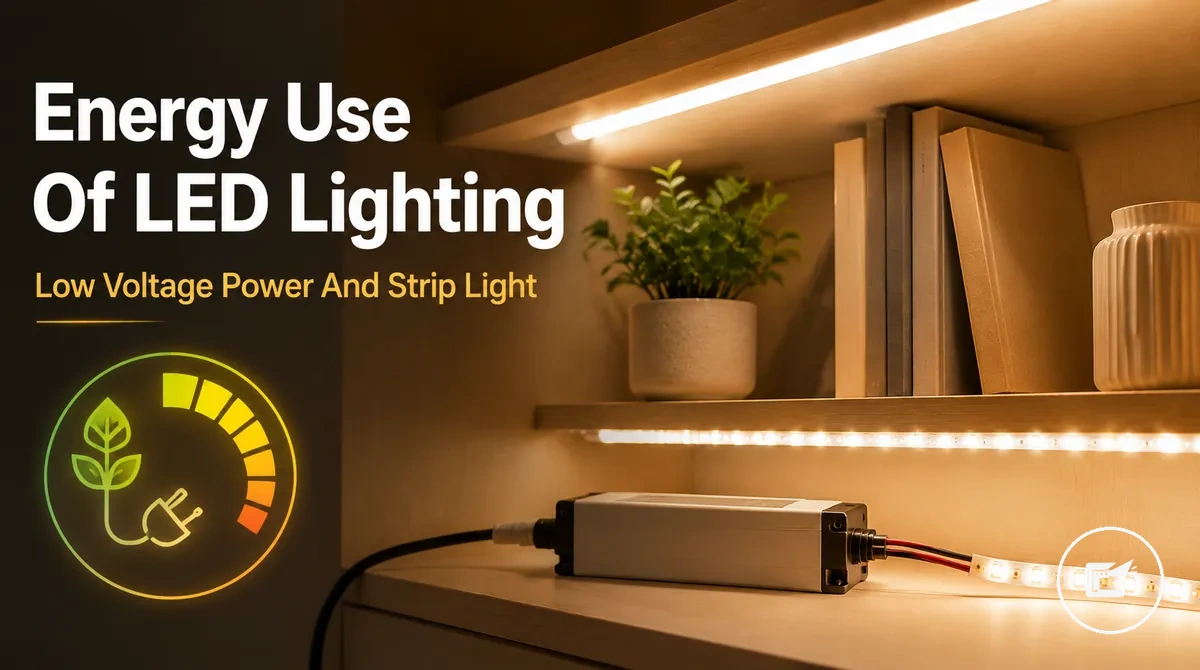
Home LED strip and cabinet lighting energy use
Home LED strip and cabinet lighting energy use is usually low in normal household use, but the exact electricity cost is not fixed. Cost changes with wattage, installed length, operating hours, brightness controls, power supply behavior, and local electricity price.
Rated watts describe the power an LED strip may draw under stated conditions, while actual use can change with a dimmer, controller setting, timer, motion control, or daily use pattern. Electricity use is measured through kWh, so wattage and runtime need to be understood separately before monthly cost is estimated. In this article, home LED strip and cabinet lighting accessories are treated as a lighting setup where strips, controls, and power parts work together to affect energy use.
A short under-cabinet strip used for evening task lighting may consume less electricity than a longer shelf or display run used for many hours. The same cabinet lighting can also have a different running cost when the brightness level is reduced, the power supply has standby draw, or the local electricity rate changes. The next step is to separate LED strip wattage, installed length, and operating hours before estimating electricity cost.
How LED strips use electricity in cabinet lighting
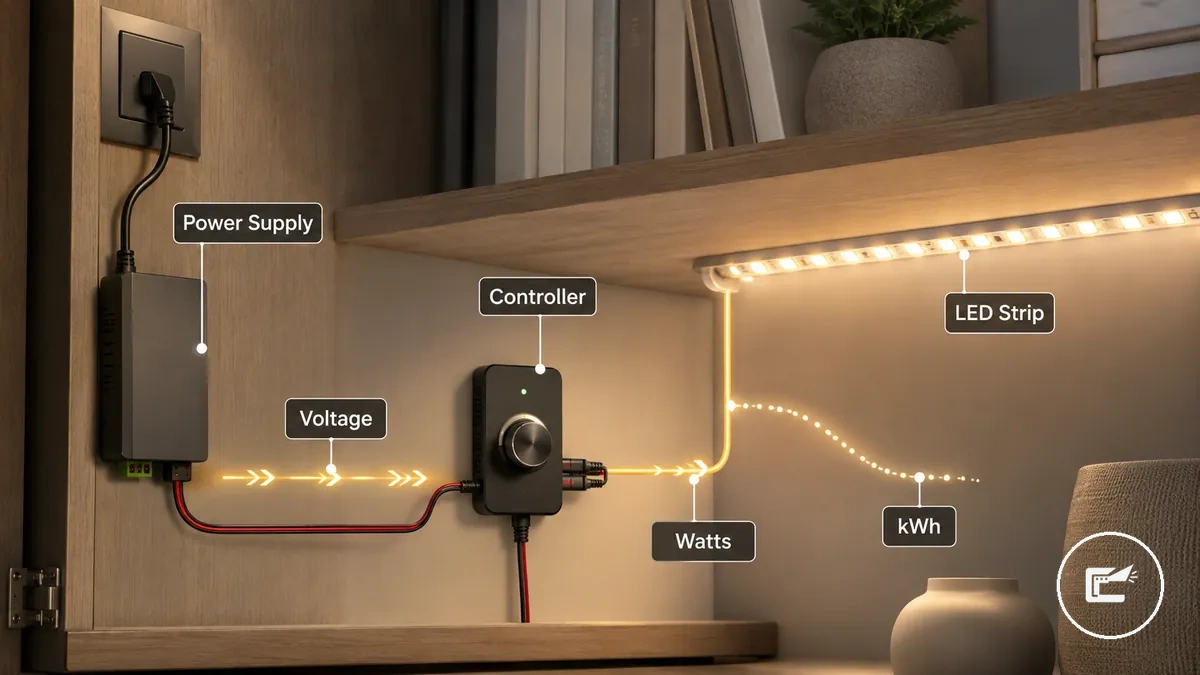
LED strips use electricity in cabinet lighting through a low-voltage circuit that delivers power to the LEDs for cabinet, shelf, or under-cabinet illumination. A power supply provides usable power for the LED strip, while a controller or dimmer may adjust brightness and operating behavior. Watts are the practical measurement used to describe power draw.
The electricity path typically starts at the power supply, passes through a controller or dimmer when present, and reaches the LED strip through the low-voltage circuit. Voltage and current work together to create watts, which describe how much power the LED strip uses at a given moment. When a dimmer changes the brightness level, actual power draw may also change depending on controller behavior and system design. A common example is cabinet lighting that uses a power supply and controller to operate an LED strip beneath a cabinet or shelf.
How LED strips use electricity in cabinet lighting becomes easier to understand when voltage, watts, watt-hours, and kilowatt-hours are viewed together. The table below organizes the key measurements used to describe energy consumption.
| Concept | What it means | Why it matters for energy use |
|---|---|---|
| Voltage | The electrical potential supplied to the system. | Helps define operating conditions but does not measure energy consumption by itself. |
| Watts | The rate of power draw at a given moment. | Shows how much power the LED strip uses while operating. |
| Watt-hours | Watts used over a period of operating time. | Connects power draw to accumulated electricity use. |
| Kilowatt-hours | A larger unit of energy based on accumulated watt-hours. | Commonly used to represent electricity use over time. |
Voltage, watts, and operating time describe different parts of energy consumption. Watts combined with operating time determine watt-hours, and watt-hours accumulate into kilowatt-hours. Voltage alone does not determine energy cost because electricity use also depends on power draw and operating time.
Wattage factors that change LED strip power consumption
LED strip power consumption depends on the attributes that determine total wattage and real operating conditions. Higher wattage, longer strip length, and increased brightness usually increase energy use when operating time remains similar. The main wattage factors include strip length, watts per metre, LED density, chip type, brightness setting, color mode, 12V or 24V system design, and power supply capacity.
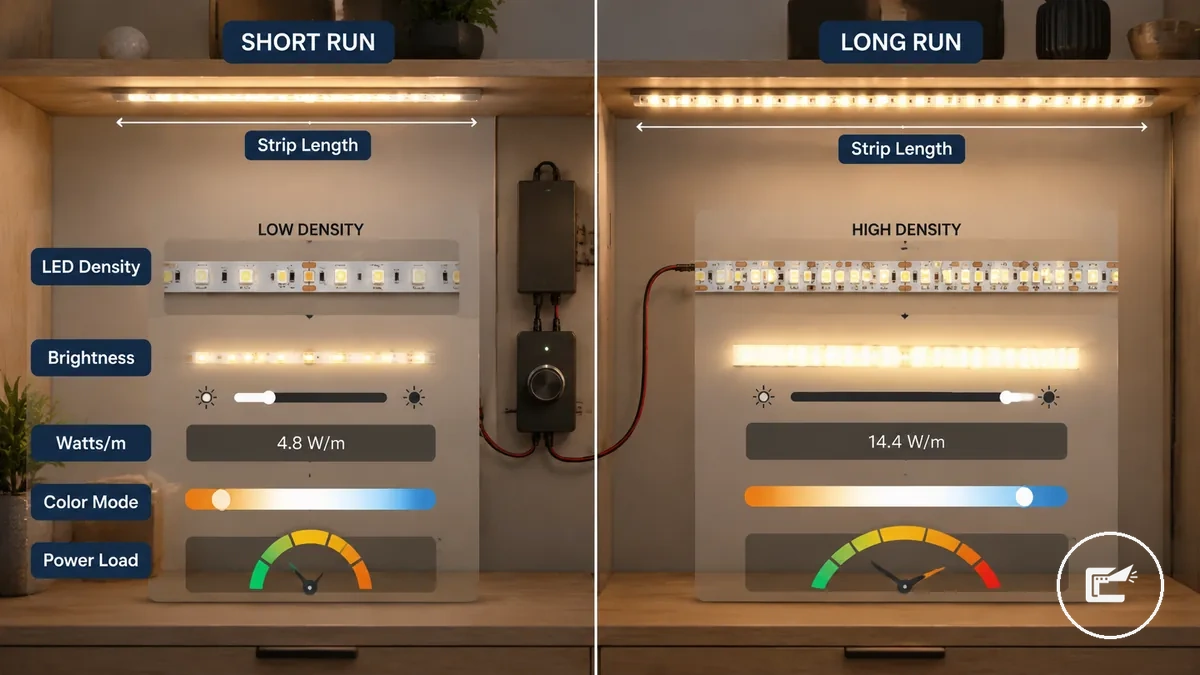
Wattage factors that change LED strip power consumption can be grouped into physical strip factors, control factors, and power-system factors. The EAV table below shows how each attribute can affect power draw under different conditions.
| Entity/part | Attribute/criterion | Value/condition | Effect on power draw |
|---|---|---|---|
| LED strip | Strip length | Short run vs long run | Longer strip length usually increases total wattage and power draw. |
| LED strip | Watts per metre | Lower or higher rated watts | Higher watts per metre generally increases power consumption. |
| LED strip | LED density | Fewer or more LEDs per metre | Higher LED density can increase energy use when operated at similar brightness levels. |
| LED strip | Brightness setting | Dimmed or full output | Lower brightness settings may reduce actual power draw. |
| LED strip | Color mode | Single-color or RGB operation | Power consumption can vary depending on controller behavior and active color channels. |
| Power system | Power supply capacity | Different load conditions | Actual energy use may vary with load, power supply behavior, and voltage system conditions. |
A short cabinet-lighting run often requires less total wattage than a longer decorative run because fewer illuminated sections are active. Chip type, LED density, and brightness setting can further influence strip power, while 12V and 24V system design should be evaluated as local attributes rather than assuming one voltage system is always lower in power consumption.
Watts per metre and total strip length
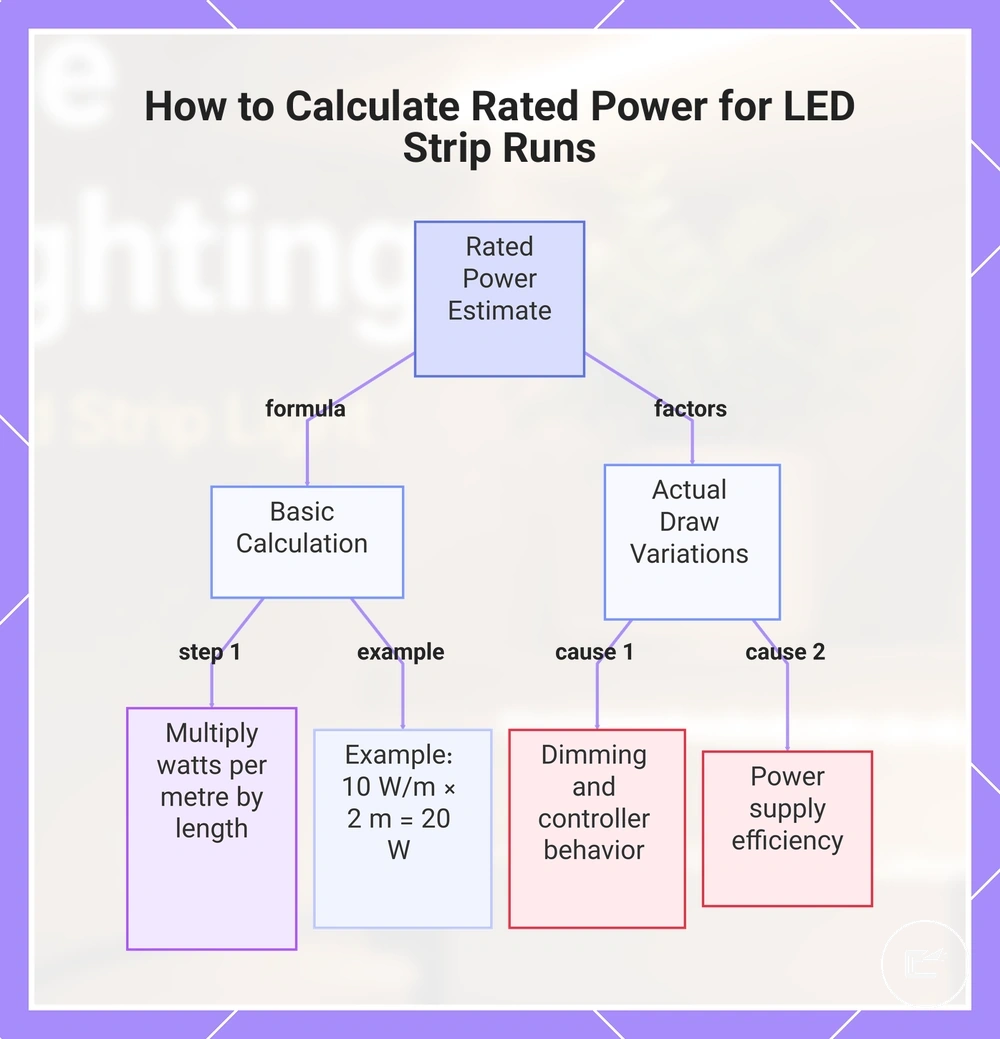
Watts per metre and total strip length determine the basic rated power estimate for a strip run. Rated power is calculated by multiplying watts per metre by the installed length, which gives the estimated total watts for that strip run.
For example, a strip with a rated power of 10 watts per metre and an installed length of 2 metres has an estimated total watts value of 20 watts. If the strip run is cut shorter, the rated power estimate decreases, while an extended run increases the estimate. Actual draw may vary because dimming, controller behavior, and power supply efficiency can influence real draw compared with the rated power estimate.
This chart shows the formula to estimate rated power from watts per metre and strip length, along with factors that cause actual power draw to differ.
LED density, brightness, and strip type
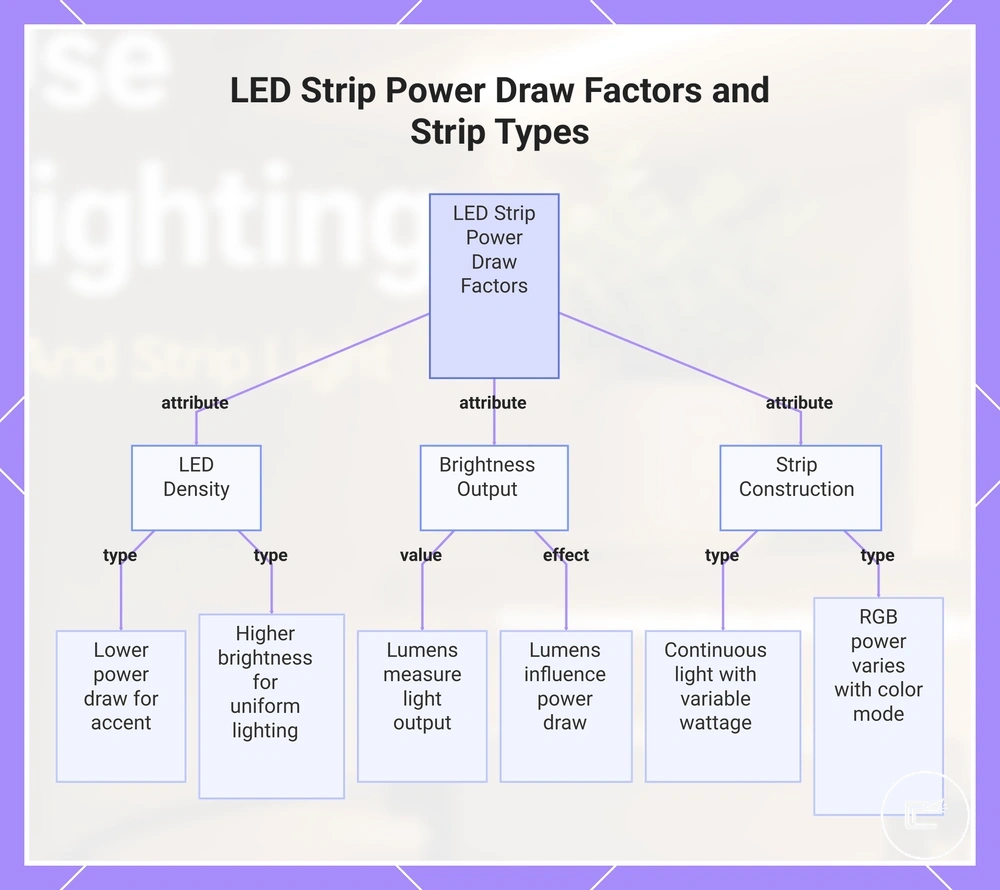
LED density, brightness output, and strip type are attributes that can influence power draw within a strip run. LED density, lumens, and strip construction affect how much light output is produced and how much power may be required under similar operating conditions, linking visible strip design to power demand.
The relationships below show how strip type, LED density, and brightness output can affect power draw. Each factor should be evaluated by its local design and operating conditions rather than by strip type alone.
- Low-density strip: Lower LED density may result in lower power draw than a comparable high-density strip; often used for light accent lighting in cabinets.
- High-density strip: Higher LED count can increase brightness output and may increase power draw when operated at a similar brightness level; often used where more uniform cabinet lighting is desired.
- COB strip: COB strip construction can provide continuous light, and wattage may vary depending on LED density, brightness output, and strip design.
- RGB strip: RGB strip power consumption can vary with color mode, controller behavior, and active color channels; cabinet accent lighting is one possible use case.
- Single-color strip: A single-color strip may have different power demand depending on brightness output and lumens; it is often used for task lighting or accent lighting with consistent light output.
This chart shows the main attributes that affect LED strip power draw and the characteristics of different strip types.
12V and 24V power draw differences
12V and 24V power draw differences are not determined by voltage alone. A 12V strip and a 24V strip with equal wattage used for equal runtime consume similar energy, because watts and time determine energy use. Voltage affects current flow and system behavior, while watts remain the key measure of power consumption.
The comparison below separates what voltage can influence from what voltage does not decide by itself. Run length, voltage drop, current, amps, and power supply sizing may vary between low-voltage system designs, but compatibility details depend on the specific strip and power supply.
| What voltage changes | What voltage does not decide alone |
|---|---|
| 12V strip systems may require higher amps for the same watts and can be more sensitive to voltage drop over a longer run length. | Voltage alone does not determine energy use when equal wattage operates for equal runtime. |
| 24V strip systems may use lower current for a similar electrical load and can help reduce voltage drop on longer runs. | Voltage alone does not determine power draw without considering watts. |
| Power supply sizing depends on voltage, current, watts, and the requirements of the strip run. | Voltage alone does not determine energy cost without considering total energy consumption. |
Calculating electricity cost for LED strips
Electricity cost for LED strips is estimated by calculating energy use in kWh and multiplying it by the electricity rate. The basic relationship is: electricity cost = (total wattage × hours used × monthly days ÷ 1000) × electricity rate. Total wattage, hours used, monthly days, kWh, and electricity rate are the variables that determine the cost calculation.
Calculating electricity cost for LED strips becomes easier when the formula is organized into separate inputs. The table below shows the variables used to estimate energy cost and monthly running cost.
| Variable | Meaning | Example value |
|---|---|---|
| Total wattage | Total power draw of the strip run | 20 W |
| Hours used | Daily operating time | 5 hours |
| Monthly days | Days used during a month | 30 days |
| kWh | Energy consumed after conversion from watts and time | Calculated value |
| Electricity rate | Local price per kWh | Local tariff |
Calculating electricity cost for LED strips is illustrated in the diagram below, which clarifies how total watts, hours used, kWh conversion, and electricity rate combine into an estimated running cost.
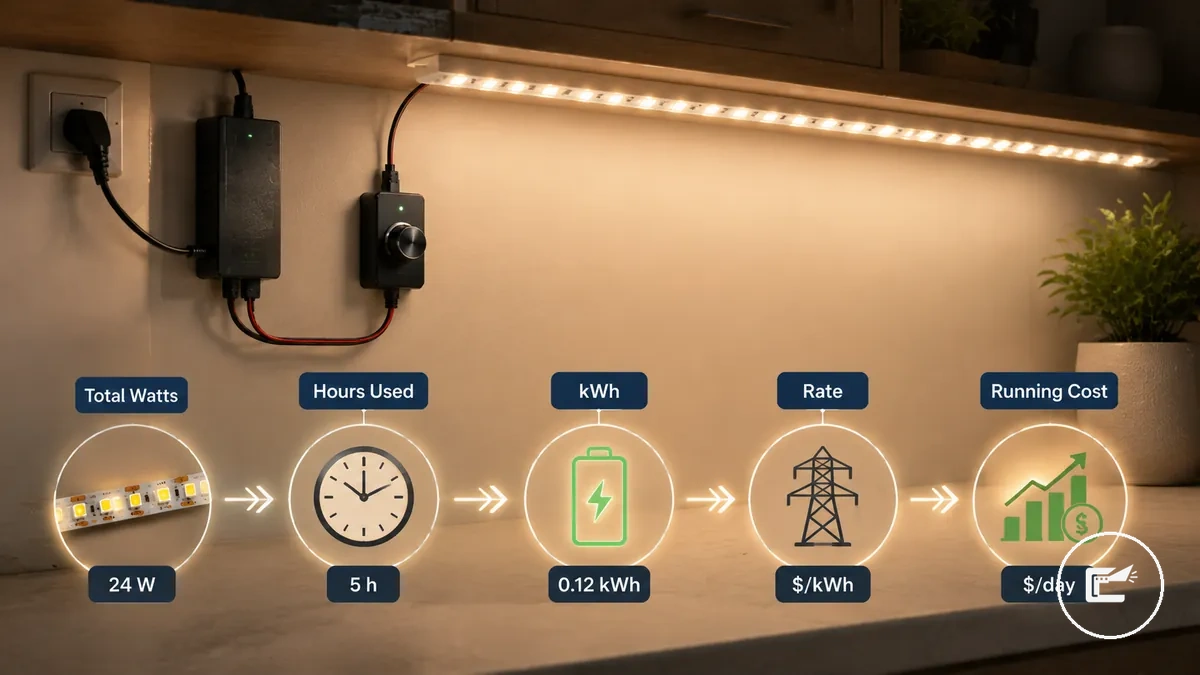
In a cabinet lighting scenario, a strip run with a known total wattage can be combined with daily use and monthly use to estimate kWh consumption. The calculated kWh value can then be multiplied by the local electricity rate to estimate monthly running cost. Dimming, installed length, and actual operating patterns may change the final estimate compared with expected use. Installation cost is a separate cost category from operating cost, and local electricity rates can cause the final cost outcome to vary.
Hourly, daily, and monthly running cost
Hourly, daily, and monthly running cost change as runtime increases when wattage and electricity rate remain the same. The same LED strip wattage can produce different cost outcomes over an hour, a day, or a month because longer runtime increases energy consumption. The comparison below assumes a fixed wattage, a fixed runtime pattern, and a rounded estimate for calculation purposes.
Hourly, daily, and monthly running cost can be compared by applying the same wattage, kWh conversion, and electricity rate across different runtime periods. Use the table as a calculation guide and substitute your local electricity price when estimating household use.
| Runtime period | Calculation basis | Estimated cost cue |
|---|---|---|
| Hourly cost | Wattage × runtime of 1 hour → kWh conversion × electricity rate | Lowest cost level for the shortest operating period |
| Daily cost | Wattage × daily runtime → kWh conversion × electricity rate | Increases as daily operating hours increase |
| Monthly cost | Wattage × daily runtime × monthly days → kWh conversion × electricity rate | Reflects cumulative use over the longest period |
Cabinet lighting operating cost versus installation cost
Cabinet lighting operating cost versus installation cost refers to two separate cost categories. Operating cost comes from ongoing electricity use during runtime, while installation cost is a one-time cost associated with purchasing and setting up the lighting system. The two categories are operating cost and installation cost.
Cabinet lighting operating cost versus installation cost becomes easier to compare when energy-related expenses are separated from setup-related expenses. The contrast block below identifies what each category typically includes and helps distinguish running cost from total setup cost.
| Operating cost | Installation or setup cost |
|---|---|
| Electricity use during runtime | LED strip purchase |
| Ongoing energy consumption | Controller purchase |
| Power supply losses during operation | Mounting accessories and related hardware |
| Running cost that can vary with usage patterns | Installation complexity that may affect setup requirements |
A cabinet lighting system may have a relatively low running cost while still requiring a higher one-time cost when additional components or mounting accessories are included. Total cost can vary depending on both long-term electricity use and the overall setup configuration.
Energy efficiency compared with traditional cabinet lighting
Energy efficiency compared with traditional cabinet lighting is generally higher with LED strips because they can provide useful brightness with lower watts and less heat output than many older lighting options. LED strips and traditional cabinet lighting differ in how efficiently electricity is converted into visible light, which can influence energy use and cost-value outcomes. In this context, energy efficiency means useful brightness relative to the electricity used.
Energy efficiency compared with traditional cabinet lighting becomes easier to evaluate when watts, heat output, usable brightness, and cost-value implications are compared side by side. The table below summarizes common lighting types used in cabinet lighting applications.
| Lighting option | Typical energy-use behavior | Heat or brightness note | Cost-value implication |
|---|---|---|---|
| LED strips | Often provide useful brightness with relatively low watts. | Usually produce less heat output while maintaining usable brightness. | Can support lower electricity use when the lighting layout matches the application. |
| Incandescent cabinet lights | Typically use higher wattage for similar lighting tasks. | Often generate more heat output during operation. | May increase energy use over time compared with many efficient lighting options. |
| Halogen cabinet lights | Commonly operate with higher power use than many LED strips. | Can provide strong brightness but may produce noticeable heat. | Cost-value depends on runtime, layout, and operating conditions. |
| Fluorescent options | Often use less power than incandescent lighting, though performance varies by product type. | Can balance brightness and energy use with different trade-offs. | May provide moderate energy efficiency in cabinet lighting applications. |
Practical energy efficiency depends on more than lighting technology alone. Poor layout, excessive brightness, and weak controls can increase power use even when LED strips are installed. Practical savings may improve when useful brightness, runtime, and control settings are aligned with the actual lighting requirement.
Low wattage choices for efficient cabinet lighting
Low wattage choices for efficient cabinet lighting depend on whether the selected power level can provide the desired brightness for the intended use. Low wattage LED strips can reduce power demand, but suitability depends on cabinet size, lighting purpose, and installation conditions. Low wattage must still meet the lighting task.
Task lighting often requires more usable light than accent lighting, so the same watts per metre may produce different outcomes depending on the application. Cabinet size, surface reflectance, diffuser use, and strip placement can influence how effectively light reaches the target area and how bright the space appears. A low-power strip may be suitable for accent lighting in a compact cabinet, while task lighting may require greater brightness to reduce the risk of under-lighting.
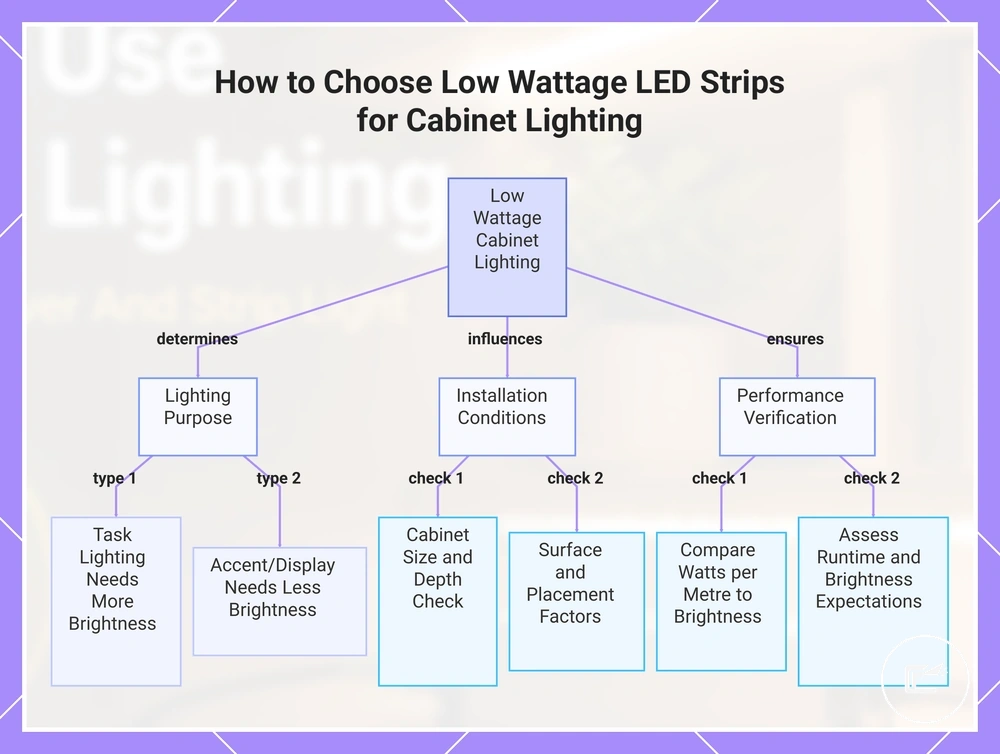
Low wattage choices for efficient cabinet lighting are easier to assess when key decision signals are reviewed before selecting a power level. Use the checklist below to compare lighting needs with expected performance, while keeping in mind that insufficient watts per metre may lead to under-lighting.
- Check whether cabinet size and depth are appropriate for a low wattage lighting approach.
- Confirm whether the primary goal is task lighting, accent lighting, or display and night lighting.
- Consider whether dark surfaces or low surface reflectance may reduce perceived brightness.
- Evaluate whether a diffuser may change how usable light is distributed within the cabinet.
- Review strip placement to determine how effectively light reaches the intended area.
- Compare watts per metre with the desired brightness instead of selecting the lowest power level automatically.
- Assess runtime and brightness expectations to verify that the lighting outcome remains functional for the application.
This chart shows the key factors to check when selecting low wattage LED strips for cabinet lighting, including lighting purpose, installation conditions, and performance verification.
When lower wattage is enough for cabinets
Lower wattage can be enough for cabinet lighting when the intended use does not require high light output and the cabinet conditions support usable brightness. Suitability depends on cabinet depth, ambient light, surface color, runtime, and the lighting task, with the main condition being that the application does not demand strong task lighting.
The examples below show situations where lower wattage may be appropriate and where caution may be needed. A failure case can occur when the work surface is far from the light source and the lighting task requires greater visibility.
- Accent shelves: Lower wattage may work when the goal is decorative highlighting rather than direct task lighting; darker surface color may reduce perceived brightness.
- Display cabinets: A low-power approach may be suitable when cabinet depth is limited and objects need gentle illumination; deeper spaces may require more usable light.
- Night lighting: Lower output can often support orientation and visibility during short runtime periods; expectations should match the intended use.
- Short runs: Lower wattage may be suitable for short runs where light is positioned close to the illuminated area; strip placement still influences the outcome.
- Cabinets with ambient light: Existing ambient light may reduce the need for higher output; changing room conditions can affect perceived brightness.
Brightness trade-offs with low power strips
Brightness trade-offs with low power strips depend on maintaining usable brightness while reducing power demand. Low power strips can lower energy use, but usable brightness depends on lumens, watts per metre, LED density, diffuser loss, and the lighting need. The key trade-off is selecting the lowest suitable power rather than the lowest possible power.
Brightness trade-offs with low power strips become easier to evaluate when brightness need, power implication, and likely outcome are compared together. Dimming range and color temperature can influence perceived light output and comfort, so suitability depends on the intended cabinet lighting conditions.
| Brightness need | Power implication | Suitable use | Risk if underpowered |
|---|---|---|---|
| Lower usable brightness | Lower watts per metre may be sufficient | Accent or display lighting | Items may appear less noticeable |
| Moderate usable brightness | Balance lumens, LED density, and power level | General cabinet lighting | Light coverage may feel uneven |
| Higher usable brightness | More light output may be required | Cabinets supporting detailed visual tasks | Lighting may not meet task needs |
| Lighting with a diffuser | Diffuser loss may reduce apparent output | Applications prioritizing smoother light distribution | Usable brightness may decrease if power is reduced too far |
| Adjustable brightness | Dimming range can support brightness control and energy use management | Changing lighting preferences or conditions | Limited flexibility if the starting output is already low |
Dimmers and usage controls that reduce energy use
Dimmers and usage controls that reduce energy use work by changing either brightness levels, runtime, or both. Energy use can decrease when cabinet lighting operates at a lower brightness setting or remains on for fewer hours. Brightness reduction and runtime reduction affect energy use differently, so they should be evaluated as separate control behaviors.
Dimmers adjust the brightness setting and may reduce energy use when lower light output still provides usable cabinet lighting. Timers reduce runtime through automatic shutoff, while motion sensors respond to occupancy patterns and may limit unnecessary operation. Reducing runtime can reduce energy use directly, while the effect of dimming depends on the lighting level selected and the controller behavior.
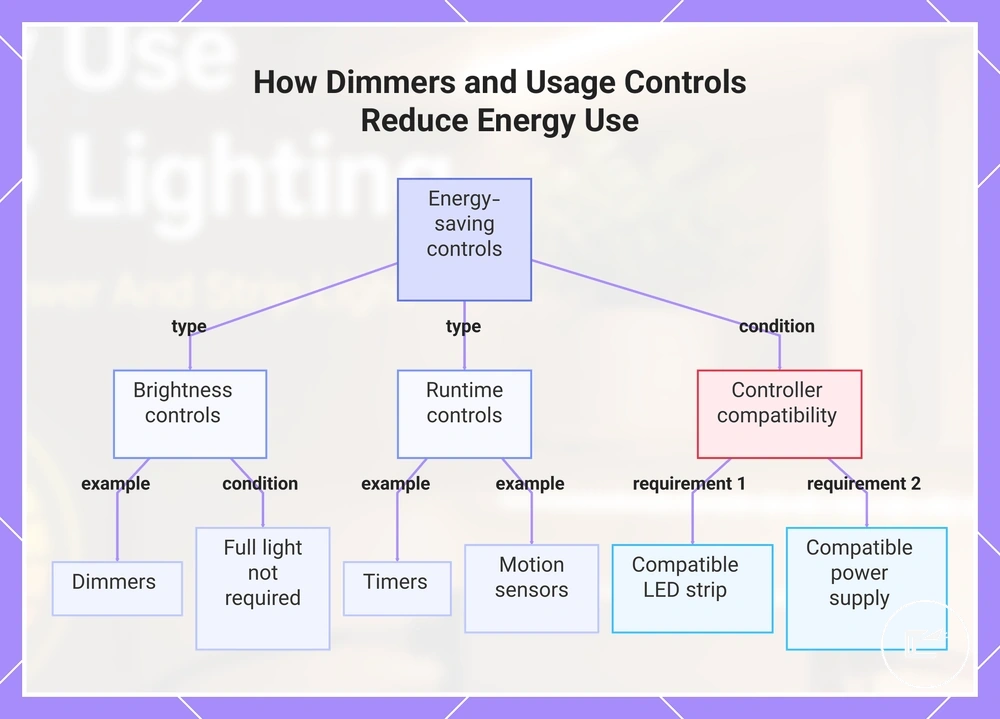
Dimmers and usage controls that reduce energy use are easier to compare when each control is viewed by what it changes and when it may help. The checklist below separates brightness controls from runtime controls and highlights that controller compatibility depends on the LED strip and power supply conditions.
- Dimmers: Change the brightness setting; may help when full light output is not required and lighting comfort remains acceptable.
- Timers: Change runtime through automatic shutoff; often help when cabinet lighting stays on longer than needed.
- Motion sensors: Change runtime based on occupancy patterns; may help where cabinet use is occasional or intermittent.
- Brightness settings: Adjust light output levels; may reduce energy use when lower output still provides usable brightness.
- Usage habits: Influence both runtime and lighting behavior; can affect overall energy use regardless of the control type.
- Controller compatibility: Affects whether dimmers, timers, or motion controls operate as intended with the LED strip and power supply configuration.
This chart shows the two main types of energy-saving controls (brightness and runtime) and the compatibility conditions required for effective operation.
Dimming, timers, and motion control
Dimming, timers, and motion control affect energy use through different mechanisms. Dimming changes reduced brightness through the selected dimmer level, while timers and motion control reduce runtime by limiting how long cabinet lighting remains active. The three control effects are reduced brightness, reduced runtime, and automatic shutoff.
Dimming, timers, and motion control can be compared by focusing on what each control changes and which factors influence the outcome. Energy effects may vary with controller type, sensor trigger behavior, and user habit, while compatibility depends on the LED strip and control configuration.
| Control | What changes | Energy effect | Caveat |
|---|---|---|---|
| Dimming | Reduced brightness through the selected dimmer level | May reduce power use when lower light output remains suitable | Outcome can vary by controller type and brightness setting |
| Timers | Reduced runtime through scheduled shutoff | Can reduce energy use by shortening operating time and increasing hours avoided | Effect depends on user habit and operating schedule |
| Motion control | Automatic shutoff based on sensor trigger patterns and cabinet use | May reduce active lighting time when occupancy is intermittent | Results can vary with sensor trigger behavior and usage patterns |
Power supply efficiency and standby consumption
Power supply efficiency and standby consumption depend on the relationship between the LED strip, power supply, controller, and operating conditions. Power supplies and controllers can affect real energy use beyond the LED strip's rated wattage because energy losses, standby draw, load percentage, and control behavior may influence total system consumption. LED strip rated wattage describes the lighting load, while power supply efficiency affects how effectively that load is supplied.
Power supply efficiency and standby consumption can be evaluated by separating each component into its attribute, condition, and effect. The table below highlights how power supply rating, load range, controller behavior, and standby draw may influence compatibility decisions and real energy use.
| Entity/part | Attribute/criterion | Value/condition | Effect or decision |
|---|---|---|---|
| Power supply | Power supply rating | Selected with a sizing margin above the expected operating load | May support stable operation while leaving additional capacity available |
| Power supply | Load percentage | Varies according to LED strip demand | Can influence power supply efficiency and heat generation |
| Power supply | Efficiency | Depends on operating conditions and load range | May affect real energy use beyond rated strip wattage |
| Controller | Standby draw | Present when the controller remains powered | Can contribute to standby consumption or idle consumption over time |
| Dimmer | Control level | Changes light output through dimmer adjustment | May influence energy use depending on the selected dimmer level |
| System | Heat | Changes with voltage, load percentage, and operating conditions | Can indicate how efficiently power is being handled |
A sizing margin is a compatibility and planning allowance rather than a measure of constant energy use. Extra power supply capacity does not mean the LED strip continuously draws that additional power because energy calculations are based on the expected operating load. Standby consumption may continue when a controller remains powered, even when lighting output is inactive. For broader compatibility details related to voltage, component selection, and operating requirements, see power supply planning.
Long-term value of efficient LED cabinet lighting
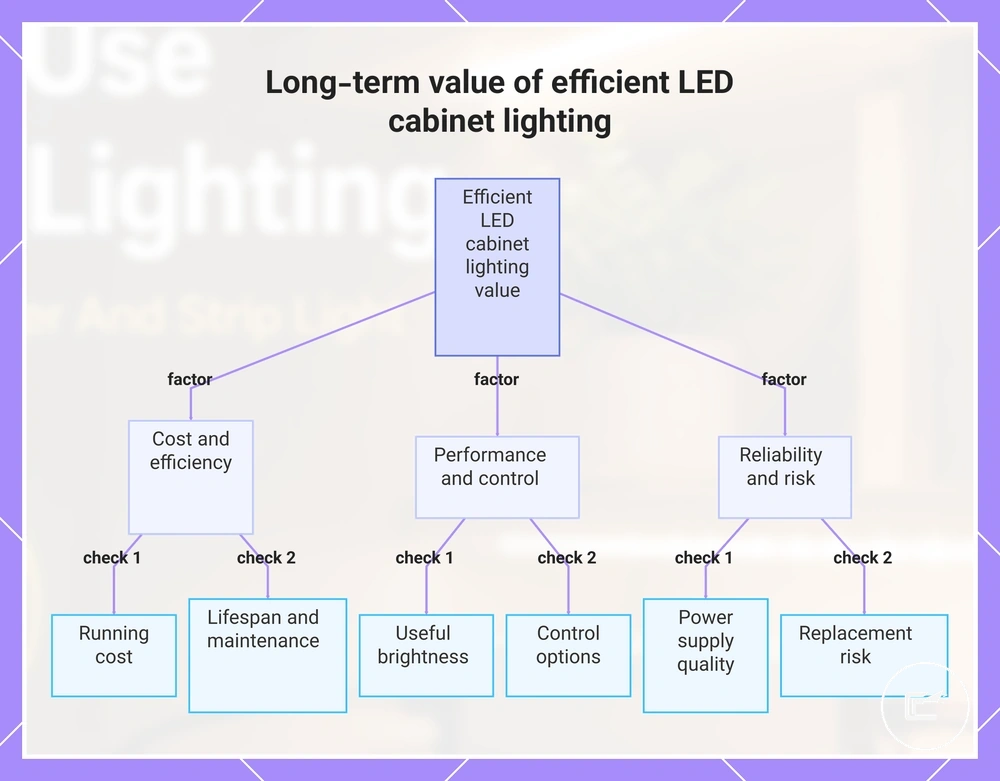
Long-term value of efficient LED cabinet lighting depends on both running cost and how well the lighting system matches the intended use. Lower energy use can contribute to value over time, but useful brightness, comfort, and control options also influence the outcome. Long-term value is the combination of cost and suitability rather than energy cost alone.
Energy cost is one part of long-term value because cabinet lighting may operate for many hours throughout its service life. Useful brightness matters because lighting that is too dim or unnecessarily powerful may reduce suitability for the intended task. Control options can help align energy use with actual lighting needs, depending on usage patterns and lighting preferences.
Lifespan and maintenance burden can influence ownership cost beyond day-to-day energy use. A lighting system that may require fewer replacements can reduce replacement risk and maintenance effort over time, although outcomes vary with operating conditions and power supply quality. As a value criterion, lifespan and maintenance can help assess long-term suitability alongside running cost and useful brightness.
Long-term value of efficient LED cabinet lighting is often easier to assess when decision criteria are considered together. The checklist below summarizes key value signals that may help compare efficient LED cabinet lighting with cheaper or higher-wattage alternatives. For a broader evaluation process, see the buying checklist.
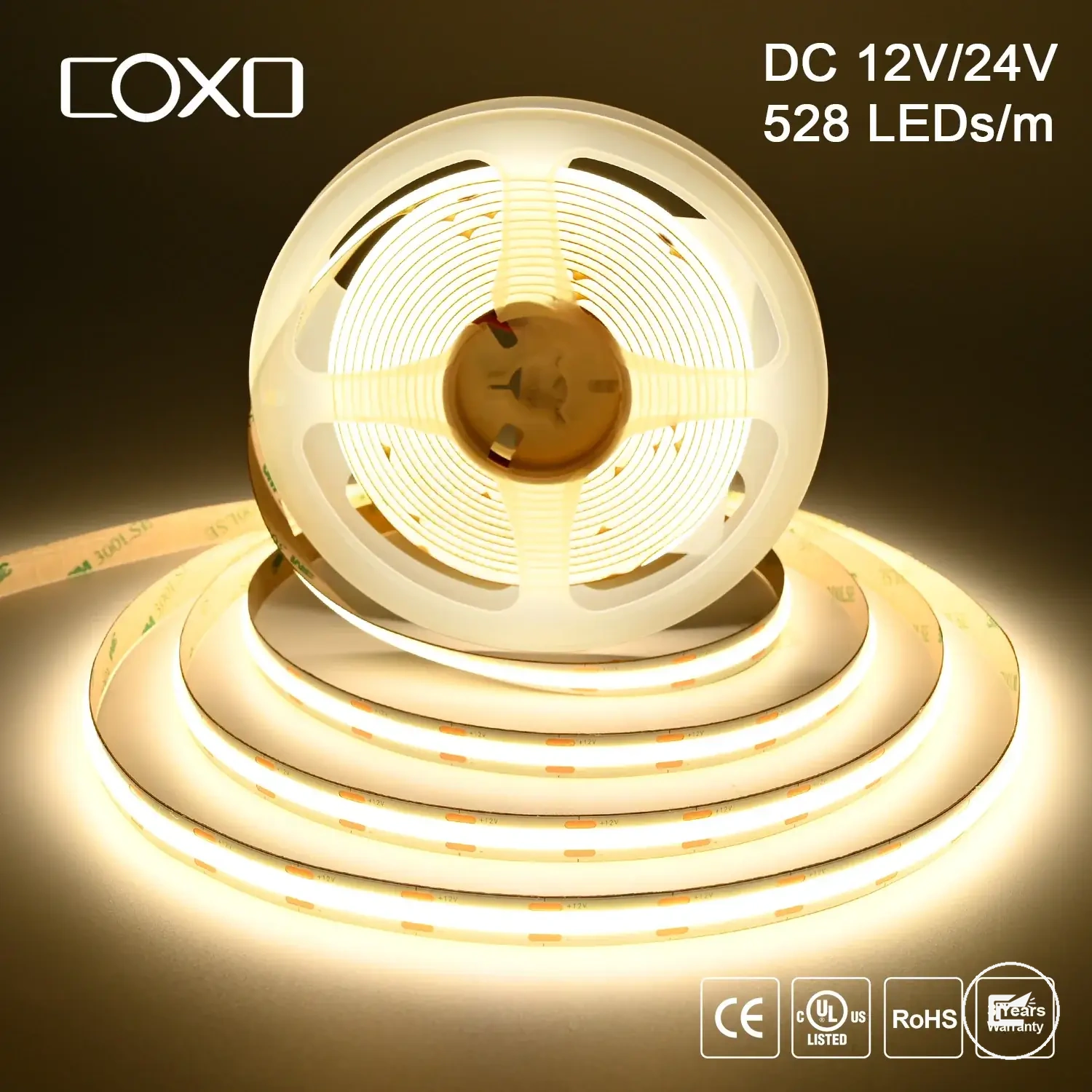
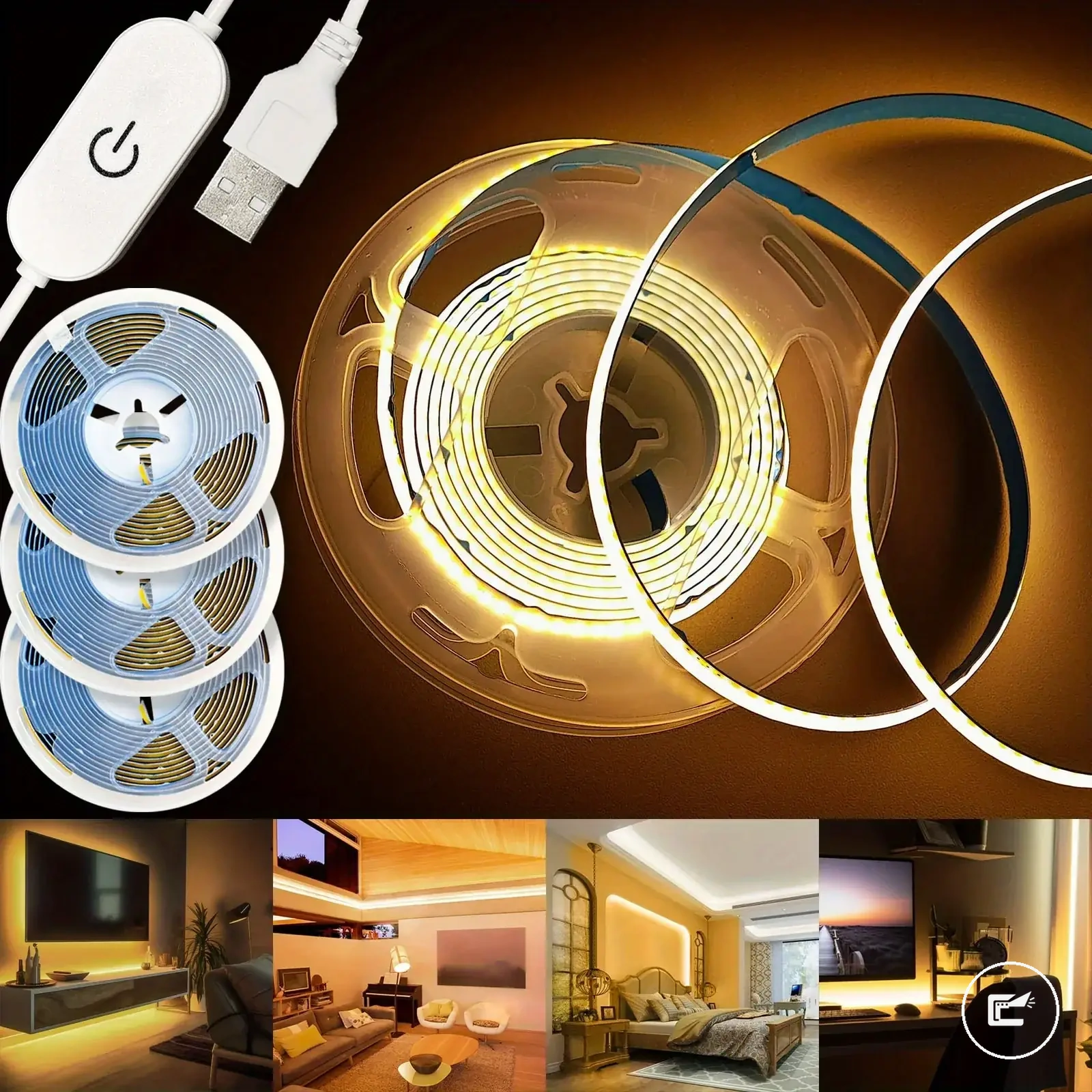
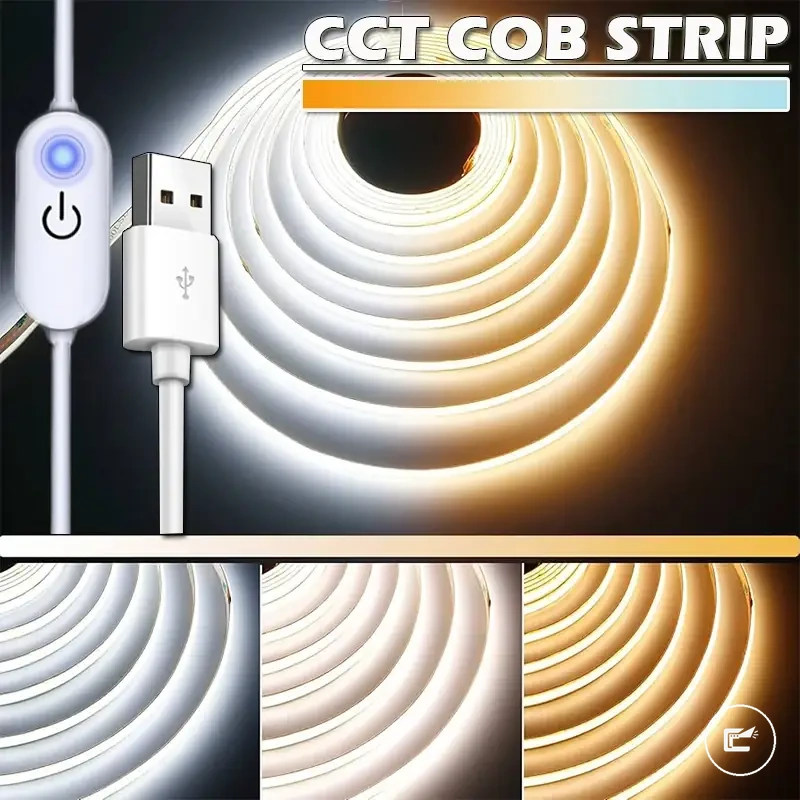
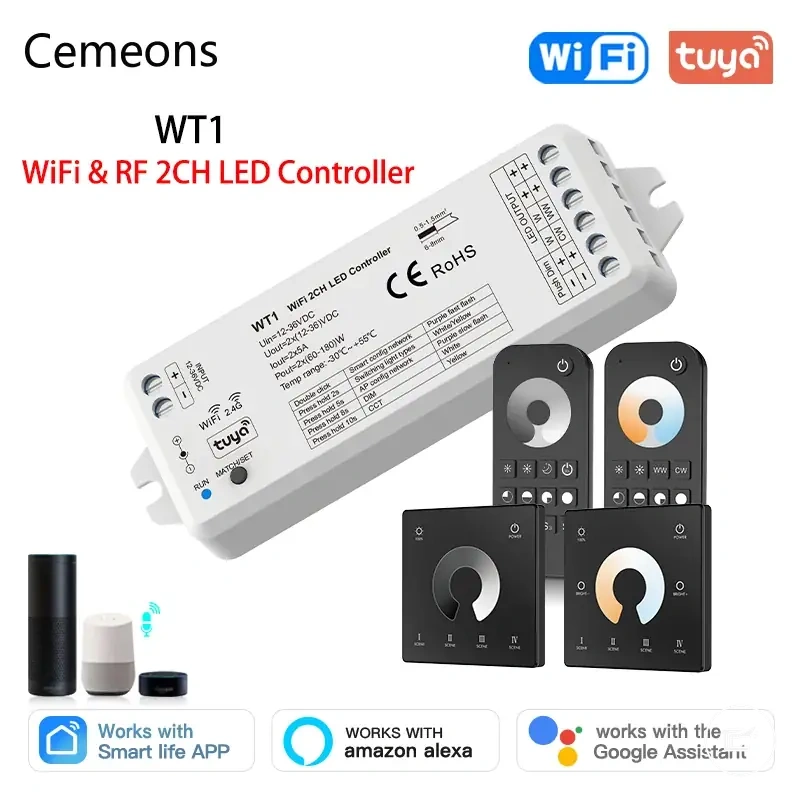
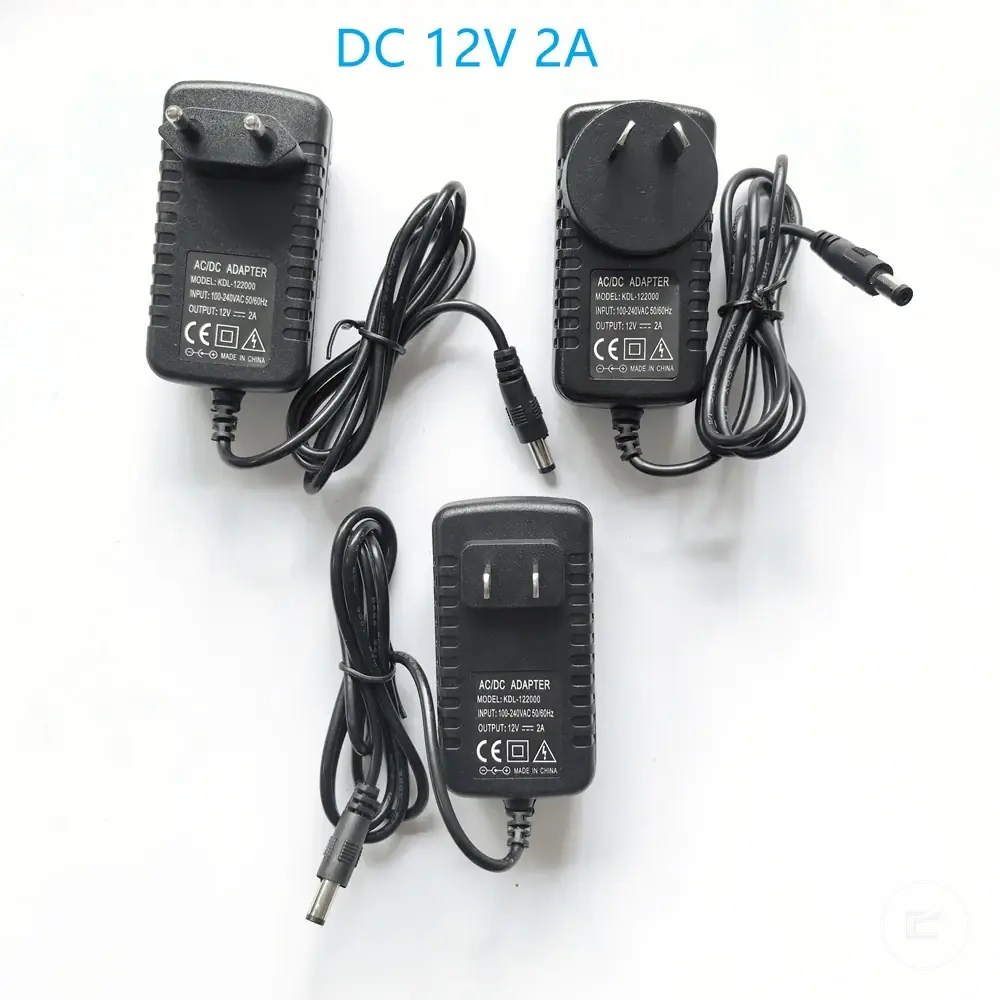
The products below are useful examples for comparing available options. Before buying, check that the compatibility criteria, key features, and product details match your needs.
- Compare running cost with expected lighting hours and usage patterns.
- Confirm that useful brightness matches the intended cabinet lighting task.
- Consider whether lifespan may support fewer replacements over time.
- Review maintenance burden when evaluating value over time.
- Assess power supply quality as part of overall system performance.
- Check whether available control options support the intended use case.
- Evaluate replacement risk when comparing lower-cost and higher-wattage alternatives.
This chart shows the key value factors and checklist items for assessing long-term value of efficient LED cabinet lighting.